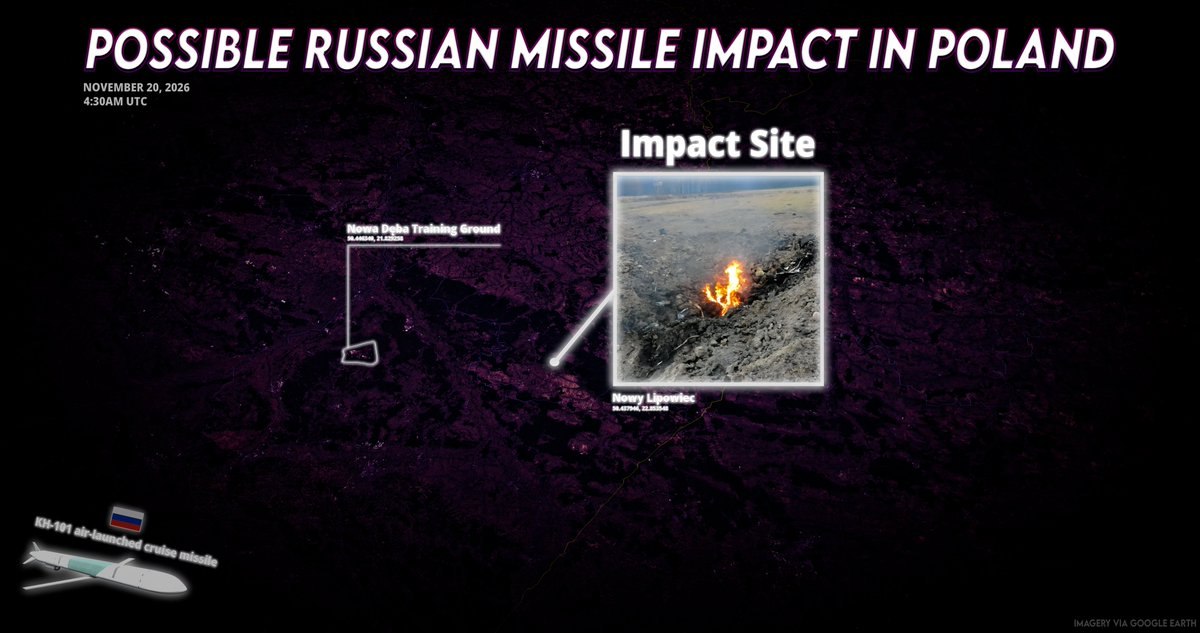
At 10:41 local time on 20 November 2026, a Russian‑origin missile crossed into Polish airspace and impacted near the town of Rudnik nad Sanem, situated close to the Nowa Dęba training complex where NATO forces are conducting a large‑scale exercise involving nearly 3,000 troops. The strike caused material damage to a civilian structure but resulted in no reported casualties. The incident was first reported by the Telegram channel monitor_the_situation and corroborated by satellite imagery released later that day.
Details of the Rudnik nad Sanem Impact
The projectile, identified by on‑site investigators as a ballistic missile, landed in a field approximately 2 km west of the town centre. Witnesses described a bright flash followed by a concussive blast. Local emergency services secured the site, and the Polish Ministry of Defence confirmed that the missile was not intercepted by air‑defence assets before impact. The author of the original report asserted that the strike was deliberate, though no official statement from Russian authorities has confirmed intent.
"The missile strike near Rudnik nad Sanem represents a serious escalation and a direct violation of Poland’s sovereign airspace," Defence Minister Władysław Kosiniak‑Kamysz told a press briefing, emphasizing that the incident will be treated as a provocation.
Earlier Missile Incidents in Eastern Poland
Two hours prior, at 08:39, a CCTV camera in the village of Chmielek, Biłgoraj County, captured what appeared to be the impact of a Russian cruise missile. The footage, posted by monitor_the_situation, showed a plume of smoke and debris on a rural road, prompting automatic air‑raid sirens across the Lublin Voivodeship. No injuries were reported, and the missile’s exact type was not confirmed on site.
At 09:50, a second missile—identified by analysts as a Kh‑101 cruise missile—struck a field near Nowy Lipowiec, also in Lublin Voivodeship. Prime Minister Donald Tusk confirmed the airspace violation in a televised address, noting that the missile landed in an uninhabited area and caused no casualties. Photographs of the impact site were circulated by the same Telegram channel, showing a crater approximately 3 metres in diameter.
Air‑Defence Mobilisation
In response to the series of violations, the Polish Ministry of Defence activated multiple air‑defence systems at 10:53, as reported by the intelligence outlet intelslava. Patriot, Poprad, and the newer Pilica+ systems were placed on high alert, and three Territorial Defence brigades were deployed to the Nowa Dęba region. Helicopter units were also scrambled to provide rapid reconnaissance and potential interception capabilities.
The activation of these assets underscores Poland’s reliance on a layered defence architecture that integrates NATO‑provided Patriot batteries with domestically produced Poprad and Pilica+ platforms. The Defence Ministry indicated that the systems successfully tracked the incoming missile near Rudnik nad Sanem but were unable to engage before impact due to the missile’s low‑altitude trajectory.
Additional Incidents and Alerts
At 08:59, Rzeszów‑Jasionka Airport was temporarily evacuated after air‑traffic controllers detected an unidentified cruise missile entering Polish airspace. Nine airport personnel took shelter in the control tower until the threat passed. The airport resumed normal operations after a brief lockdown, and no damage to infrastructure was reported.
Earlier in the morning, at 07:25, a Russian‑manufactured drone crashed near Chmielek, triggering sirens and prompting a rapid response from Poland’s Operational Command. Video footage released by monitor_the_situation shows the unmanned aerial vehicle descending in a wooded area before impact. The drone was recovered for forensic analysis.
Separate from the missile incidents, a rocket alert was issued for the city of Lublin at 06:59, and an explosion was captured near the village of Khmelek at 06:59:43. Both events were reported by intelslava but lacked confirmed attribution to a specific weapon system. No casualties were reported in either case.
Operational Context
The string of violations occurs against the backdrop of ongoing Russian military operations in Ukraine and heightened NATO activity in the region. The Coalition of the Willing exercises, scheduled near Nowa Dęba, involve forces from multiple NATO member states and are designed to test rapid deployment and interoperability. Russian officials have not publicly commented on the November 20 incidents, and diplomatic channels remain engaged to de‑escalate the situation.
Poland’s response demonstrates a coordinated approach that leverages both national and alliance resources. The rapid mobilisation of air‑defence systems, combined with the deployment of Territorial Defence brigades, reflects Warsaw’s intent to deter further incursions while maintaining readiness for potential escalation.
Key Sources
All event details are drawn from open‑source Telegram channels: monitor_the_situation (Rudnik nad Sanem), monitor_the_situation (Chmielek), monitor_the_situation (Nowy Lipowiec), monitor_the_situation (Rzeszów‑Jasionka), intelslava (Air‑defence activation), intelslava (Khmelek explosion), and intelslava (Lublin alert).