On 16 November 2026, a series of maritime incidents underscored the escalating threat environment for commercial shipping in the Gulf of Oman, the Arabian Sea and the Red Sea corridor. The incidents involve naval mines laid in the Strait of Hormuz, an armed skiff encounter east of Socotra, and a ground offensive by Yemen’s Houthi movement toward Aden. Together they illustrate a multi‑dimensional pressure on vessels that rely on these chokepoints for oil and cargo transport.
Iranian‑claimed naval mine strikes in the Strait of Hormuz
At 04:38 UTC, the Iranian government announced that two oil tankers transiting the Strait of Hormuz were hit by naval mines. The statement, relayed by the GeoPWatch monitoring channel, described “extremely powerful explosions” that caused significant hull damage and released oil into the water. The announcement also claimed that these were the sixth tanker to catch fire and sink since the previous day, suggesting a rapid escalation in mine deployment.
“Iran has just claimed another two oil tankers struck naval mines in the Strait of Hormuz, sparking ‘extremely powerful explosions’… the sixth tanker that has caught fire and sunk since yesterday.” – GeoPWatch, 04:38 UTC, 16 Nov…2026
No casualty figures were released, and the two vessels have not yet confirmed the damage independently. The mines are described as conventional contact or influence devices, but the exact type was not disclosed. The incident occurred in a waterway that sees an estimated 20 million barrels of oil per day, and the presence of mines raises immediate concerns for both commercial and naval traffic.
Key actors: Iranian government (mine placement), United States naval forces (providing escort to the tankers, according to Iranian claims), and the commercial operators of the affected tankers.
International response has been limited to heightened alerts from the International Maritime Organization (IMO) and advisory notices from the United Kingdom Maritime Trade Operations (UKMTO). The incident follows a pattern of Iranian signaling through asymmetric maritime tactics, which analysts note could be intended to pressure oil markets and deter perceived U.S. naval presence.
Armed skiff approach near Socotra, Arabian Sea
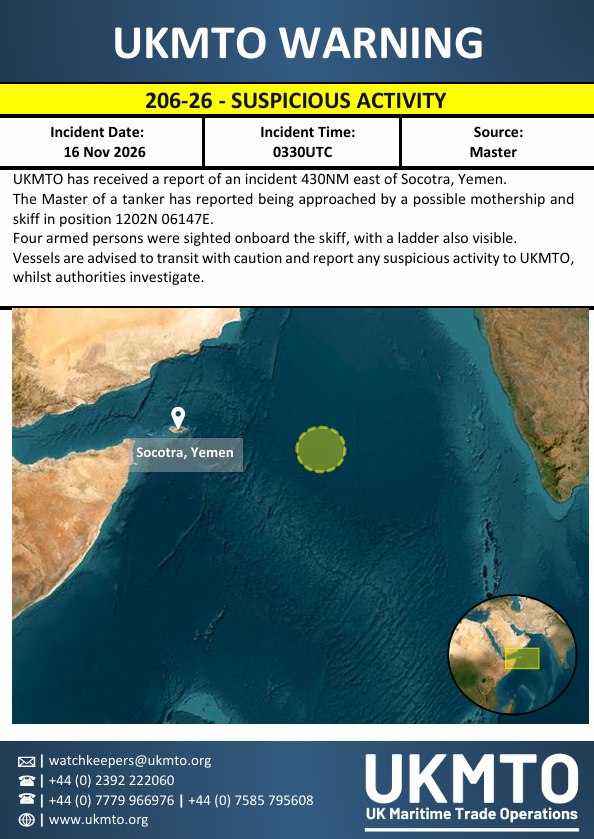
At 04:22 UTC, a commercial tanker reported an encounter with an armed skiff and a possible mothership 430 nautical miles east of Socotra, Yemen, in international waters of the Arabian Sea. The report, posted by the monitor_the_situation channel, indicated that four armed individuals boarded a small skiff equipped with a ladder, suggesting an attempt to board or intimidate the tanker.
“A tanker reported being approached by a possible mothership and skiff with four armed persons and a ladder 430 nautical miles east of Socotra, Yemen. Vessels are advised to transit with caution.” – monitor_the_situation, 04:22 UTC, 16 Nov…2026
No weapons were discharged, and the tanker sustained no damage or injuries. The incident prompted UKMTO to issue a caution advisory for vessels operating in the vicinity, emphasizing the need for heightened vigilance against small‑craft threats that can be used for piracy, terrorism, or proxy militia actions.
While the identity of the skiff operators was not confirmed, the region has seen increased activity by Iranian‑aligned maritime militias and Somali piracy networks. The lack of a clear claim of responsibility leaves analysts monitoring the incident for patterns that could indicate a coordinated campaign against commercial shipping.
Houthi ground advance toward Aden, Yemen
At 02:22 UTC, Al Jazeera reported that Houthi forces were advancing toward Aden, Yemen’s last major government stronghold on the southern coast. The movement represents a significant territorial gain for the Houthi armed group, which has been engaged in a protracted conflict with the internationally recognized Yemeni government since 2014.
“An advance by the Houthi armed group in Yemen is threatening one of the government’s last strongholds.” – Al Jazeera, 02:22 UTC, 16 Nov…2026
No casualty numbers were released at the time of reporting, but the advance raises the risk of further disruption to the port of Aden, a critical node for humanitarian aid and commercial cargo. Control of Aden would give the Houthis direct access to the Gulf of Aden and the Bab al‑Mandeb strait, potentially extending their influence over maritime routes that connect the Red Sea to the Indian Ocean.
International observers have warned that a Houthi foothold in Aden could complicate existing naval security operations, including the EU‑Navfor and U.S. Fifth Fleet patrols that aim to deter piracy and protect shipping lanes. The development also adds a land‑based dimension to the broader maritime threat environment highlighted by the mine and skiff incidents.
Collectively, these events illustrate a convergence of asymmetric maritime tactics—naval mines, small‑craft aggression, and land‑based advances—that increase operational risk for commercial vessels. Shipping companies are advised to review route planning, maintain real‑time situational awareness, and coordinate closely with naval escorts and maritime security agencies.