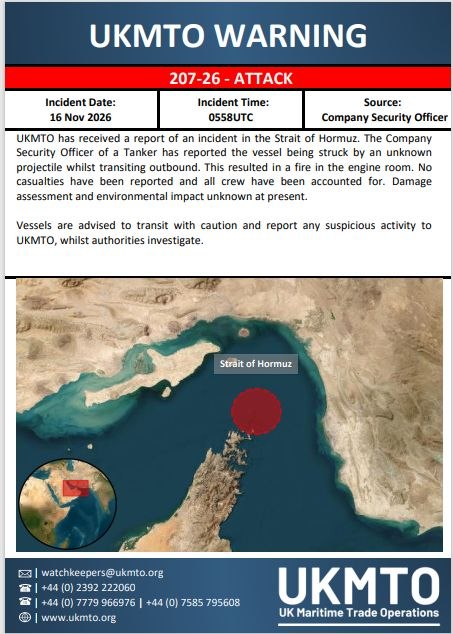
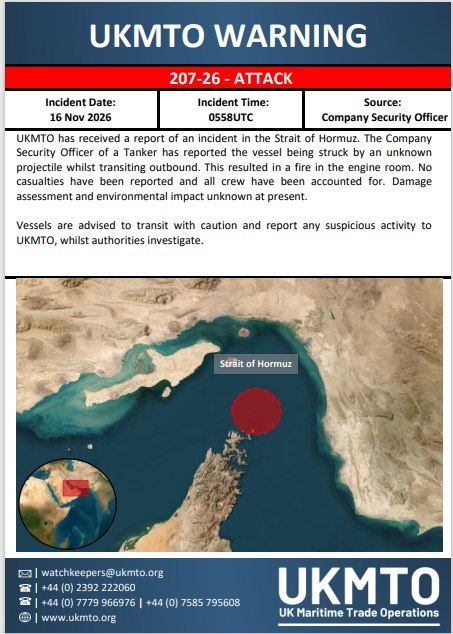
On 16 November 2026 Iran’s military reported a series of kinetic events across the Strait of Hormuz and the broader Persian Gulf, ranging from the downing of a U.S. unmanned aircraft to multiple attacks on commercial tankers. The incidents, documented by open‑source monitoring channels, illustrate a coordinated escalation of maritime security threats that could affect commercial shipping and regional stability.
Drone Interception
At 16:20 local time Iran’s Army announced that it had shot down a United States Army MQ‑1C Gray Eagle combat drone using a surface‑to‑air missile. The claim was accompanied by video footage released on the GeoPWatch channel, showing a missile plume intersecting the drone’s airframe before it descended into the water. No casualties were reported, and the United States has not issued an official statement as of the time of writing. The incident marks the first confirmed engagement of a U.S. armed UAV by Iranian forces since the 2023 naval confrontations.
"Iran’s Army claims it intercepted a U.S. Army MQ-1C Gray Eagle combat drone over the Strait of Hormuz, releasing footage showing a surface‑to‑air missile striking the drone." – GeoPWatch, https://t.me/GeoPWatch/41783
The interception underscores Iran’s growing confidence in short‑range air‑defence systems capable of targeting high‑altitude UAVs. Analysts note that the use of a surface‑to‑air missile suggests operational readiness of legacy systems such as the Russian‑made 9K33 Osa or domestically produced equivalents, though the exact model was not identified.
Sea Mine Incidents
Earlier in the day, at approximately 15:38, two oil tankers reported striking sea mines while transiting the narrow waterway between Iran and Oman. The AlJazeera channel posted video evidence of the explosions and confirmed that the vessels sustained hull damage but no crew injuries. The mines’ origin remains unverified; however, the timing coincides with heightened diplomatic friction over Iran’s nuclear negotiations.
"Oil tankers hit sea mines in the Strait of Hormuz." – AlJazeera, https://www.aljazeera.com/video/newsfeed/2026/11/16/oil-tankers-hit-sea-mines-in-the-strait-of-hormuz?traffic_source=rss
Maritime security agencies, including the United Kingdom Maritime Trade Operations (UKMTO), issued advisories urging vessels to adhere to designated lanes and to increase vigilance for underwater threats.
Cruise Missile Strike
At 13:10, the Islamic Revolutionary Guard Corps (IRGC) Navy released video footage showing a cruise missile striking a vessel’s engine room, causing a secondary explosion. The clip, shared by the intelslava channel, depicted the missile’s impact and the resulting fireball. The target vessel was described as “unauthorised” for the route, but its flag and cargo were not disclosed. No casualties were reported, and the ship’s crew managed to contain the fire with assistance from nearby vessels.
"The IRGC Navy has released footage showing the moment a cruise missile struck a vessel's engine room, triggering an explosion as it transited an unauthorized route through the Strait of Hormuz." – intelslava, https://t.me/intelslava/98143
The use of a cruise missile indicates that the IRGC retains a stockpile of precision‑guided munitions capable of engaging surface targets at medium range, reinforcing its deterrent posture against perceived violations of Iranian maritime sovereignty.
Unknown Projectile Attacks on Tankers
Two separate incidents involving unknown projectiles were reported in the morning. At 10:25, a tanker exiting the Persian Gulf was struck by an unidentified projectile, igniting a fire in the engine room. The vessel’s security officer reported the event to UKMTO, confirming that all crew members were accounted for and that there were no injuries. A photo of the damaged engine room was posted by GeoPWatch.
"A tanker has been struck by an unknown projectile transiting out of the Persian Gulf, the engine room was set on fire but all personnel were accounted for with no casualties reported." – GeoPWatch, https://t.me/GeoPWatch/41773
Later, at 07:19, another tanker in the Strait of Hormuz suffered a similar projectile strike, resulting in an engine‑room fire but again no casualties. The monitor_the_situation channel shared a photo of the blaze and noted that the UKMTO had logged the incident.
"A tanker was struck by an unknown projectile in the Strait of Hormuz, resulting... No casualties were reported, and all crew are accounted for." – monitor_the_situation, https://t.me/monitor_the_situation/43381
Both incidents highlight a pattern of low‑level kinetic attacks that, while not immediately lethal, pose significant risks to commercial shipping and could disrupt oil transit flows if they become more frequent.
Analysis
The clustering of these events on a single day suggests a coordinated effort by Iranian forces to assert control over the strategic chokepoint of the Strait of Hormuz. The diversity of weapons—surface‑to‑air missiles, sea mines, cruise missiles, and unidentified projectiles—demonstrates a layered approach to maritime denial. While casualty figures remain low, the potential for escalation is evident, particularly if the United States or allied navies respond with force.
International monitoring bodies, including the International Maritime Organization (IMO) and regional navies, are likely to increase patrols and surveillance. Shipping companies may reroute vessels around the Gulf of Oman, incurring higher fuel costs and longer transit times. The incidents also underscore the importance of real‑time open‑source intelligence in tracking rapid developments in contested waterways.