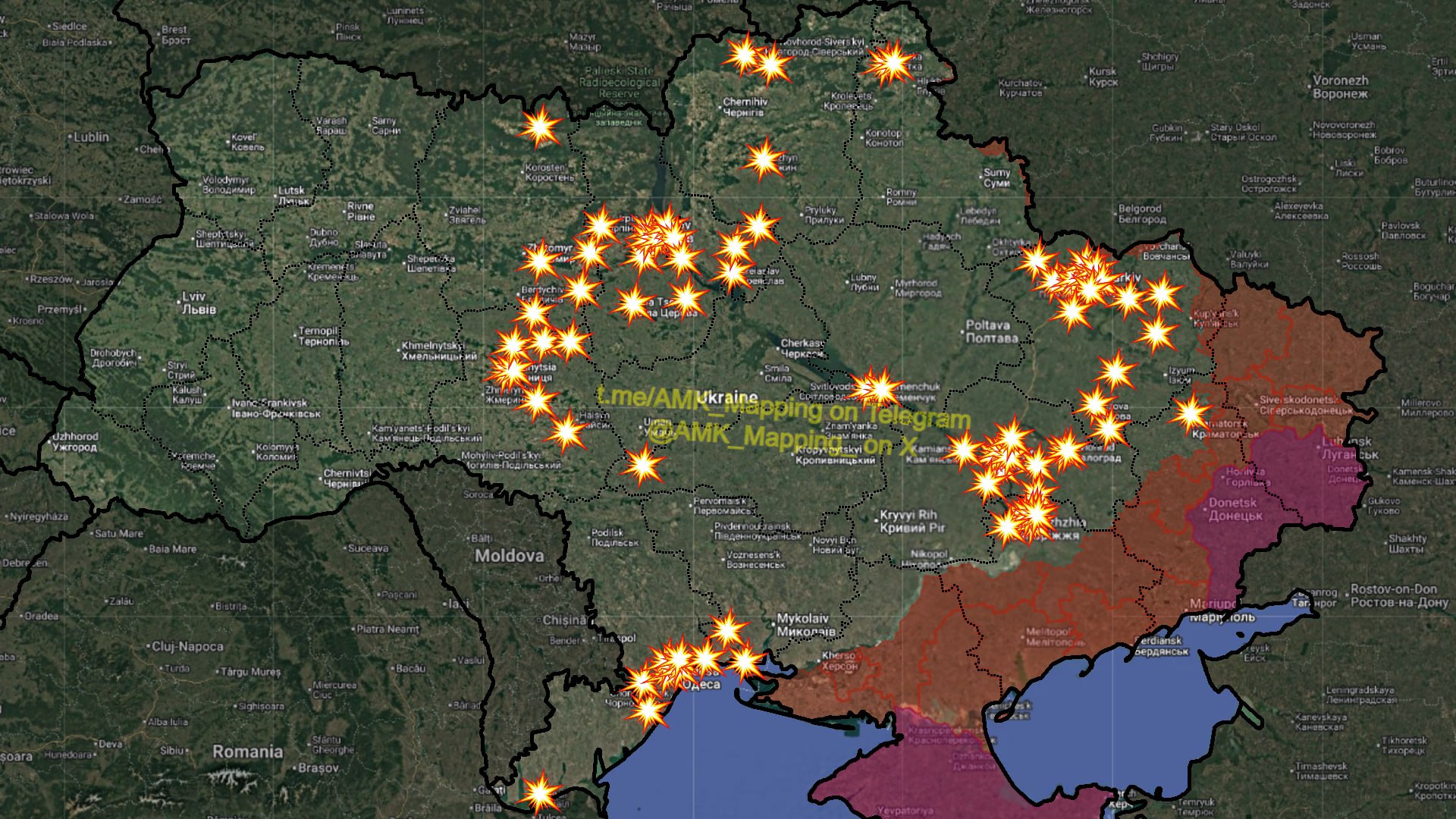
On 16 November 2026, high‑technology aerial attacks intensified across three separate conflict zones, underscoring a growing reliance on unmanned systems and precision‑guided munitions. The most consequential operation unfolded in Ukraine, where Russian forces launched a coordinated barrage of more than 200 Geran‑2, Geran‑4 and Geran‑5 drones together with S8000 Banderol cruise missiles, striking a wide swath of central and northern regions.
Russia escalates drone and cruise‑missile barrage in central Ukraine
The attack, reported by BellumActaNews at 00:20 UTC, targeted Ovruch in Zhytomyr Oblast and extended to key urban and industrial centers in Kyiv, Vinnytsia, Dnipropetrovsk, Zaporizhzhia and Kharkiv Oblasts. Over a 24‑hour window, Russian forces deployed more than 200 Geran‑series drones—each capable of loitering for extended periods and delivering payloads of up to 30 kg—and fired a fleet of S8000 Banderol cruise missiles, which have a range exceeding 1,200 km and are equipped with satellite‑guided terminal homing. No civilian casualty figures were released at the time of reporting, and Ukrainian defense officials indicated that air‑defense systems intercepted a portion of the incoming threats, though the overall impact on infrastructure remains under assessment.
"Russia continued their large‑scale Geran‑2/4/5 drone attacks against Ukraine, using over 200 drones and S8000 Banderol cruise missiles over the last 24 hours," BellumActaNews reported.
The shift in targeting away from western Ukraine toward the capital region suggests a strategic intent to pressure Kyiv directly and disrupt logistical corridors in the heartland. Analysts note that the combined use of loitering munitions and long‑range cruise missiles represents a hybrid approach, blending saturation attacks with precision strikes to overwhelm layered air‑defense networks.
Ukrainian drones cripple oil storage at Russia’s Ust‑Luga port
At 05:51 UTC, the intelligence outlet intelslava released satellite imagery confirming the destruction of five oil storage tanks at the Russian port of Ust‑Luga. The tanks, part of a larger complex handling crude and refined products for export, were hit by Ukrainian‑operated drones on 11 November, with the damage persisting into the 16th‑day briefing. The drones employed were standard commercial‑grade quadcopters modified to carry explosive payloads, demonstrating Ukraine’s capacity to project force into Russian territory using low‑cost, high‑impact aerial platforms. No casualties were reported, and Russian authorities have not disclosed the extent of the operational disruption.
"Western satellites have recorded the destruction of five oil storage tanks at the port of Ust‑Luga following an attack by Ukrainian drones," intelslava noted.
The incident underscores a broader trend of using unmanned aerial systems to target critical energy infrastructure, a tactic that can impose economic costs without direct kinetic confrontation. The lack of defensive response reported by the source suggests either a gap in short‑range air‑defense coverage at the port or a calculated decision to avoid escalation.
Iranian Shahed‑136 drones strike U.S. Camp Buehring in Kuwait
In a separate development, footage released by CBS and sourced to intelslava at 01:19 UTC showed Iranian‑manufactured Shahed‑136 loitering munitions impacting Camp Buehring, a U.S. Army training base in Kuwait. The Shahed‑136, a derivative of the Russian ZALA Lancet, is a winged, propeller‑driven drone capable of autonomous navigation to pre‑programmed coordinates. The attack resulted in structural damage to several facilities; however, official statements from the U.S. Central Command indicated that there were no fatalities or serious injuries among personnel.
"CBS has released new footage showing Iranian Shahed‑136 drone strikes on Camp Buehring in Kuwait during the latest round of fighting," intelslava reported.
The strike marks a notable escalation in the use of Iranian drone technology against U.S. assets outside the immediate Middle‑East theater, reflecting Tehran’s expanding export of loitering munitions to allied non‑state actors and its willingness to employ them in direct attacks on coalition forces.
Implications for regional security dynamics
Collectively, these events illustrate a convergence of high‑tech aerial capabilities across disparate conflicts. The Russian deployment of Geran drones and S8000 missiles demonstrates a scaling up of autonomous strike capacity, while Ukrainian and Iranian actors leverage commercially available or proliferated drone designs to achieve strategic effects against higher‑value targets. The absence of reported casualties in each case does not diminish the operational significance; rather, it highlights a shift toward infrastructure denial and psychological pressure as primary objectives.
For policymakers and military planners, the pattern suggests that air‑defense architectures must adapt to a broader spectrum of threats, ranging from high‑altitude cruise missiles to low‑observable loitering munitions operating at varying speeds and altitudes. The integration of satellite‑based early‑warning systems, rapid‑response interceptor batteries, and electronic warfare suites will be essential to mitigate the growing risk posed by these versatile platforms.
As the conflict environment evolves, continuous monitoring of drone proliferation, launch tactics, and target selection will be critical to anticipate future escalations and to formulate calibrated responses that balance deterrence with the avoidance of unintended escalation.