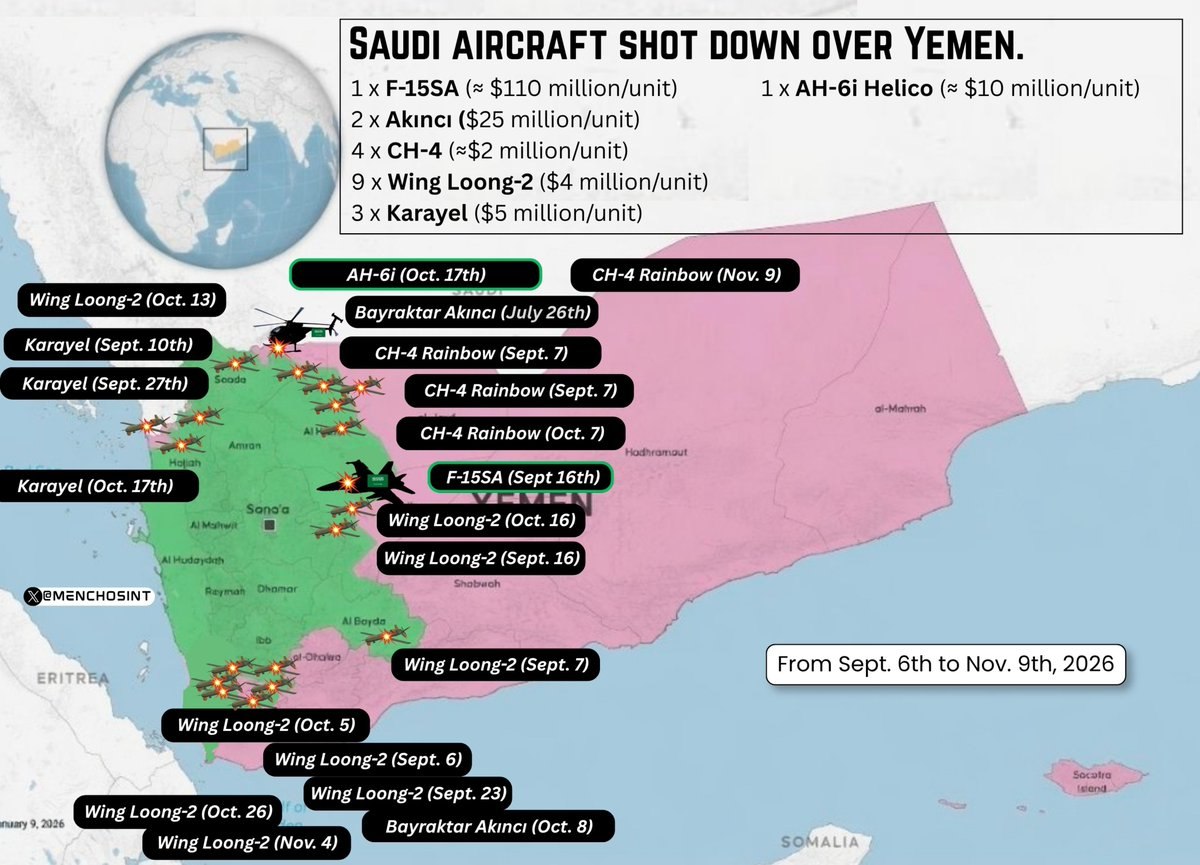
On 10 November 2026, Saudi‑backed air operations in Yemen escalated sharply, with two high‑intensity strikes in the capital Sana’a followed by a reported drone interception in Al‑Jawf Governorate. The sequence of events underscores a widening kinetic focus on both militant targets and civilian infrastructure, raising operational and humanitarian concerns for the conflict‑monitoring community.
Saudi Airstrike Targets Ansarullah in Sana’a
At 03:27 local time, a Saudi‑conducted airstrike struck a location identified by the Ansarullah movement in Sana’a. The strike was reported by the open‑source monitoring channel GeoPWatch, which posted a short video of the aftermath. While the precise coordinates were not disclosed, the target was described as a “facility used by Ansarullah,” suggesting a strategic effort to degrade the group’s command and control capabilities within the Houthi‑controlled capital.
"Saudi airstrikes are targeting the Ansarullah group in Sana'a, Yemen." – GeoPWatch, 03:27 22 Nov 2026
No casualty figures were released in the immediate aftermath, and the video did not show clear evidence of personnel loss. However, the use of precision‑guided munitions—implied by the limited blast footprint—indicates a calibrated approach aimed at minimizing collateral damage while neutralising the militant target.
Operational implications include a potential shift in Saudi strategy toward direct engagement with Ansarullah, a faction allied with the Houthi movement but operating semi‑autonomously. By striking Ansarullah assets, Saudi forces may be attempting to fragment the broader anti‑Saudi coalition, thereby reducing the operational depth of Houthi‑aligned forces in the capital.
Gas Station Strike Ignites City‑wide Smoke
Just 41 minutes earlier, at 02:46, a separate Saudi airstrike hit a civilian gas station in Sana’a, igniting a large fire that produced a visible plume of smoke over the city. GeoPWatch again supplied video evidence, showing a column of black smoke rising from the blast site. The incident occurred in a densely populated district, and while no immediate casualty reports were confirmed, the fire threatened nearby residential structures and disrupted local fuel supplies.
"A Saudi airstrike on a gas station in Sana'a sparked a large fire, with smoke seen over the city." – GeoPWatch, 02:46 06 Nov 2026
The targeting of a fuel depot raises questions about the intended military value of the strike. Gas stations can serve as logistical nodes for both civilian and combatant use; destroying such a node could impair the mobility of Houthi‑aligned forces. Conversely, the civilian impact is evident, with potential secondary effects on public health, economic activity, and civilian morale.
Humanitarian considerations are acute. The smoke plume, observed across multiple districts, likely degraded air quality and may have prompted temporary evacuations. International humanitarian law obliges parties to distinguish between military objectives and civilian objects, and to take all feasible precautions to avoid excessive civilian harm. The lack of an official statement from the Saudi coalition regarding the rationale for the strike complicates assessment of compliance.
Ansarallah Claims Drone Shoot‑Down Over Al‑Jawf
In the early morning hours, at 01:53, the Ansarallah movement announced that its forces had downed a Saudi‑operated CH‑4 armed reconnaissance drone over Al‑Jawf Governorate, a northern province bordering Saudi Arabia. The claim was posted by the Telegram channel monitor_the_situation, accompanied by a photograph of the wreckage. This marks the fourth documented CH‑4 shoot‑down since the escalation began earlier in the year.
"Ansarallah forces claim to have shot down a Saudi‑operated CH‑4 armed reconnaissance drone over Al‑Jawf Governorate, Yemen." – monitor_the_situation, 01:53 15 Nov 2026
The CH‑4 platform is a Chinese‑manufactured UAV capable of carrying precision‑guided munitions and conducting real‑time intelligence, surveillance, and reconnaissance (ISR). Its loss represents a tactical setback for Saudi aerial surveillance and strike coordination in the border region, potentially limiting the coalition’s ability to monitor Ansarallah movements and to conduct precision strikes.
Strategic impact includes a possible recalibration of Saudi UAV deployment patterns, with increased emphasis on electronic warfare or higher‑altitude platforms less vulnerable to ground‑based air‑defence fire. For Ansarallah, the successful shoot‑down serves as a propaganda tool, reinforcing its narrative of resistance against external aggression.
Analytical Overview
The three events on 10 November illustrate a multi‑dimensional kinetic campaign by Saudi forces, combining high‑value target strikes, infrastructure attacks, and aerial reconnaissance. The temporal proximity of the two Sana’a strikes suggests coordinated operations designed to achieve simultaneous tactical effects: degrading militant capabilities while disrupting logistical support.
From a conflict‑dynamics perspective, the escalation may be driven by several factors:
- Political pressure on the Saudi coalition to demonstrate progress in the protracted war, especially ahead of upcoming regional diplomatic engagements.
- Operational momentum following recent intelligence gains, possibly derived from prior drone surveillance, enabling precise targeting of Ansarullah assets.
- Deterrence signaling aimed at both the Houthi‑Ansarullah alliance and external actors monitoring the conflict, indicating willingness to employ kinetic force across civilian and militant domains.
Nevertheless, the lack of publicly disclosed casualty data and the absence of official statements from the Saudi‑led coalition limit comprehensive assessment of the strikes’ effectiveness and legality. Continued monitoring of open‑source channels, satellite imagery, and on‑the‑ground reports will be essential to verify impact, civilian harm, and any subsequent shifts in operational posture.