On 2 November 2026, the Middle East experienced a pronounced escalation across multiple domains, beginning with high‑profile nuclear threat statements that have heightened strategic uncertainty throughout the region.
U.S. Nuclear Strike Warnings Target Iran
At 05:58 UTC, commentator Tucker Carlson, identified as closely aligned with former President Donald Trump, warned that the United States could launch a nuclear strike against Iran within days. Carlson cited Israeli intelligence indicating a resurgence of uranium enrichment activities in Iran, though the precise target location was not disclosed. The claim was disseminated by the Telegram channel intelslava and linked to a post dated 02‑Nov‑2026 05:58:46 (source: https://t.me/intelslava/97392).
"🇺🇸🇮🇷⚡️ — Previously, Tucker Carlson, a commentator close to Trump, suggested that the United States might launch a nuclear strike against Iran in the coming days, targeting a location where, according to Israeli intelligence, Iran has resumed uranium enrichment."
The assertion references Israeli intelligence as the source of the enrichment claim, but no official statements from Israeli or U.S. defense ministries have been released to corroborate the allegation. The potential use of nuclear weapons, even as a rhetorical threat, represents a significant escalation in the strategic calculus of the region, raising concerns among diplomatic and security analysts about the risk of miscalculation.
Specific Target Claims: Pickax Mountain
Earlier, at 04:37 UTC, Carlson reiterated the possibility of a nuclear strike, this time naming Pickax Mountain in central Iran as a prospective target. The claim appeared on the Telegram channel monitor_the_situation and referenced alleged Israeli pressure on the Trump administration to act against a purportedly restarted enrichment program (source: https://t.me/monitor_the_situation/40577).
"🟡 **Carlson Claims Trump May Strike Iran Nuclear Site** Tucker Carlson alleges the Trump administration may launch a nuclear strike on Pickax Mountain in central Iran within days, citing Israeli pressure and claims of a restarted enrichment program."
Pickax Mountain, a remote area in central Iran, has not been publicly identified in prior open‑source intelligence as a nuclear facility. No corroborating evidence from satellite imagery or independent monitoring agencies has emerged, underscoring the unverified nature of the claim. Nonetheless, the repeated publicization of a potential nuclear strike amplifies diplomatic pressure on Washington and Tehran, and may influence regional actors’ threat assessments.
Maritime Incident in the Arabian Gulf
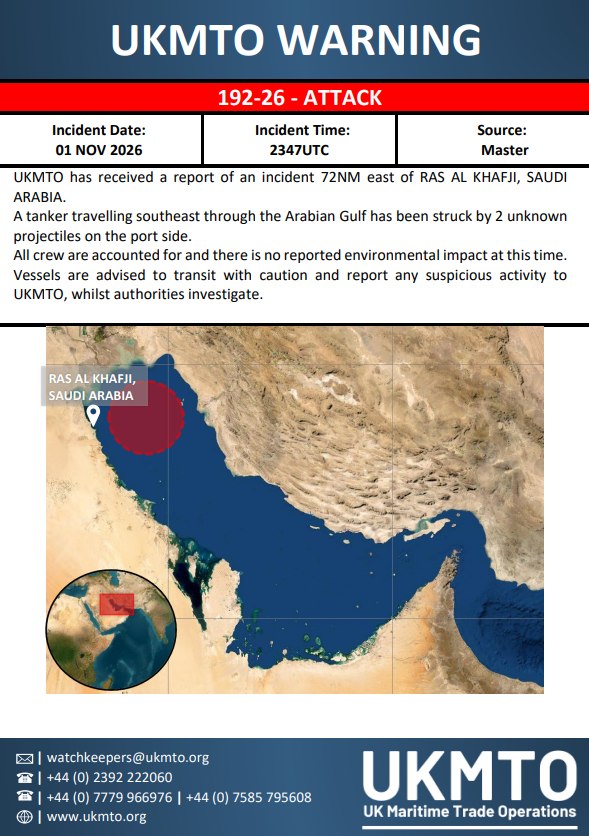
At 01:46 UTC, the United Kingdom Maritime Trade Operations (UKMTO) reported that a commercial tanker was struck by two unidentified projectiles 72 nautical miles east of Ras Al Khafji, Saudi Arabia, in international waters of the Arabian Gulf. The incident, documented by the Telegram channel monitor_the_situation, noted that all crew members were accounted for and no injuries were reported (source: https://t.me/monitor_the_situation/40566).
"UKMTO 192-26: Tanker Struck by Projectiles in Arabian Gulf. UKMTO reported an incident on November 1, 2026, where a tanker was struck by two unknown projectiles 72 nautical miles east of Ras Al Khafji, Saudi Arabia, while transiting the Arabian Gulf. All crew are accounted for with no reported injuries."
The projectiles’ origin and weapon type were not identified, and no group claimed responsibility. The incident adds to a pattern of maritime security challenges in the Gulf, where commercial shipping routes are vulnerable to both state and non‑state actors. The UKMTO’s prompt reporting underscores the importance of real‑time maritime monitoring for the safety of international trade.
Ground Offensive in Yemen: Ansarullah Captures Al‑Maqatirah Fortress
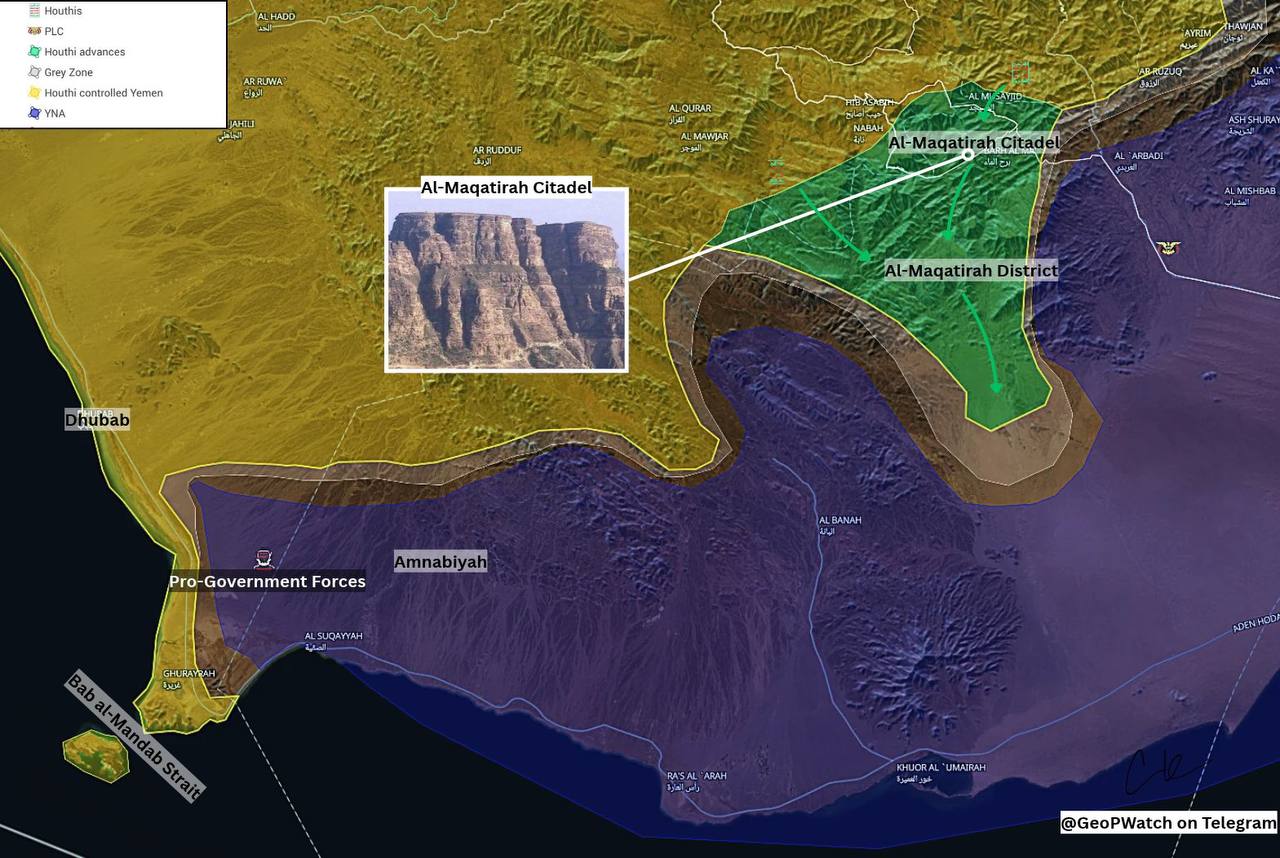
At 01:24 UTC, the Yemeni militant group Ansarullah, aligned with the Houthi movement, seized the Al‑Maqatirah fortress and the surrounding district in Lahij Governorate. The development was reported by the Telegram channel GeoPWatch and corroborated by both PLC and Houthi‑affiliated media outlets (source: https://t.me/GeoPWatch/41231).
"Ansarullah continues to advance further into Lahij governorate, both PLC and Houthi affiliated media report about the fall of the Al-Maqatirah fortress to Ansarullah and their rapid advance into the Al-Maqatirah district. With the important Citadel and Al-Maqatirah district now under Houthi control, pro-government forces in and around the Dhubab-Amnabiyah area could soon be operationally encircled."
The capture of the fortress, a strategic high‑ground position, threatens to encircle pro‑government forces operating near Dhubab‑Amnabiyah. No casualty figures were released, and the offensive appears to be part of a broader Houthi effort to consolidate control over southern Yemen. The rapid territorial gain demonstrates the fluid nature of ground combat in the region and the capacity of Ansarullah to exploit gaps in government defenses.
Implications for Regional Stability
The convergence of nuclear rhetoric, maritime aggression, and ground offensives on 2 November illustrates a multi‑dimensional surge in Middle Eastern conflict. While the nuclear strike warnings remain unverified, their public dissemination raises the stakes of diplomatic engagement and may influence the posture of regional powers, including Israel, Saudi Arabia, and the United Arab Emirates. The tanker attack, though resulting in no injuries, signals a potential escalation in Gulf maritime threats that could disrupt oil shipments and global energy markets. Simultaneously, the Yemeni ground offensive underscores the ongoing volatility in the country’s southern theater, with possible spill‑over effects into neighboring Saudi territory.
Analysts recommend close monitoring of official statements from the United States, Israel, and Iran to assess whether the nuclear threat narrative transitions from speculation to policy. Maritime authorities should maintain heightened vigilance in the Arabian Gulf, and diplomatic channels must prioritize de‑escalation mechanisms to prevent inadvertent escalation across these interconnected domains.