On 29 October 2026, a market in the Darfur region of Sudan was hit by a series of strikes that killed more than 100 civilians, including women and children, according to a rights group cited by Al Jazeera. The attack, attributed to the Rapid Support Forces (RSF), targeted civilian shopkeepers and sparked international condemnation. The scale of the loss, combined with concurrent ballistic missile activity across the region, illustrates a widening security crisis that threatens civilian populations and critical infrastructure.
Darfur Market Attack
The market strike occurred in the early hours of the day, with witnesses reporting that RSF fighters opened fire on densely packed stalls. Casualties were confirmed at 100, with the majority being non‑combatants. Al Jazeera’s report, sourced from on‑the‑ground testimonies, noted that the RSF’s involvement was evident from the presence of distinctive uniforms and vehicle markings. The rights group’s statement, published on the Al Jazeera website, emphasized that the attack violated international humanitarian law and called for an independent investigation.
"Women and children were among the dead, and shopkeepers were targeted while trying to protect their families," the rights group said, as quoted by Al Jazeera.
The incident adds to a pattern of RSF‑linked violence that has plagued Sudan since the 2023 power struggle, raising concerns about the group’s willingness to target civilian economic hubs to exert control.
Ballistic Missile Launches Across the Region
In parallel with the Darfur tragedy, multiple ballistic missile launches were reported on 29 October, reflecting heightened militarisation in the broader region. At 00:27:50 UTC, the Telegram channel intelslava reported that Houthi forces in Yemen launched ballistic missiles toward Saudi Arabia. The message did not specify the missile type or launch coordinates, but identified the actors as the Houthi movement, which has previously targeted Saudi oil facilities.
"Reports of Houthi ballistic missile launches toward Saudi Arabia," intelslava posted, linking to a video of the launch.
Later, at 04:03:59 UTC, BellumActaNews relayed Japanese media reports of a possible ballistic missile launch from North Korea. While the exact trajectory and target remain unconfirmed, the launch aligns with a series of Pyongyang‑initiated tests aimed at demonstrating strategic reach. The source URL points to a Telegram post that aggregates the Japanese media coverage.
"A ballistic missile, possibly, has been launched from North Korea," BellumActaNews reported.
These launches underscore the multiplicity of state and non‑state actors employing long‑range weapons, increasing the risk of miscalculation and collateral damage.
Saudi Arabia’s Interception Claim
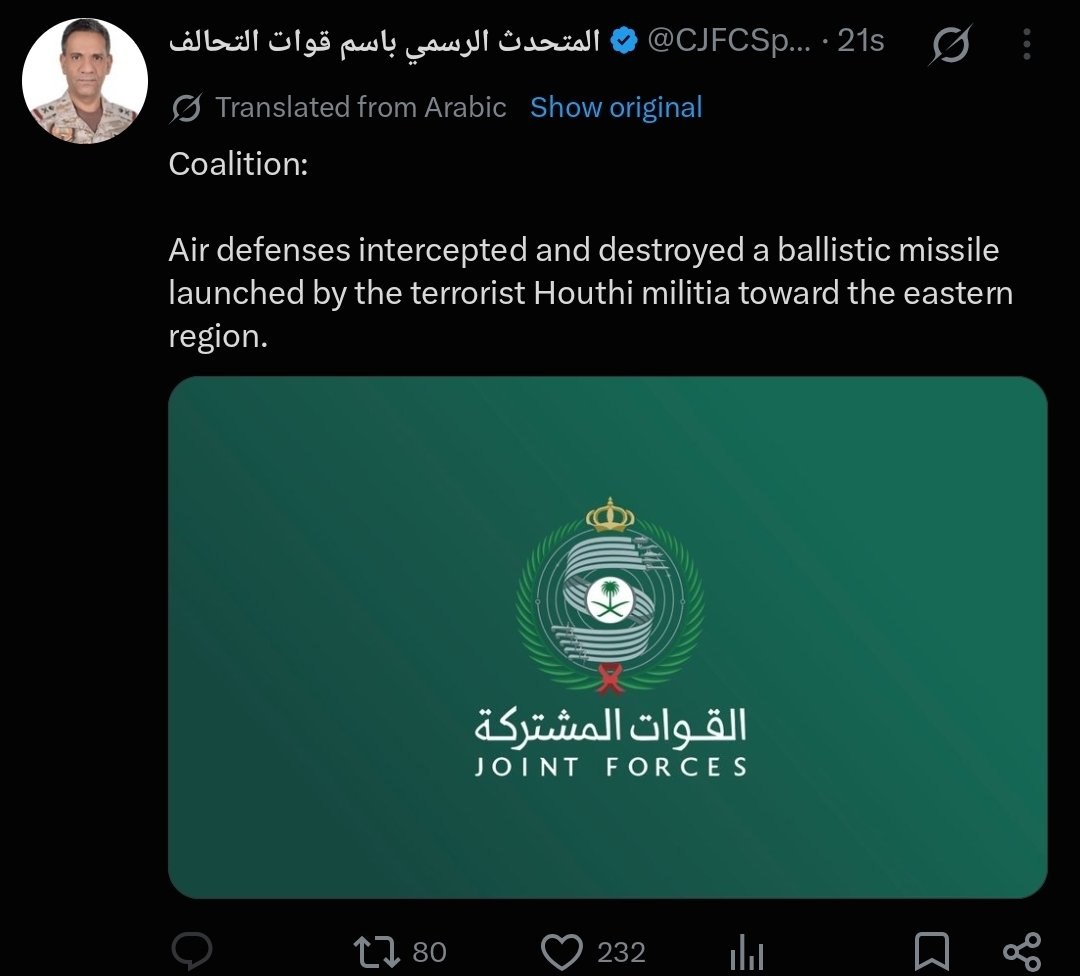
At 01:24:53 UTC, the Telegram channel monitor_the_situation reported that Saudi officials claimed to have intercepted a ballistic missile aimed at the Eastern Province. The statement, issued by a Saudi spokesperson, asserted that air‑defence systems successfully neutralised the threat. However, the claim arrived only two days after a confirmed strike on the Ras Tanura refinery, which raised doubts about the effectiveness of Saudi missile defences.
"Saudi Spokesperson Reports Intercept of Ballistic Missile Toward Eastern Region," monitor_the_situation posted.
The interception, if verified, would represent a rare successful defence against a ballistic missile in the Gulf, but the lack of independent corroboration leaves the claim open to scrutiny.
Implications for Regional Security
The convergence of a high‑casualty civilian attack in Sudan and multiple ballistic missile activities across the Middle East and North Africa illustrates a deteriorating security environment. The Darfur market strike demonstrates that armed groups are willing to target civilian economic centres, while the missile launches from North Korea, the Houthi movement, and the contested Saudi interception reveal a proliferation of long‑range strike capabilities.
From a strategic perspective, the events highlight three interrelated trends: (1) the blurring of lines between conventional warfare and asymmetric attacks on civilian infrastructure; (2) the increasing accessibility of ballistic missile technology to both state and non‑state actors; and (3) the challenges faced by regional defence systems in detecting, tracking, and neutralising fast‑moving threats.
International observers have noted that the lack of a coordinated regional response mechanism hampers timely intelligence sharing and joint defence operations. The Saudi claim of interception, juxtaposed with the recent refinery strike, suggests gaps in situational awareness that could be exploited by adversaries.
Humanitarian and Diplomatic Responses
Human rights organisations have called for urgent investigations into the Darfur market attack, urging the United Nations and the African Union to deploy fact‑finding missions. Meanwhile, diplomatic channels have been activated to address the missile launches. Japan’s Ministry of Defense issued a statement expressing concern over the North Korean launch, while the United Nations Security Council is expected to convene an emergency session to discuss the broader implications of missile proliferation in the region.
In Saudi Arabia, the Ministry of Interior has pledged to enhance missile‑defence readiness and to cooperate with allied nations on intelligence sharing. However, the effectiveness of these measures remains to be tested against future launch attempts.
Conclusion
The events of 29 October 2026—most notably the market massacre in Darfur and the series of ballistic missile launches and interceptions—underscore a volatile security landscape where civilian populations are increasingly exposed to both direct attacks and the fallout from high‑tech weaponry. Continued monitoring, transparent reporting, and coordinated diplomatic engagement are essential to mitigate further escalation and to protect vulnerable communities across the region.