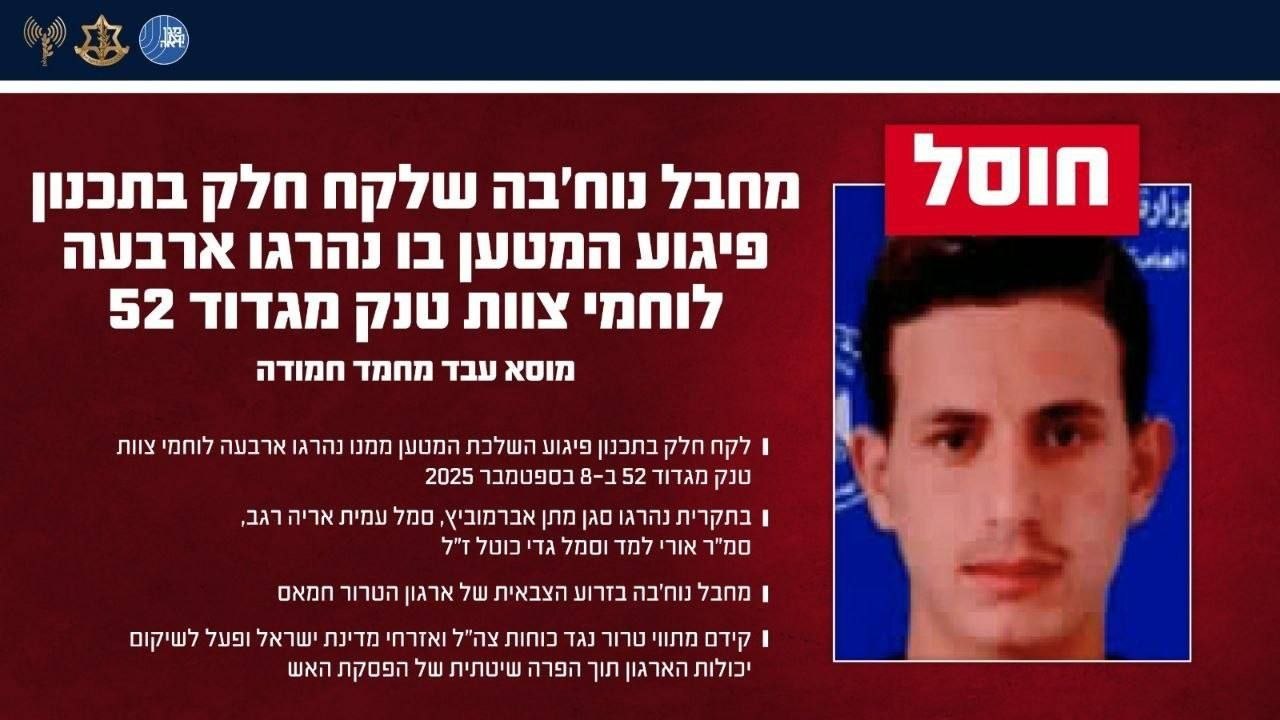
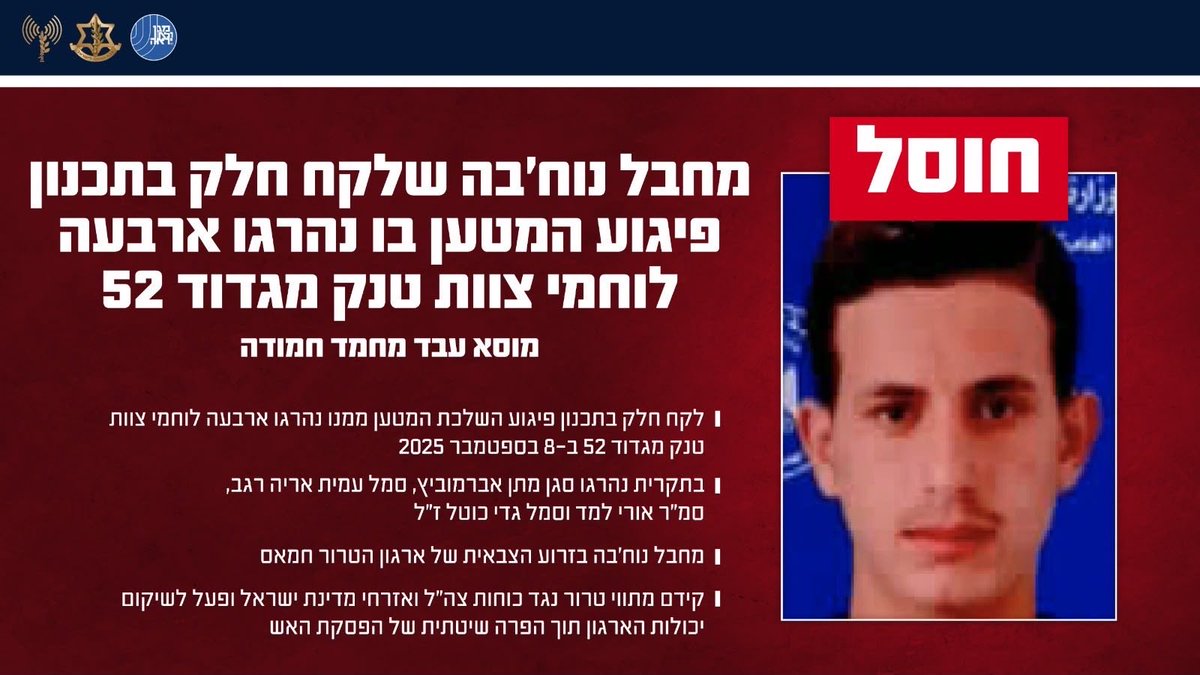
In the most consequential kinetic event recorded on 21 October 2026, Israeli forces carried out a targeted operation that resulted in the death of Hamas Nukhba operative Musa Abd Muhammad Hamouda and the simultaneous loss of four Israeli tank crew members from the 52nd Battalion. The incident, reported by the Telegram channel idkunim_il, underscores the continued intensity of the Israel‑Palestine conflict and highlights the lethal interplay between intelligence‑driven assassinations and conventional battlefield casualties.
Assassination and Tank Casualties
The operation unfolded in the Gaza Strip, where Israeli intelligence and special‑operations units located Hamouda, a senior planner of the September 2025 payload‑drop attack that killed four tank crew members on 8 September 2025. According to the source, the strike eliminated Hamouda and, in the same engagement, resulted in the deaths of Lieutenant Matan Abramovich, Sergeant Amit Arie Regev, Sergeant Ori Lamed and Sergeant Gadi Kotl. No weapons were disclosed as being used by the operative; the action was described as a precision elimination by Israeli forces.
"Musa Abd Muhammad Hamouda, a Nukhba terrorist in the military wing of Hamas who helped plan the payload‑drop attack that killed four tank crew members of the 52nd Battalion on 8 September 2025, has been eliminated. In the incident Lieutenant Matan Abramovich, Sergeant Amit Arie Regev, Sergeant Ori Lamed and Sergeant Gadi Kotl (deceased) were killed." – idkunim_il, 21 Oct 2026, https://t.me/idkunim_il/64636
Casualties: Four Israeli soldiers killed; one Hamas operative killed. Organizations involved: Hamas (Nukhba unit), Israeli Defense Forces (IDF), specifically the 52nd Battalion. Geographic focus: Gaza Strip, Palestine.
Airstrike Targets Hamas and PIJ Snipers
Later the same day, at 16:48, the Israeli Air Force conducted an airstrike in Gaza City that eliminated two high‑ranking militants: Abdullah Manir Mahmoud Haraz, identified as a deputy squad commander in the Palestinian Islamic Jihad (PIJ) rocket array, and Muhammad Wail Mustafa Sha'asha'a, a sniper affiliated with Hamas’s Darij Tuffah battalion. The strike was reported by the Telegram channel monitor_the_situation and included video evidence of the aftermath.
"IDF strikes in Darij Tuffah and Gaza City eliminated Abdullah Manir Mahmoud Haraz, deputy squad commander in PIJ's rocket array, and Muhammad Wail Mustafa Sha'asha'a, a sniper in Hamas's Darij Tuffah battalion. Both were advancing sniper…" – monitor_the_situation, 21 Oct 2026, https://t.me/monitor_the_situation/38396
Casualties: Two militants killed; no Israeli casualties reported. Weapons: Air‑delivered munitions; specific ordnance not disclosed. Organizations involved: Israeli Air Force, IDF, Palestinian Islamic Jihad, Hamas. Location: Gaza City, Gaza Strip.
West Bank Grave Arson Sparks Religious Outrage
At 16:01, a separate incident unfolded in the West Bank village of Ovrata, Samaria, where militants set fire to the historic graves of Eleazar and Itamar, sons of Aaron the priest. The act, captured on video and disseminated by idkunim_il, was described as an arson attack targeting a site of religious significance to both Jewish and Christian communities. No fatalities were reported, but the destruction of the graves has heightened communal tensions and prompted condemnation from religious leaders.
"Shocking: the graves of Eleazar and Itamar, sons of Aaron the priest, were set on fire by militants in the village of Ovrata in Samaria." – idkunim_il, 21 Oct 2026, https://t.me/idkunim_il/64659
Casualties: No loss of life; property damage to religious site. Weapons: Arson (incendiary devices). Organizations involved: Unidentified militants; the incident is attributed to “militants” without a specific group claim. Location: Ovrata, Samaria, West Bank.
Collectively, these events illustrate a pattern of high‑intensity kinetic operations by Israeli forces targeting senior Hamas and PIJ operatives, coupled with retaliatory or opportunistic attacks by Palestinian militants against symbolic targets. The elimination of Hamouda, a key architect of a previous IED attack, demonstrates the effectiveness of Israeli intelligence in disrupting Hamas’s operational leadership. Simultaneously, the airstrike that removed two additional snipers reflects a broader strategy to degrade the enemy’s long‑range and precision‑fire capabilities. The arson incident, while not resulting in casualties, signals an escalation in symbolic violence that could inflame sectarian sentiments across the region.
From an analytical perspective, the coordination of the assassination and the tank crew fatalities suggests a possible operational overlap, where the targeted operative may have been present in proximity to Israeli armored units during a separate engagement. The absence of disclosed weaponry in the assassination report aligns with the use of covert methods, likely involving close‑quarters neutralization rather than conventional firepower. In contrast, the airstrike employed standard aerial munitions, underscoring the IDF’s reliance on air superiority to neutralize high‑value targets embedded within densely populated urban environments.
These incidents occurred within a narrow temporal window, indicating a heightened operational tempo by Israeli forces on 21 October 2026. The simultaneous execution of multiple kinetic actions across Gaza and the West Bank reflects a coordinated campaign aimed at degrading militant command structures while also responding to provocations such as the grave arson. The events are expected to influence the security calculus of both sides, potentially prompting adjustments in force posture, intelligence priorities, and community outreach efforts to mitigate further escalation.