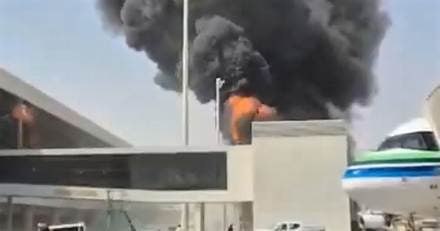
On 13 October 2026, a coordinated Houthi missile and drone barrage struck Riyadh International Airport, killing at least 18 people and wounding more than 300. The attack occurred shortly after midnight, catching the airport’s civilian and military personnel off‑guard. According to the Telegram channel monitor_the_situation, Saudi authorities did not issue any public warning before the strikes, a lapse that has prompted immediate scrutiny of the kingdom’s threat‑alert protocols.
Details of the Riyadh Airport Attack
The assault involved multiple missiles and unmanned aerial systems (UAS) launched from Houthi‑controlled areas in Yemen. The weapons penetrated the airport’s perimeter, striking the main terminal, a cargo facility, and nearby parking structures. Casualties were confirmed at 18 dead and over 300 injured, including passengers, airport staff, and emergency responders. The OSINTdefender channel reported that the barrage also targeted nearby air‑defense installations, further complicating the response.
Saudi Warning System Silent Before Deadly Riyadh Airport Strikes
The lack of an audible or visual alert, as highlighted by monitor_the_situation, suggests a failure either in the detection chain or in the decision‑making process that governs public warnings. Saudi officials have since halted the public warning system, citing a need to “review and recalibrate” the mechanisms that trigger alerts.
Investigation into Air‑Defense Failures
Within hours of the attack, the Saudi Ministry of Defense announced a formal investigation into why its air‑defense network failed to intercept the incoming threats. The OSINTdefender report notes that the kingdom’s Patriot and Saudi‑made “Sky Guard” systems were active but did not engage the missiles or drones. Analysts cited three potential failure points: radar detection latency, command‑and‑control communication breakdown, and rules‑of‑engagement that may have delayed interceptor launch.
Preliminary data from the investigation indicates that the radar signature of the Houthi missiles was initially classified as low‑altitude commercial traffic, leading to a delayed classification as hostile. By the time the threat was confirmed, the missiles were already within striking distance of the airport’s critical infrastructure.
Houthi Tactics and Capabilities
The Houthi rebels, formally identified as “Houthi rebels” in the OSINTdefender source, have increasingly employed mixed‑payload attacks that combine ballistic missiles with low‑cost commercial drones. This hybrid approach complicates detection because drones often fly at altitudes and speeds that differ from traditional missile trajectories. The weapons used in the Riyadh attack were not disclosed in detail, but the presence of both missiles and drones aligns with recent patterns observed in Houthi operations along the Red Sea corridor.
Strategically, the targeting of Riyadh International Airport serves multiple objectives: inflicting civilian casualties, disrupting a major economic hub, and demonstrating the ability to strike deep within Saudi territory. The attack underscores the Houthi’s expanding logistical network, which now includes supply lines for precision‑guided munitions sourced from regional allies.
Ansarullah’s Drone Downing Claim
In a separate development, the Yemen‑based militant group Ansarullah claimed to have shot down a Saudi “Loong 2” reconnaissance drone on 13 October 2026. The claim, posted by the Telegram channel GeoPWatch, adds another layer to the evolving aerial contest between Saudi forces and Yemen‑based actors. While the incident’s location was not disclosed, the downing of a high‑altitude Loong 2 platform indicates that Saudi aerial surveillance assets are also vulnerable to ground‑based anti‑aircraft fire.
Although the Ansarullah claim does not directly relate to the Riyadh airport attack, it reflects a broader trend of increasing anti‑aircraft capabilities among Yemen‑aligned groups. The loss of a Loong 2 drone could degrade Saudi situational awareness, potentially affecting the speed and accuracy of future threat assessments.
Implications for Saudi Defense Posture
The combined events of 13 October reveal systemic weaknesses in Saudi Arabia’s integrated air‑defense architecture. The failure to issue public warnings, the inability of radar and interceptor systems to neutralize the Houthi barrage, and the vulnerability of surveillance drones suggest gaps in both detection and response layers.
In response, Saudi officials have pledged to accelerate the deployment of next‑generation radar arrays and to conduct joint exercises with allied forces to refine command‑and‑control protocols. The investigation’s findings are expected to inform revisions to the kingdom’s rules‑of‑engagement, potentially allowing for more permissive interceptor launches against ambiguous targets.
Conclusion
The 13 October attacks mark a significant escalation in Houthi offensive capabilities and expose critical deficiencies in Saudi Arabia’s air‑defense and warning systems. With at least 18 fatalities and over 300 injuries, the human cost is stark, but the strategic ramifications extend far beyond the immediate casualties. Saudi Arabia’s forthcoming policy adjustments and technical upgrades will be closely monitored by regional security analysts, as they will determine whether the kingdom can restore confidence in its ability to protect civilian infrastructure against increasingly sophisticated cross‑border attacks.