On 6 October 2026 a series of high‑intensity kinetic events unfolded across several theatres, the most consequential being the identification of ten commercial tankers struck in the Strait of Hormuz. The attacks, reported by the open‑source monitor the situation channel, bring the total number of vessels hit in the corridor over the past week to fourteen, raising immediate concerns for global oil logistics and regional security.
Maritime Attacks in the Strait of Hormuz
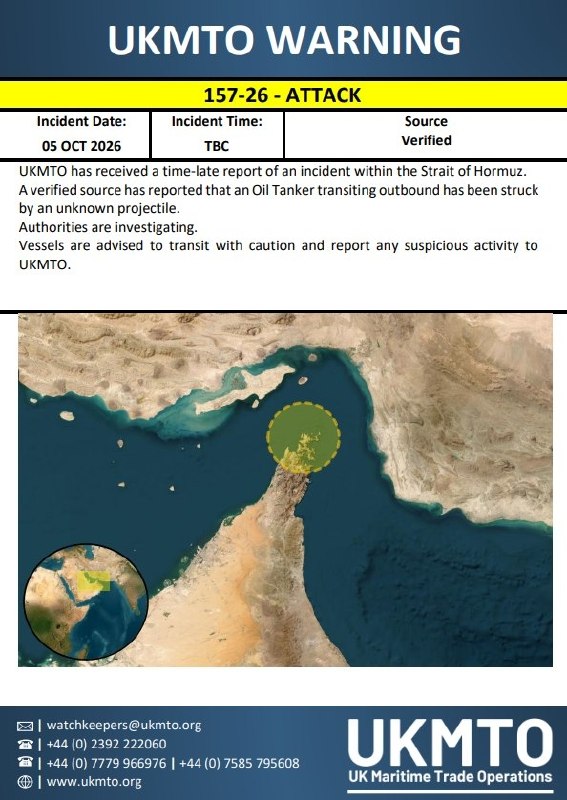
According to a post on the Telegram channel monitor_the_situation, ten tankers – flagged to Kuwait, the United Arab Emirates, Greece and Singapore, including two vessels managed by Sinokor – were confirmed as victims of recent hostile actions. The United Kingdom Maritime Trade Operations (UKMTO) also logged a separate strike on 5 October in the southern Hormuz corridor, confirming that the threat remains active. A projectile impact on a Panama‑flagged tanker earlier in the day injured eleven Indian nationals, while a later report described an oil tanker hit by an unknown projectile, bringing the day’s tally to five confirmed attacks on merchant vessels.
"🔴 **10 Tankers Identified in Strait of Hormuz Attacks** Of 14 tankers hit in recent days, 10 identified: Kuwaiti, UAE, Greek, Singapore‑flagged vessels, including two Sinokor‑managed. UKMTO reports another strike Oct 5 in southern Hormuz corridor." – monitor_the_situation, 06 Oct 2026
The strategic importance of the Strait – a chokepoint through which roughly 20 % of global petroleum shipments pass – means that each successful strike has outsized economic and geopolitical ramifications. No specific weapon system was disclosed for the ten confirmed hits, but the pattern of projectile‑type attacks suggests the use of small‑calibre anti‑ship missiles or improvised explosive devices launched from nearby platforms.
Ukrainian Drone Swarm Over Moscow Region
In a separate theatre, Ukraine launched a large‑scale drone swarm targeting Russia’s Moscow region, resulting in two civilian fatalities. Al Jazeera reported that 290 unmanned aerial systems were deployed overnight, striking multiple sites across the capital and surrounding oblasts. The attack marks one of the most extensive aerial offensives directed at the Russian heartland since the conflict began.
"Ukraine launches major drone attack on Russia’s Moscow region, killing two. Russia says 290 drones targeted Moscow and nearby regions in the overnight Ukrainian assault." – AlJazeera, 06 Oct 2026
The drones, described simply as "drone" in the source, were likely commercial‑grade quadcopters modified for loitering‑munition roles, a tactic Ukraine has refined throughout 2024‑2026 to bypass dense Russian air‑defence networks.
Houthi Rocket and Missile Campaign Against Saudi Arabia
Yemen’s Houthi movement intensified its cross‑border campaign, striking several Saudi targets on 6 October. Confirmed incidents include:
- Damage to King Khalid International Airport in Riyadh, as well as the airports in Najran and Jizan, with three injuries reported (GeoPWatch).
- Burn marks on an AESSCO warehouse or hangar at King Khalid Airport, attributed to rocket fire (CIG_telegram).
- Ballistic missile strikes on a Saudi Aramco refinery, producing thick smoke plumes (monitor_the_situation).
- Claims of hitting Aramco fuel tanks in Riyadh and additional airport facilities in Jizan and Najran (monitor_the_situation).
Casualties remain limited to the three injured at the Riyadh airport, but the repeated targeting of critical energy infrastructure underscores the Houthis’ strategic aim to disrupt Saudi oil production and export capabilities.
Other Notable Kinetic Events
Additional high‑impact incidents recorded on 6 October include:
- A massive fire at an oil depot in Sochi, Russia, visible across the city (OSINTdefender).
- Russian drones striking merchant vessels in the Black Sea, killing at least one crew member on a Marshall Islands‑flagged ship (monitor_the_situation).
- Ukrainian drones igniting a fire at the Volodarskaya oil depot in Moscow Oblast, a facility storing 250,000 m³ of fuel (monitor_the_situation).
- Russia’s air‑defence forces intercepting 868 Ukrainian fixed‑wing UAVs over Russian territory during the night (intelslava).
These events illustrate a broader pattern of aerial and maritime kinetic activity, with both state and non‑state actors employing drones, missiles, and conventional projectiles to achieve tactical objectives.
Strategic Context and Emerging Trends
The convergence of maritime attacks in the Gulf, large‑scale drone operations over Russian territory, and intensified Houthi rocket strikes against Saudi Arabia reflects a multi‑front escalation. While each theatre operates under distinct political motivations, the shared reliance on low‑cost, high‑impact weapons – particularly drones and rockets – points to a diffusion of asymmetric capabilities across the region.
In parallel, France conducted its first acceptance firing of the upgraded M51.3 submarine‑launched ballistic missile from the SSBN Le Vigilant, signaling a continued emphasis on strategic deterrence amid heightened tensions with Russia. Although not a kinetic event in the conventional sense, the test underscores the broader security environment in which these kinetic actions are occurring.
Finally, the deployment of Turkish and Pakistani troops to Saudi Arabia under the Mecca Pact, as reported by OSINTdefender, indicates a diplomatic response aimed at bolstering Saudi defence against the escalating Houthi threat.