The Yemen conflict entered a new escalation phase on 6 October 2026 as the Houthi movement (Ansarullah) announced that missile strikes on Ras al‑Ara, Al‑Saqia, Al‑Jawf and Marib had killed more than 200 Saudi and Yemeni People’s Liberation Committee (PLC) troops. The claim, posted by the monitoring channel GeoPWatch at 04:32 UTC, described the attacks as “unprecedented” in their destructive impact on coalition forces.
Houthi Missile Campaign
According to GeoPWatch, the rockets were launched from Houthi‑controlled areas in northern Yemen and targeted multiple Saudi‑backed installations. The channel reported that the weapons used were a mix of ballistic missiles and precision‑guided rockets, though specific missile types were not disclosed. The Houthi statement emphasized that the strikes were part of a broader effort to “eliminate enemy concentrations” and to deter further Saudi air operations in Yemeni territory.
"We have inflicted heavy losses on the PLC and Saudi forces, killing over two hundred combatants in a single coordinated barrage," the Houthi spokesperson said, as cited by GeoPWatch.
The claim of 200 casualties, while not independently verified, marks the highest single‑day loss reported for coalition forces since the conflict’s intensification in 2024. The announcement was accompanied by a graphic map showing impact zones around Ras al‑Ara and the surrounding districts.
Saudi and Coalition Counter‑Air Operations
In parallel, the Houthi‑aligned coordination body warned commercial airlines to avoid Saudi airspace, citing recent missile and drone attacks on Saudi Aramco facilities in Riyadh and the Khurais oil‑field complex. The warning, relayed by the Telegram channel intelslava at 04:32 UTC, referenced a Reuters report that the Houthis had declared the kingdom’s airspace “unsafe for civilian aviation,” with the exception of corridors over Mecca and Medina.
"All airlines must refrain from flying over Saudi Arabia until further notice," the Houthi coordination body announced, according to intelslava.
Saudi Arabia responded by intensifying its own air campaign over Yemen. Satellite imagery and open‑source video released by intelslava showed a series of coalition airstrikes targeting Houthi command‑and‑control sites near Marib and Al‑Jawf, as well as damage to a Khurais pumping station attributed to a Houthi drone strike. The Saudi‑led coalition has confirmed that its operations aim to neutralize Houthi missile launch sites and to protect critical oil infrastructure.
Ground Movements in Taizz and Surrounding Areas
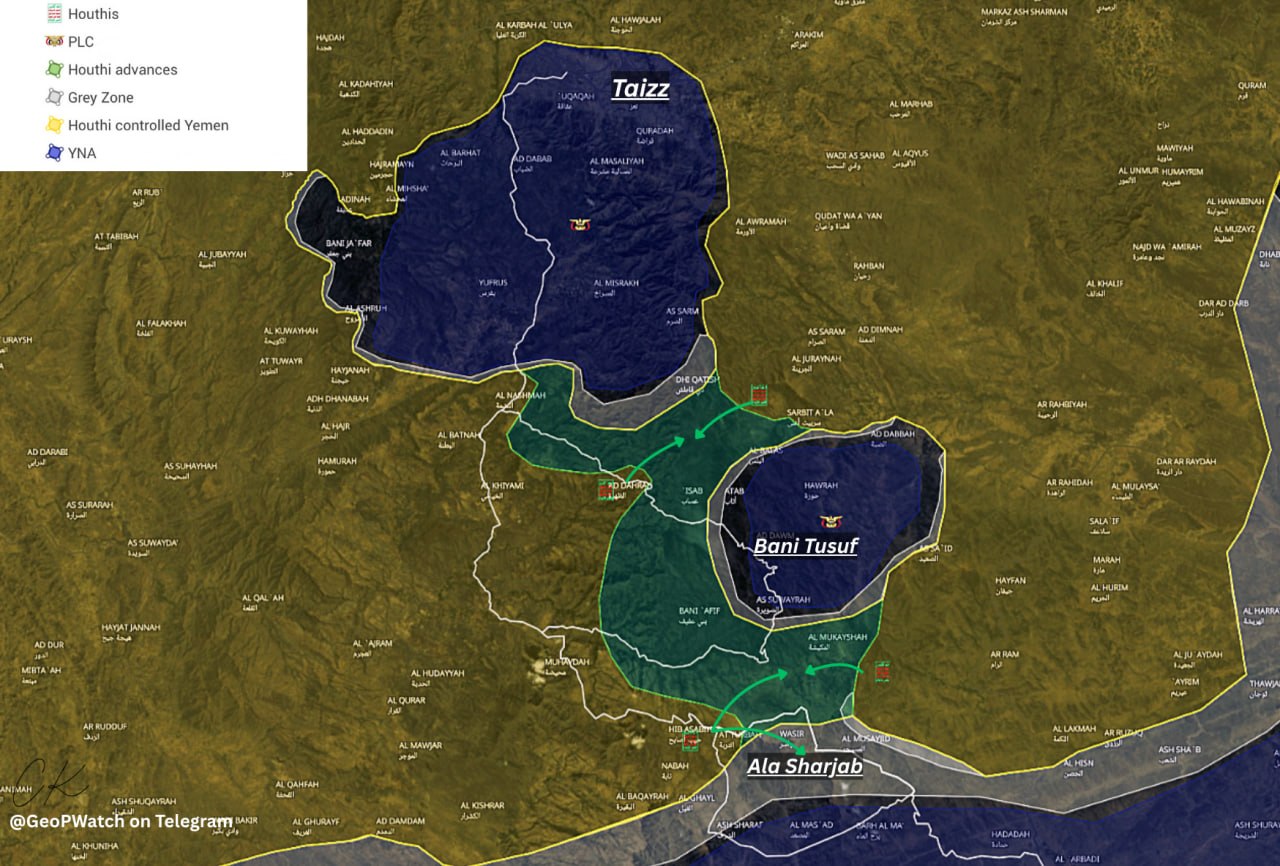
On the ground, Houthi forces reported continued advances in Taizz province. GeoPWatch, at 04:45 UTC, quoted a Houthi spokesperson stating that Saudi‑backed troops were being pursued across the remaining districts of Taizz, leading to “significant disruption” and “desertions” among coalition ranks. Earlier, at 01:04 UTC, the same source indicated that Ansarullah had fully encircled the city of Taizz and the nearby PLC formations in Bani Tusuf, positioning the Houthis for a potential southward push toward Aden, where fighting at Al‑Sharjab had already begun.
The encirclement of Taizz represents a strategic gain for the Houthis, as the city sits on a key supply corridor linking northern and southern Yemen. Control of Taizz would enable the Houthis to threaten coalition supply lines to the southern port of Aden and to exert pressure on the PLC’s remaining footholds in the highlands.
Strategic Port of Mocha Recaptured
In a separate development, Yemeni forces loyal to the PLC announced the recapture of the strategic Red Sea port city of Mocha at midnight, as reported by Al Jazeera. The port, which had been under Houthi control since early 2025, is vital for maritime trade and for the coalition’s logistical chain. The announcement was accompanied by a photo released on GeoPWatch, showing PLC troops raising their flag over the city’s main square.
Mocha’s liberation provides the coalition with a forward logistics hub that could support renewed offensive operations in the western coastal region. However, the Houthi claim of high‑casualty missile strikes earlier in the day suggests that the coalition’s momentum may be challenged by continued long‑range attacks.
International Military Support for Saudi Arabia
Amid the escalating violence, Turkey and Pakistan agreed to deploy rapid‑deployment forces to Saudi Arabia, according to an Al Jazeera video feed at 01:39 UTC. The agreement was reached during emergency talks in Riyadh and is framed as part of the broader “Mecca defence pact” aimed at safeguarding the kingdom’s critical infrastructure and holy sites. Both nations pledged to send air‑defense units and ground contingents capable of operating alongside Saudi forces.
The Turkish and Pakistani deployments underscore the regional dimension of the Yemen conflict, highlighting how the war’s intensification is prompting broader security collaborations among Saudi allies. While the exact size and composition of the forces remain undisclosed, the pledges signal a willingness to provide both logistical support and combat capabilities in the event of further Houthi escalation.
Implications and Outlook
The confluence of high‑casualty missile attacks, intensified coalition airstrikes, and rapid‑deployment pledges from regional partners marks a significant escalation in the Yemen war. The Houthi claim of over 200 coalition casualties, if accurate, could prompt a reassessment of the coalition’s operational posture, potentially leading to deeper air campaigns and increased ground offensives in Taizz and surrounding provinces.
At the same time, the recapture of Mocha and the encirclement of Taizz illustrate the fluidity of front‑line dynamics, where territorial gains can be quickly offset by long‑range missile strikes. The involvement of Turkey and Pakistan adds a new layer of external support for Saudi Arabia, which may influence the coalition’s capacity to sustain prolonged operations.
Monitoring agencies will continue to verify casualty figures and assess the impact of the Houthi missile barrage on coalition morale and logistics. The next 48‑hour window is likely to see further air operations targeting Houthi missile launch sites, as well as potential ground engagements as coalition forces attempt to consolidate gains around Taizz and Mocha.