On 27 September 2026 Iran experienced a cascade of kinetic events that spanned its capital, the Persian Gulf, and the southern coastline. The most consequential incident was a joint United States‑Israel airstrike that targeted a civilian hospital in Tehran, nearly killing senior cleric Mojtaba Khamenei. Within hours, explosions were reported off Qeshm Island in Hormozgan Province, and the Islamic Revolutionary Guard Corps (IRGC) Navy announced multiple engagements in the Strait of Hormuz, including the seizure of two U.S. unmanned vessels. The sequence of attacks underscores a rapid escalation in both aerial and maritime domains.
Critical Hospital Airstrike in Tehran
At 12:51:58 local time, a coordinated strike by United States forces, reportedly with Israeli participation, struck a hospital in Tehran. The operation caused extensive structural damage and forced emergency crews to extract Mojtaba Khamenei from the rubble. While official casualty figures have not been released, the incident is described as a “second assassination attempt” on the cleric. The strike was documented by the Telegram channel monitor_the_situation, which posted a photo of the damaged facility and a brief report stating,
Mojtaba Khamenei was pulled from rubble after US/Israeli strikes hit his hospital, a second assassination attempt.The attack marks the first known use of a direct airstrike against a civilian medical target inside Iran since the 2020s, raising serious concerns under international humanitarian law.
Explosions Near Qeshm Island
At 16:38:45, residents of Qeshm Island in Hormozgan Province reported hearing a series of loud explosions emanating from the sea. The same Telegram source, monitor_the_situation, described the blasts as “originating from the sea” and linked them to the broader regional tension involving Iran, the United States, and Israel. No casualties were reported, and the Iranian authorities have not confirmed the nature of the devices. The incident adds a maritime dimension to the day's kinetic activity, suggesting possible naval mines, unmanned surface vessels, or stray missile fragments.
IRGC Claims 19 Ship Hits in the Strait of Hormuz
According to a statement from the IRGC‑linked Fars News Agency, the IRGC Navy engaged 19 vessels attempting to transit the Strait of Hormuz over the previous 48 hours. The engagements employed anti‑ship missiles, though specific missile types were not disclosed. The claim was posted on the Telegram channel CIG_telegram at 14:52:17, accompanied by a brief excerpt:
The IRGC Navy struck 19 ships in the past two days while trying to cross the Strait of Hormuz.No independent verification of the ship identities or casualty figures is available, but the assertion reflects Tehran’s intent to assert control over the strategic chokepoint.
Seizure of Second U.S. Remus 600 Surface Vessel
At 10:40:37, the IRGC announced the capture of a second U.S. Remus 600 unmanned surface vessel (USV) operating in the Strait of Hormuz. The vessel, described as “advanced” and used for espionage, was reportedly seized through a coordinated operation involving intelligence and electronic‑warfare capabilities. The announcement, posted on the Telegram channel intelslava, included a short video of the USV being towed aboard an IRGC craft. The IRGC labeled the platform as belonging to the “American terrorist army” and declared the waterway closed to foreign navigation pending further security assessments.
Capture of Second U.S. Underwater Drone
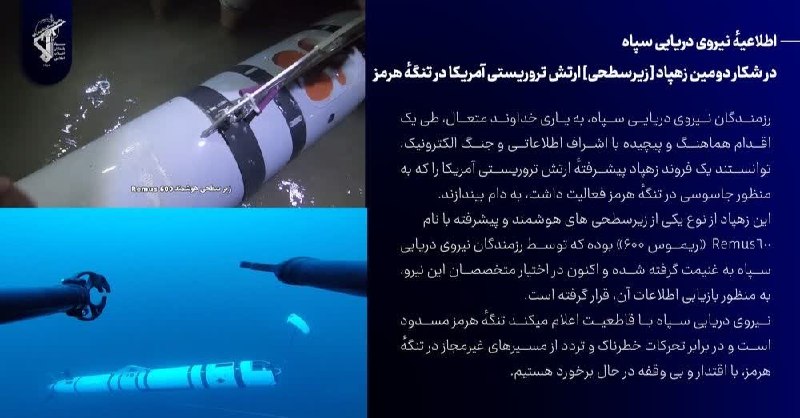
Just minutes earlier, at 10:38:18, the IRGC Navy reported the capture of a second U.S. underwater drone, also identified as a Remus 600 unmanned underwater vehicle (UUV). The Telegram channel CIG_telegram shared a photo of the recovered drone and a statement:
Iran’s IRGC Navy announced that they captured a second U.S. military underwater drone in the Strait of Hormuz following a coordinated operation involving intelligence surveillance and electronic warfare.The seizure underscores Tehran’s growing capability to detect and interdict autonomous maritime platforms operating in its near‑shore waters.
Collectively, these events illustrate a multi‑layered kinetic campaign targeting both Iranian domestic infrastructure and maritime traffic. The hospital airstrike represents a direct escalation of aerial operations against Iranian sovereign territory, while the maritime incidents demonstrate the IRGC’s increasing proficiency in anti‑access/area‑denial (A2/AD) tactics. The proximity of the events in time and geography suggests a coordinated effort, potentially aimed at pressuring Iran’s strategic decision‑making ahead of upcoming diplomatic negotiations concerning its nuclear program and regional activities.
International observers have called for restraint and verification. The United Nations has not yet issued a formal statement, but the Security Council is expected to convene an emergency session to assess the implications for regional stability. Meanwhile, Iran’s foreign ministry has condemned the hospital strike as a violation of international law and warned of “proportionate retaliation” against any further aggression.