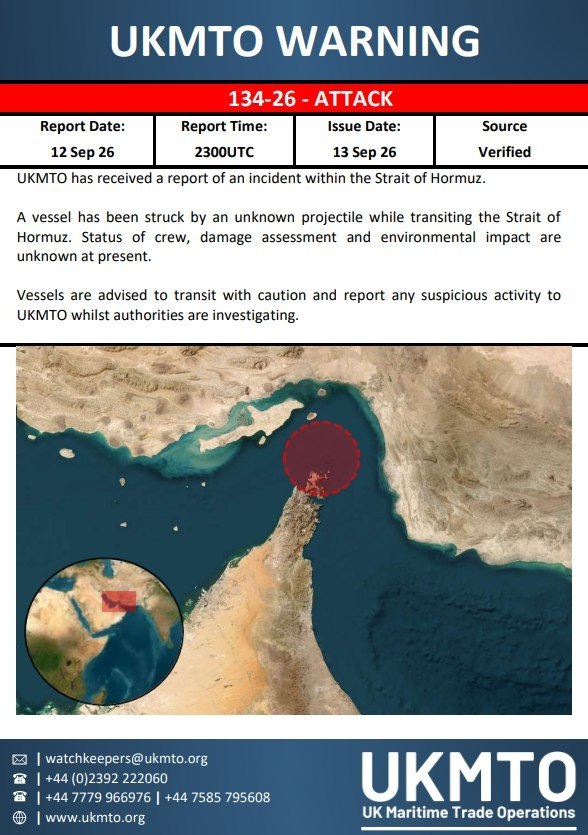
At 02:31 UTC on 13 September 2026, Iranian forces launched anti‑ship missiles at a commercial vessel transiting the US‑secured lane of the Strait of Hormuz. The vessel was reported to be sailing in close proximity to United States Navy warships when the missiles struck, marking the most significant maritime escalation of the day (Source: monitor_the_situation). The incident underscores Tehran’s willingness to target commercial traffic in a chokepoint that handles roughly 20 percent of global oil shipments.
Iranian Missile Attack in the Strait of Hormuz
The missiles, identified as shore‑based anti‑ship systems, were fired from Iranian territory and impacted the commercial ship without immediate confirmation of crew casualties or environmental damage. A separate report from GeoPWatch at 01:12 UTC noted that Iran struck another vessel in the strait with a projectile, though the crew status remained unknown. The United Kingdom Maritime Trade Operations (UKMTO) also recorded an unknown projectile hitting a vessel at 00:59 UTC, further illustrating a pattern of ambiguous but potentially lethal engagements (Source: monitor_the_situation; Source: GeoPWatch).
"Iranian forces fired anti‑ship missiles at a commercial vessel in the US‑secured lane of the Strait of Hormuz, with the ship reportedly flying close to US warships, per sources." – monitor_the_situation
Key implications include heightened risk to international shipping, possible escalation of US‑Iran naval encounters, and increased insurance premiums for vessels navigating the strait. The lack of an official Iranian statement leaves open the question of whether the attack was a direct response to recent US naval deployments or part of a broader strategy to pressure regional adversaries.
Houthi Expansion in the Bab al‑Mandeb Strait
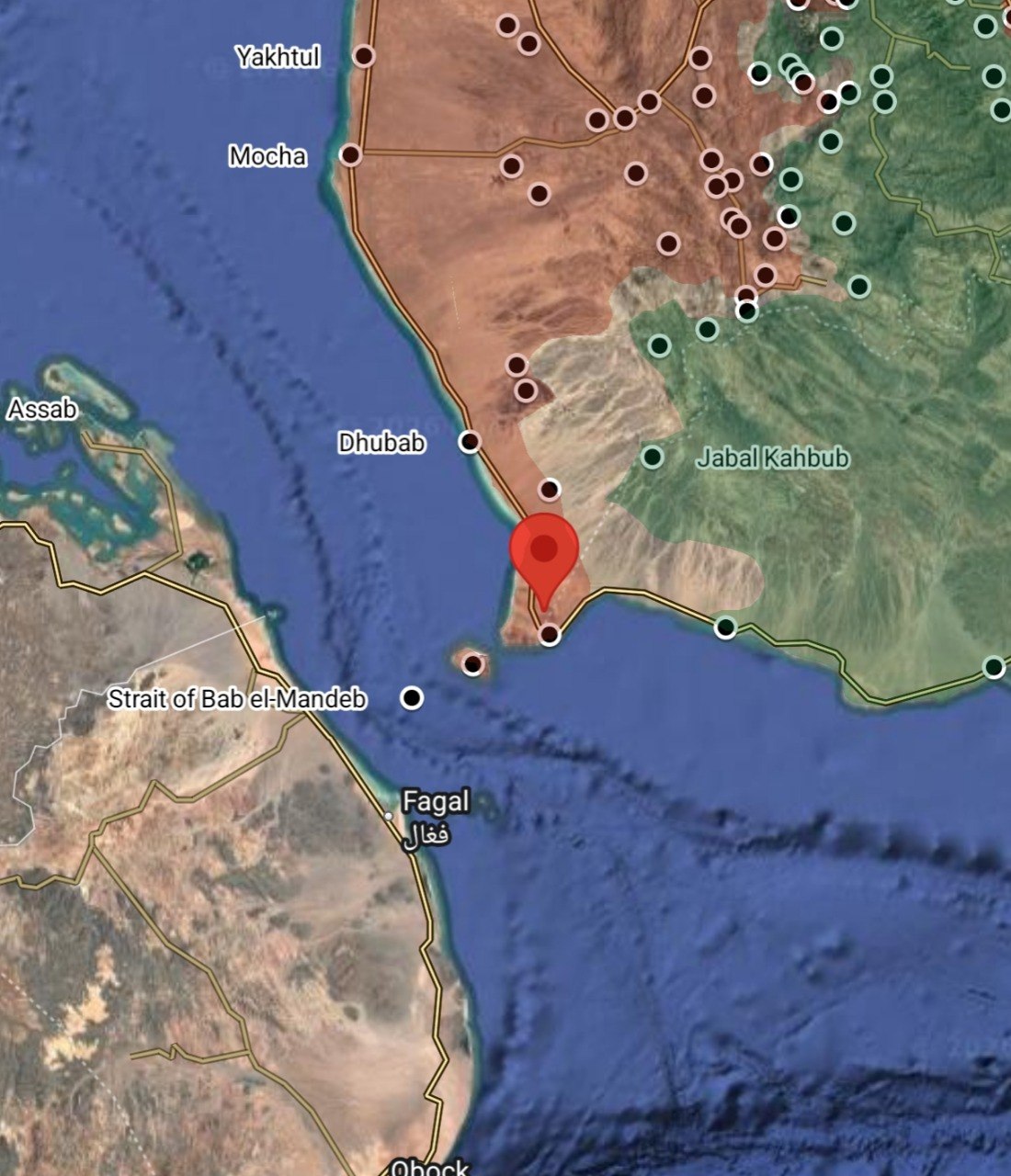
Simultaneously, Yemen’s Houthi movement consolidated territorial control in the Red Sea by seizing Mayun Island, a strategic outpost that commands the southern entrance to the Bab al‑Mandeb Strait. The capture, reported by Al Jazeera at 02:44 UTC, represents a tangible gain for the Houthis, who have previously relied on missile and drone attacks to influence maritime traffic. Control of Mayun Island enables the group to monitor and potentially interdict vessels passing through one of the world’s busiest maritime corridors.
In the preceding hours, the Houthis announced that Saudi Arabia had conducted 129 strikes across the Bab al‑Mandeb region within a 48‑hour window, a claim that raises concerns about the intensity of the Saudi‑Houthi exchange and its impact on Saudi oil export capacity (Source: AlJazeera). The Houthis also reported a projectile that wounded two civilians and damaged a mosque in Saudi Arabia’s Jazan region, asserting that the intended target was a military base in Sharurah (Source: AlJazeera). While casualty figures remain limited, the incident illustrates the Houthis’ continued use of long‑range rockets to project power onto Saudi territory.
Further complicating the security environment, the pro‑Presidential Leadership Council (PLC) Giant Brigades released a statement via rnintel at 01:20 UTC claiming that Ansarullah forces were constructing fortifications, trenches, and tunnels in Murat, a coastal settlement near the Bab al‑Mandeb. These defensive works suggest a shift from purely kinetic attacks to a more entrenched presence, potentially enabling sustained control over key maritime approaches.
Broader Maritime Security Implications
The convergence of Iranian missile activity in the Strait of Hormuz and Houthi territorial gains in the Bab al‑Mandeb creates a dual‑theater risk profile for commercial shipping. Vessels navigating the Gulf of Aden and Red Sea now face threats from state‑aligned missile strikes, non‑state militant fortifications, and the possibility of collateral damage from high‑intensity air campaigns.
Additional incidents on 13 September reinforce this assessment. Iraqi authorities seized a drone‑launching platform in Maysan Province near the Iran border, a site allegedly used to target a Saudi oil pipeline (Source: AlJazeera). Although the platform was neutralized, its discovery highlights the transnational nature of drone warfare and the potential for cross‑border escalation.
Collectively, these events demonstrate a pattern of increasing militarization of maritime chokepoints, with both state and non‑state actors employing a mix of conventional missiles, rockets, and emerging drone technologies. The lack of transparent casualty reporting and the ambiguous status of damaged vessels impede accurate risk assessment, prompting shipping companies to consider rerouting or heightened defensive measures.
Maritime security agencies, including the US Navy’s Fifth Fleet and the European Union Naval Force Operation Atalanta, have issued advisories urging vessels to maintain heightened vigilance, report any suspicious activity, and adhere to established convoy protocols where available. The ongoing volatility underscores the need for coordinated diplomatic engagement to de‑escalate tensions and protect the free flow of commerce through these critical waterways.