On 31 August 2026 a cluster of security incidents involving Iran, the United States and Israeli forces highlighted a sharp escalation in regional volatility. The most consequential event was a U.S. airstrike on two Iranian rocket launchers located on Larak Island in the Strait of Hormuz, followed by a cascade of naval, aerial and ground actions that underscore the interconnected nature of security dynamics in the Middle East.
U.S. Airstrike on Larak Island
At 04:36 UTC the United States military conducted precision strikes against two Iranian rocket launchers on Larak Island, Hormozgan Province. The operation, reported by the open‑source outlet OSINTdefender, was framed as a defensive measure to protect civilian shipping from imminent IRGC mine‑laying activities in the Strait of Hormuz. No casualties were reported among the launchers’ crews, and the weapons used were conventional air‑delivered munitions. The Islamic Revolutionary Guard Corps (IRGC) publicly vowed retaliation, describing the attack as an “act of aggression” that would be “punished” (source: OSINTdefender).
"U.S. forces struck two Iranian rocket launchers on Larak Island, prompting a vow of retaliation from Iran's IRGC," OSINTdefender reported.
Key actors: U.S. military (CENTCOM), IRGC rocket units. Strategic implication: The strike signals a willingness by U.S. forces to intervene directly when Iranian maritime threats emerge in a chokepoint that handles roughly 20 % of global oil shipments.
IRGC Naval Activity and Mine Incidents
Within the same hour, the IRGC Navy announced that a “rogue supertanker” had detonated two naval mines while traversing the Omani lane of the Strait. The claim, posted by GeoPWatch at 04:27 UTC, was not independently verified by third‑party observers, but it contradicts earlier statements by the United States that all known mines had been cleared from the waterway.
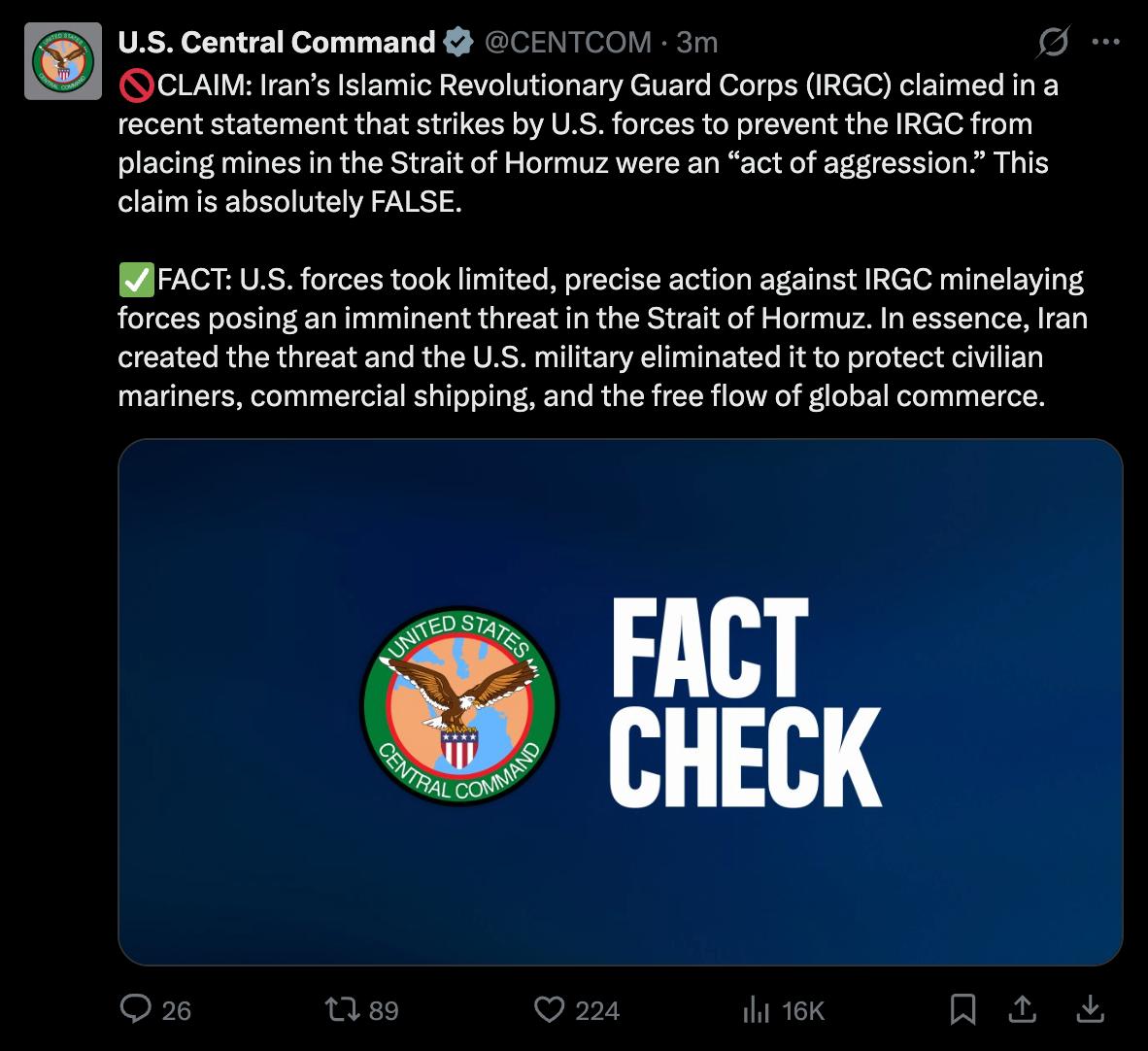
At 00:59 UTC U.S. Central Command reported a limited, precise interception of Iranian minelaying vessels in the Strait, describing the action as necessary to neutralize an imminent threat to civilian navigation. Iran labeled the interception an “act of aggression.” The incident was documented by monitor_the_situation, which included a photograph of U.S. naval assets engaging the IRGC vessels.
These naval confrontations illustrate a pattern of reciprocal escalation: Iranian forces employ mines and minelaying vessels to assert control over the Strait, while U.S. forces respond with targeted interdictions and kinetic strikes on associated launch platforms.
Iranian Drone Operations
Iran’s aerial campaign extended beyond the maritime domain. At 04:24 UTC the Iranian Foreign Ministry claimed the launch of attack drones targeting the Al‑Minhad airbase in the United Arab Emirates, with sirens reportedly heard in Dubai. GeoPWatch supplied video evidence of the drone launches, though no damage or casualties were confirmed.
Earlier, at 03:35 UTC, Iran announced the downing of a U.S. MQ‑9 Reaper drone over international waters in the Strait of Hormuz. The claim, also posted by GeoPWatch, did not include details on the method of engagement or any U.S. response.
These drone incidents underscore the expanding use of unmanned systems by state actors to project power across both land and sea, raising the risk of inadvertent escalation given the limited situational awareness inherent to remote platforms.
Ground Operations in the West Bank
In a separate theater, Israeli forces conducted a raid in Nablus, West Bank, at 03:08 UTC. Al Jazeera reported that two Palestinians were killed during the operation, which involved military vehicles and personnel moving through the city. No Israeli casualties were reported. The raid reflects ongoing security operations in the occupied territories, adding another layer to the regional security environment on the same day as the maritime and aerial incidents.
While the Israeli operation is distinct from the Iran‑U.S. confrontations, its timing illustrates the broader pattern of heightened security actions across the Middle East on 31 August 2026.
Analytical Overview
The sequence of events on 31 August demonstrates a multi‑domain escalation involving maritime, aerial and ground components. The U.S. airstrike on Larak Island represents the most direct kinetic engagement between the United States and Iranian forces in 2026, setting a precedent for future responses to IRGC mine‑laying activities. Simultaneously, Iran’s use of drones against a UAE airbase and the claimed shoot‑down of a U.S. MQ‑9 Reaper illustrate Tehran’s willingness to employ asymmetric tools to challenge regional adversaries.
In the maritime domain, the interplay between Iranian minelaying, alleged rogue tanker incidents, and U.S. interdictions creates a volatile environment for commercial shipping. The Strait of Hormuz remains a strategic chokepoint where any disruption can have immediate global economic repercussions.
On the ground, the Israeli raid in Nablus adds to the cumulative security pressure in the region, highlighting that multiple state and non‑state actors are operating concurrently across different theaters.
Overall, the incidents underscore the need for robust de‑confliction mechanisms, real‑time intelligence sharing, and calibrated diplomatic engagement to prevent inadvertent escalation into broader conflict.