On 27 August 2026, a series of Ukrainian‑origin unmanned aerial system (UAS) operations struck multiple sites across the Russian Federation, marking the most intensive day of kinetic activity inside Russia since the conflict intensified in 2022. The attacks focused on high‑value air‑defence and logistics assets in the Rostov region, while also extending to civilian maritime and industrial targets in the Black Sea and the Republic of Bashkortostan.
Millerovo Air Base: Dual‑Stage Assault on Nebo‑U Radar
At 16:20 local time, a Ukrainian reconnaissance drone conducted a surveillance pass over Millerovo Air Base in Rostov Oblast, documenting aircraft movements before a RAM‑2X kamikaze drone struck a Nebo‑U radar installation located adjacent to the airfield. The RAM‑2X, a loitering munition designed for precision impact, detonated on the radar array, rendering the system inoperable. The strike was captured on video posted by the Telegram channel intelslava (source).
"A Ukrainian reconnaissance drone flew over the Millerovo airbase, observing aircraft take‑off and landing, and a RAM‑2X kamikaze drone struck a 'Nebo‑U' radar station near the airfield." – intelslava
No casualties were reported among base personnel, but the loss of a radar valued at approximately $100 million degrades Russia’s ability to detect and intercept low‑altitude threats, including Shahed loitering drones that have been employed against Ukrainian targets.
429th Achilles Brigade Rocket Strike
Earlier that day, at 11:34, the Ukrainian 429th Achilles Brigade launched a rocket attack on the same Nebo‑U radar at Millerovo airfield. While the specific munition type was not disclosed, the operation was described as a precision strike aimed at a critical air‑defence node. The attack was reported by the Telegram channel monitor_the_situation (source).
"Ukraine's 429th Achilles Brigade hit a Nebo‑U radar at Millerovo airfield, valued at ~$100M, used to launch Shahed drones against Ukraine." – monitor_the_situation
The sequential nature of the two attacks—first a rocket strike, followed by a loitering‑munition impact—suggests a coordinated effort to ensure the radar’s destruction, limiting any chance of rapid repair or replacement.
Vehicle Depot Attack in Kamensk‑Shakhtinsky
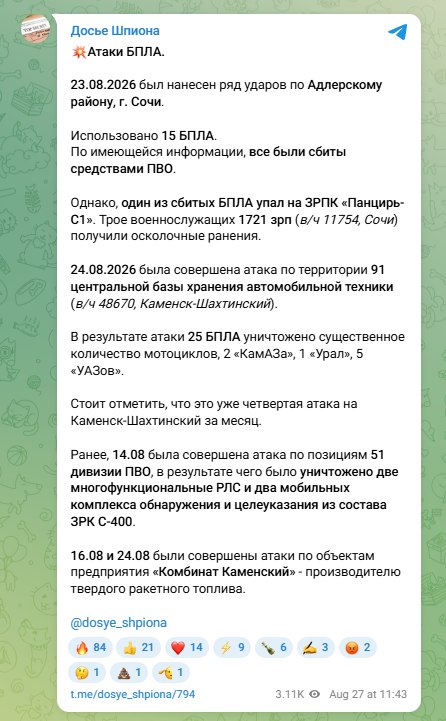
At 09:49, Ukrainian UAVs targeted the 91st Central Vehicle Storage Base in Kamensk‑Shakhtinsky, also in Rostov Oblast. According to monitor_the_situation, a swarm of 25 drones engaged the depot, destroying multiple military vehicles. This represents the fourth strike on the city within the month, indicating a sustained campaign to degrade Russian ground‑logistics capabilities.
"Ukrainian drones hit Russia's 91st Central Vehicle Storage Base with 25 drones, destroying vehicles. Fourth attack on the city this month." – monitor_the_situation
While casualty figures were not released, the loss of transport and combat vehicles hampers the Russian army’s operational mobility in the southern theatre.
Maritime Incident off Tuapse
At 11:04, three drones attacked a Turkish roll‑on/roll‑off (Ro‑Ro) vessel navigating the port of Tuapse on the Black Sea coast of Krasnodar Krai. The drones ignited a fire aboard the ship, injuring five crew members. The incident, reported by monitor_the_situation, underscores the expanding reach of Ukrainian UAVs into maritime domains and raises concerns about the safety of commercial shipping in contested waters.
"A Turkish Ro‑Ro ship was hit by three drones off Tuapse, causing a fire and injuring five crew members." – monitor_the_situation
There were no reported fatalities, and the vessel’s cargo status remains unconfirmed.
Industrial Target: Bashkir Soda Company
At 07:42, Ukrainian FP‑1 drones struck the Bashkir Soda Company chemical plant in Sterlitamak, Republic of Bashkortostan. The plant, which produces soda ash for both civilian and defence‑related applications, emitted visible smoke following the impact. The attack was documented in a video shared by monitor_the_situation (source).
"Ukrainian FP‑1 drones struck the Bashkir Soda Company in Sterlitamak, a defence‑linked chemical producer; smoke reported rising from the plant." – monitor_the_situation
No injuries were reported, but the incident highlights a tactical shift toward targeting industrial facilities that support Russia’s war economy.
Analysis of the Day’s Kinetic Operations
The coordinated UAV attacks across disparate regions illustrate a multi‑vector approach by Ukrainian forces, leveraging both reconnaissance and strike‑capable drones to achieve strategic effects. The focus on radar and vehicle assets in Rostov Oblast aligns with Ukraine’s broader objective of degrading Russian air‑defence coverage and logistical sustainment near the front line. Simultaneously, the maritime and industrial strikes serve a dual purpose: disrupting commercial activity that may indirectly support Russian military logistics and signaling the capability to project force beyond the immediate conflict zone.
All incidents reported today were disseminated via open‑source Telegram channels, reflecting the continued reliance on social media for real‑time conflict monitoring. While casualty numbers remain low, the material losses—particularly the destruction of a high‑value radar system and multiple ground vehicles—represent a tangible erosion of Russian operational capacity.