On the night of 27 August 2026, Ukraine’s capital faced the most concentrated Russian missile offensive of the year. A Ukrainian Patriot air‑defence battery in Kyiv successfully intercepted an incoming Russian ballistic missile, destroying it mid‑air before it could strike the city. The engagement, captured on video by BellumActaNews, underscores the escalating missile exchange and highlights the critical role of Ukraine’s Western‑supplied air‑defence systems.
Patriot Interception Over Kyiv
At 01:33 UTC, a Patriot surface‑to‑air missile battery stationed in Kyiv engaged a Russian ballistic missile launched from Russian‑occupied territory. The interceptor struck the target at high altitude, fragmenting the warhead and preventing any impact on civilian infrastructure. BellumActaNews reported that the interception was captured on live video, showing the missile’s trajectory and the subsequent explosion of the interceptor. No casualties were reported from this specific engagement, but the event marked a rare successful mid‑air kill of a Russian ballistic missile over the capital.
"A Ukrainian PATRIOT SAM battery in Kyiv appears to have received a limited number of interceptors, one of which smashed into an incoming Russian ballistic missile over the Ukrainian capital tonight, destroying it midair before it impacted," – BellumActaNews (https://t.me/BellumActaNews/176701)
Scale and Composition of the Russian Missile Launches
Concurrent with the Patriot interception, Russian forces launched a heterogeneous salvo of missiles targeting Kyiv and other strategic locations across Ukraine. GeoPWatch documented at least 26 missiles fired between 00:40 and 01:20 UTC, including modified S‑400 ballistic missiles, Iskander short‑range rockets, and Oniks supersonic cruise missiles. The modified S‑400 missiles, described by GeoPWatch as “easier to intercept,” suggest a tactical shift to increase the probability of penetration while preserving payloads.
Specific launches included:
- Four Iskander missiles detected from Bryansk Oblast at 00:25 UTC (GeoPWatch).
- Two Oniks cruise missiles heading toward Yuzhnyi Port in Odesa Oblast at 00:00 UTC (GeoPWatch).
- Four KAB glide‑bombs targeting Chornomorsk, Odesa Oblast, at 00:00 UTC (GeoPWatch).
- Multiple ballistic missiles aimed at Kyiv, prompting a nationwide air‑raid alert at 00:20 UTC (monitor_the_situation).
While exact impact figures remain contested, several sources reported mixed outcomes: some missiles reportedly struck their intended targets, while others were intercepted by Ukrainian air‑defence assets, including Patriot systems and other short‑range interceptors.
Ground Impact and Civilian Damage in Kyiv
Despite successful interceptions, debris from Russian attacks fell on residential structures in Kyiv’s historic Podilskyi district at 00:46 UTC, as reported by GeoPWatch. The falling fragments caused minor structural damage but no confirmed fatalities. Earlier, at 00:28 UTC, multiple explosions were reported across the city, though details on casualties remain sparse.
Extended Threats to Southern Ukraine
In the Odesa region, the arrival of Oniks cruise missiles and KAB glide‑bombs heightened the risk to critical port infrastructure. Yuzhnyi Port, a key export hub, was placed on high alert as two Oniks missiles approached. Simultaneously, Chornomorsk experienced a glide‑bomb strike, though no casualty figures were released at the time of reporting.
Ukrainian Counter‑Offensives and Drone Activity
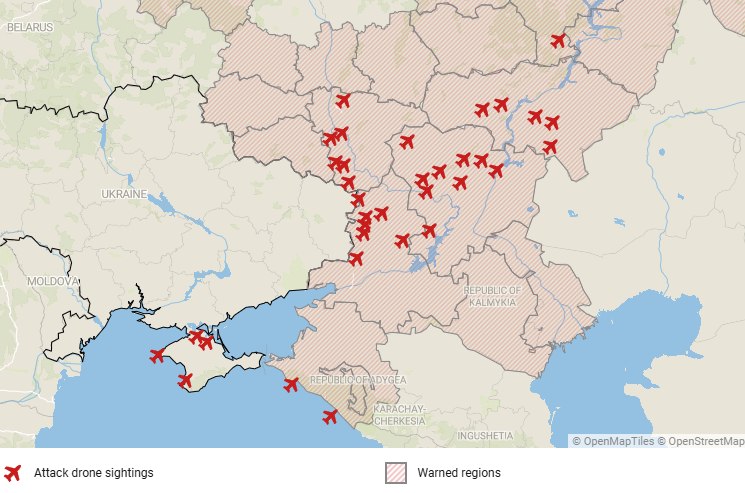
While Russian missile activity intensified, Ukrainian forces conducted notable drone operations across Russian territory. Monitor_the_situation reported a large‑scale raid of Ukrainian attack drones over the Volga River basin, with hundreds heading toward Volgograd on 27 August. Photographic evidence confirmed the presence of Ukrainian drones in the region, indicating a reciprocal escalation in aerial warfare.
Regional Spillover: Moldova and France
Beyond the Ukraine‑Russia front, Russian‑origin threats manifested elsewhere. GeoPWatch recorded a Geran drone entering southeastern Moldovan airspace at 01:37 UTC, marking a rare incursion into a neutral state. In Europe, a vehicle‑ramming attack on a bus shelter in Caen, France, resulted in two deaths and eight injuries. Although the perpetrator, identified as a Russian‑born individual named Ibrahim, may have been motivated by extremist ideology, the incident underscores the broader security implications of Russian‑linked actors in the region.
Operational Assessment
The coordinated missile barrage reflects a strategic effort by Russia to overwhelm Ukrainian air‑defence networks, testing the limits of Patriot and indigenous systems. The successful interception of a ballistic missile over Kyiv demonstrates the continued efficacy of Western‑supplied air‑defence assets, yet the volume and variety of missiles—ranging from Iskander rockets to modified S‑400 ballistic missiles—suggest a diversification of Russian launch platforms designed to complicate Ukrainian response.
Ukrainian authorities responded with a nationwide air‑raid alert, mobilizing civil defence protocols and reinforcing air‑defence positions around major population centres. The alert excluded western regions, indicating a focused threat assessment on the eastern and southern fronts.
Implications for Future Conflict Dynamics
The events of 27 August illustrate a heightened phase of kinetic exchange, with both sides employing advanced missile and drone technologies. Continued Russian missile launches, especially those employing modified S‑400 systems, may strain Ukrainian interceptor stocks and logistics. Conversely, Ukraine’s ability to down high‑value ballistic missiles reinforces the strategic value of sustained Western military aid.
Monitoring agencies, including GeoPWatch and BellumActaNews, will likely update impact assessments as debris recovery and casualty verification progress. The evolving missile composition and the emergence of cross‑border drone incursions warrant close observation for potential escalation beyond the primary theatre.