On the morning of 27 August 2026, Israeli war jets conducted two coordinated waves of airstrikes on Ali al‑Taher Hill near Nabatieh, Lebanon, employing high‑explosive concussion missiles. The operation, confirmed by the monitoring channel monitor_the_situation, marks the most significant kinetic event recorded in the region for the day and underscores the intensifying aerial campaign along Israel’s northern frontier.
Israeli Airstrike on Ali al‑Taher Hill
The strikes, launched at 04:53 UTC, targeted a strategic elevation that Israeli intelligence has linked to Hezbollah logistics and command infrastructure. According to the source, the missiles detonated in two successive waves, creating extensive blast effects across the hilltop. No civilian casualties were reported in the immediate aftermath, and local authorities have not released official damage assessments. Photographic evidence posted by the channel shows smoke plumes and cratered terrain, confirming the use of concussion‑type warheads designed for deep penetration.
Source: monitor_the_situation – https://t.me/monitor_the_situation/28590
Naval Incidents in the Strait of Hormuz and Gulf of Oman
At 02:00 UTC, a commercial tanker transiting the Strait of Hormuz was struck, igniting a fire that was later contained. The incident, reported by GeoPWatch, resulted in no injuries and did not disable the vessel. While the exact weapon system was not identified, the rapid containment suggests the fire was limited to the deck area. The tanker resumed its voyage after emergency services extinguished the blaze.
Source: GeoPWatch – https://t.me/GeoPWatch/38946
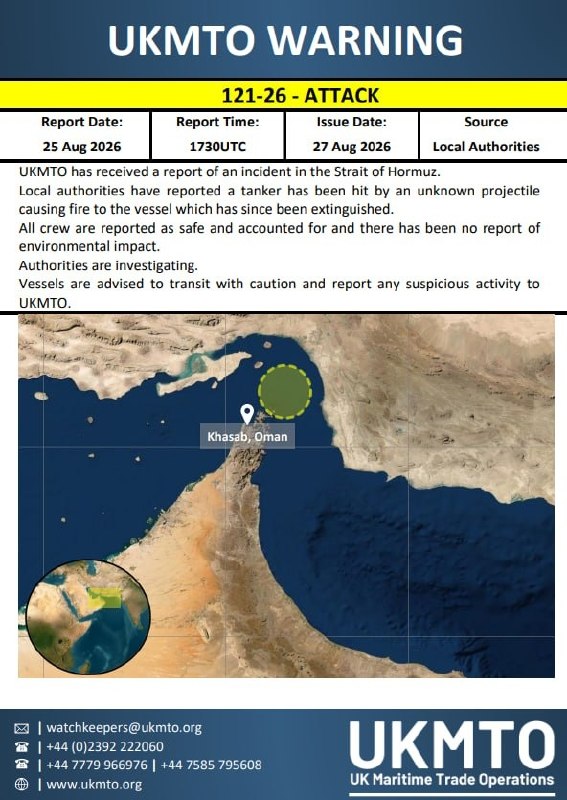
Less than an hour later, at 01:16 UTC, a separate tanker in international waters of the Gulf of Oman was hit by an unidentified projectile, causing a fire that was quickly brought under control. The United Kingdom Maritime Trade Operations (UKMTO) issued an advisory confirming the strike, noting that the crew remained safe and that there was no observable environmental impact. The projectile’s origin remains unknown, and the incident is being investigated as a distinct event from the earlier Hormuz strike.
Source: monitor_the_situation – https://t.me/monitor_the_situation/28586
US Navy Blockade of the Gulf of Oman
In a parallel development, the United States Navy announced the implementation of a maritime blockade in the Gulf of Oman at 00:48 UTC. The operation, detailed by the same monitoring channel, has reduced oil egress from the Gulf to roughly one‑third of normal levels. The blockade aims to deter further attacks on commercial shipping and to enforce maritime security, but it also introduces a new constraint on global oil supply chains. No armed engagements have been reported since the blockade’s initiation, and the US Navy has maintained a visible presence with patrol vessels and aerial surveillance assets.
Source: monitor_the_situation – https://t.me/monitor_the_situation/28582
Continued Israeli Operations in Syria and Lebanon
While the Nabatieh strikes dominated headlines, Israeli forces continued artillery, air raids, and limited incursions across Syria and Lebanon throughout the day. An Al Jazeera report highlighted that these operations persisted despite diplomatic pressure from the United States urging restraint. The report cites the use of both artillery shells and aircraft, indicating a multi‑domain approach to degrading hostile capabilities in the two neighboring states. No new casualty figures were released, but the sustained tempo suggests a broader strategic objective beyond the immediate Nabatieh target.
Source: AlJazeera – https://www.aljazeera.com/news/2026/8/27/israel-continues-attacks-on-syria-lebanon-despite-us-push-for-diplomacy?traffic_source=rss
The convergence of aerial, naval, and economic measures on 27 August illustrates a rapid escalation across multiple domains. Israeli airpower, coupled with the United States’ maritime enforcement, creates a layered pressure environment that threatens to disrupt regional stability and global energy markets. While no fatalities have been reported in the incidents documented today, the potential for collateral damage and broader conflict spillover remains elevated.
Analysts note that the absence of immediate casualties does not diminish the strategic significance of these actions. The use of concussion missiles signals a willingness to employ high‑impact ordnance against fortified positions, while the naval strikes—though limited in physical damage—demonstrate a willingness to target commercial assets, raising concerns about the safety of international shipping lanes. The US blockade, meanwhile, adds an economic lever that could influence state and non‑state actors’ calculations in the coming weeks.