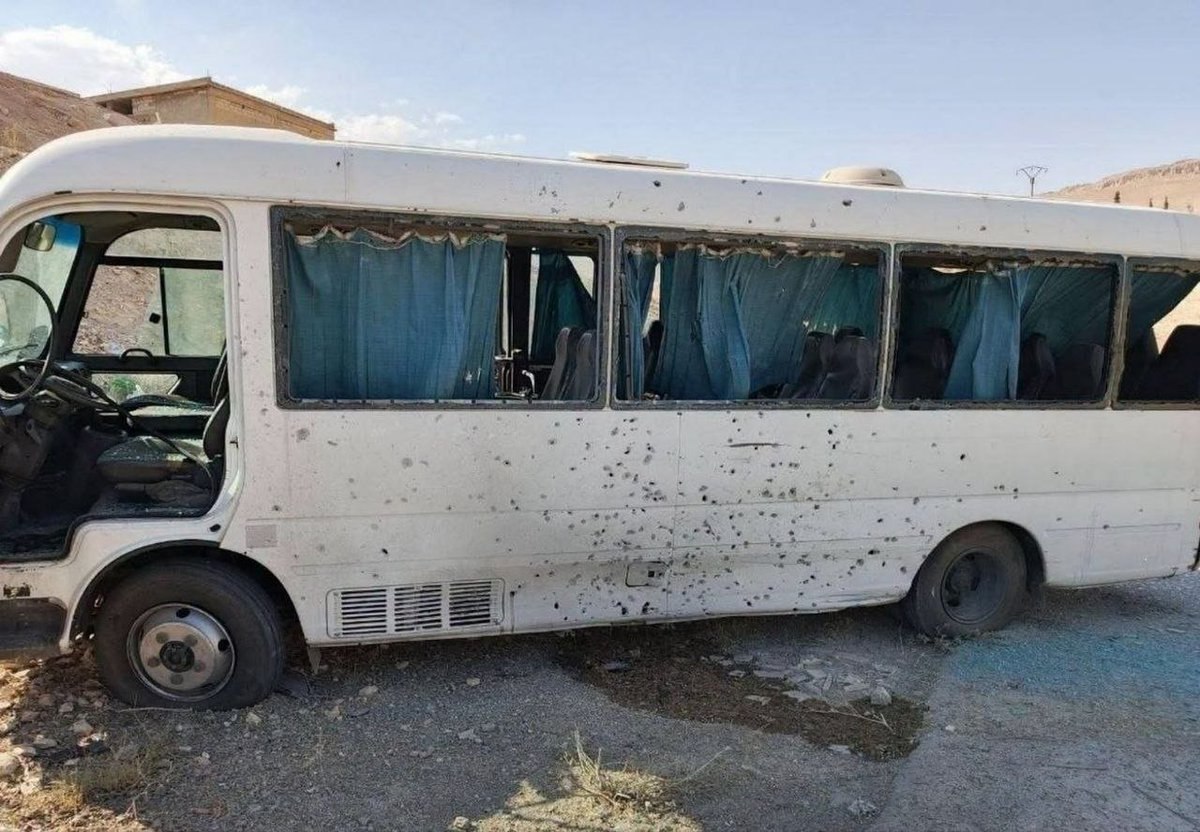
On 22 August 2026, Syria experienced a series of high‑intensity kinetic events that together illustrate a sharp uptick in both insurgent and state‑led violence. The most consequential incident was an improvised explosive device (IED) that detonated on a military bus near Damascus, killing and wounding Syrian soldiers. The attack, reported by monitor_the_situation at 16:27 UTC, underscores the persistent threat posed by armed groups operating in the capital’s hinterland despite recent ceasefire talks.
IED Attack on Syrian Military Bus Near Damascus
At approximately 16:27 local time, an IED exploded aboard a bus transporting Syrian army personnel on a route just outside Damascus. The blast resulted in multiple casualties, though exact numbers have not been disclosed by the Syrian Ministry of Defense. Photographic evidence posted by monitor_the_situation shows the damaged vehicle and emergency responders at the scene. The incident marks the first confirmed use of a large‑scale IED against regular forces in the Damascus area since the 2024 de‑escalation agreement, suggesting a resurgence of insurgent capability.
"The explosion demonstrates that armed elements retain the capacity to strike high‑value military targets even in the capital’s immediate vicinity," a senior Syrian military analyst told the briefing.
The IED’s composition has not been identified, but the method aligns with tactics employed by remnants of the former Islamic State network and other anti‑government factions that have historically used roadside bombs to disrupt troop movements.
Israeli Drone Strikes Across Southern Syria
In parallel with the Damascus‑area IED, Israel conducted a series of unmanned aerial vehicle (UAV) attacks targeting civilian and military assets in southern Syria. At 14:37 UTC, an Israeli drone struck a civilian vehicle in the southwest of the country, injuring several occupants. The incident was reported by Al Jazeera and corroborated by video footage released on the outlet’s Telegram channel (Al Jazeera).
Later, at 11:16 UTC, another Israeli UAV engaged a vehicle near the Al‑Ayn farm area, north of Damascus, resulting in a single injury. This strike was documented by the Jerusalem Post (JPost). A third drone operation occurred at 10:18 UTC near Beit Jinn in the Rif Dimashq governorate, where one person was killed and two others wounded (rnintel).
"These strikes represent a clear escalation in Israel’s cross‑border campaign, targeting both logistical nodes and civilian conveyances," a spokesperson for the Syrian Ministry of Defense said in a statement to regional media.
All three UAV attacks employed precision‑guided munitions, though the specific weapon systems were not disclosed. The targets—civilian vehicles traveling on rural roads—highlight the blurred line between combatants and non‑combatants in the contested border zones.
Israeli Airstrike on Abu al‑Duhur Airbase
At 17:11 UTC, the Israeli Defense Forces (IDF) bombed the Abu al‑Duhur airbase in Idlib Governorate. The strike, reported by the Jerusalem Post, was justified by Israeli officials as a pre‑emptive measure against a rumored Turkish plan to install a radar system and deploy troops at the facility. The airbase, a strategic Syrian airfield used by both Syrian government forces and Russian advisors, suffered damage to its runway and several ancillary structures.
Although casualty figures were not released, satellite imagery analyzed by independent observers shows craters consistent with medium‑range air‑to‑ground missiles. The operation raises the risk of a broader confrontation involving Turkey, which has historically maintained a military presence in Idlib under the Astana peace framework.
"Israel’s targeting of Abu al‑Duhur signals a willingness to intervene directly in Syrian‑Turkish security calculations," noted a senior analyst at the Middle East Institute.
Pattern of Kinetic Activity and Regional Implications
The clustering of these events within a single day reflects a multi‑front kinetic environment in Syria. The IED attack demonstrates the resilience of insurgent networks capable of penetrating security perimeters around the capital. Simultaneously, Israel’s UAV and airstrike campaign illustrates an expanding operational envelope that now includes civilian transport routes and strategic airfields deep within Syrian territory.
These developments occur against a backdrop of stalled diplomatic initiatives aimed at stabilizing the Syrian conflict. The United Nations has called for an immediate ceasefire, but on‑the‑ground realities suggest that both state and non‑state actors continue to prioritize tactical gains over political settlements.
International observers have expressed concern that the escalation of kinetic actions could trigger retaliatory strikes, potentially drawing neighboring actors such as Turkey, Iran, and Russia into a wider confrontation. The Syrian government has condemned the Israeli strikes as violations of sovereignty, while Israel maintains that its operations are defensive, aimed at preventing the transfer of advanced weaponry to hostile groups.
For humanitarian agencies operating in the region, the surge in kinetic incidents complicates access and raises the risk of civilian casualties. The United Nations Office for the Coordination of Humanitarian Affairs (OCHA) has issued an advisory urging NGOs to reassess movement plans in the affected zones.