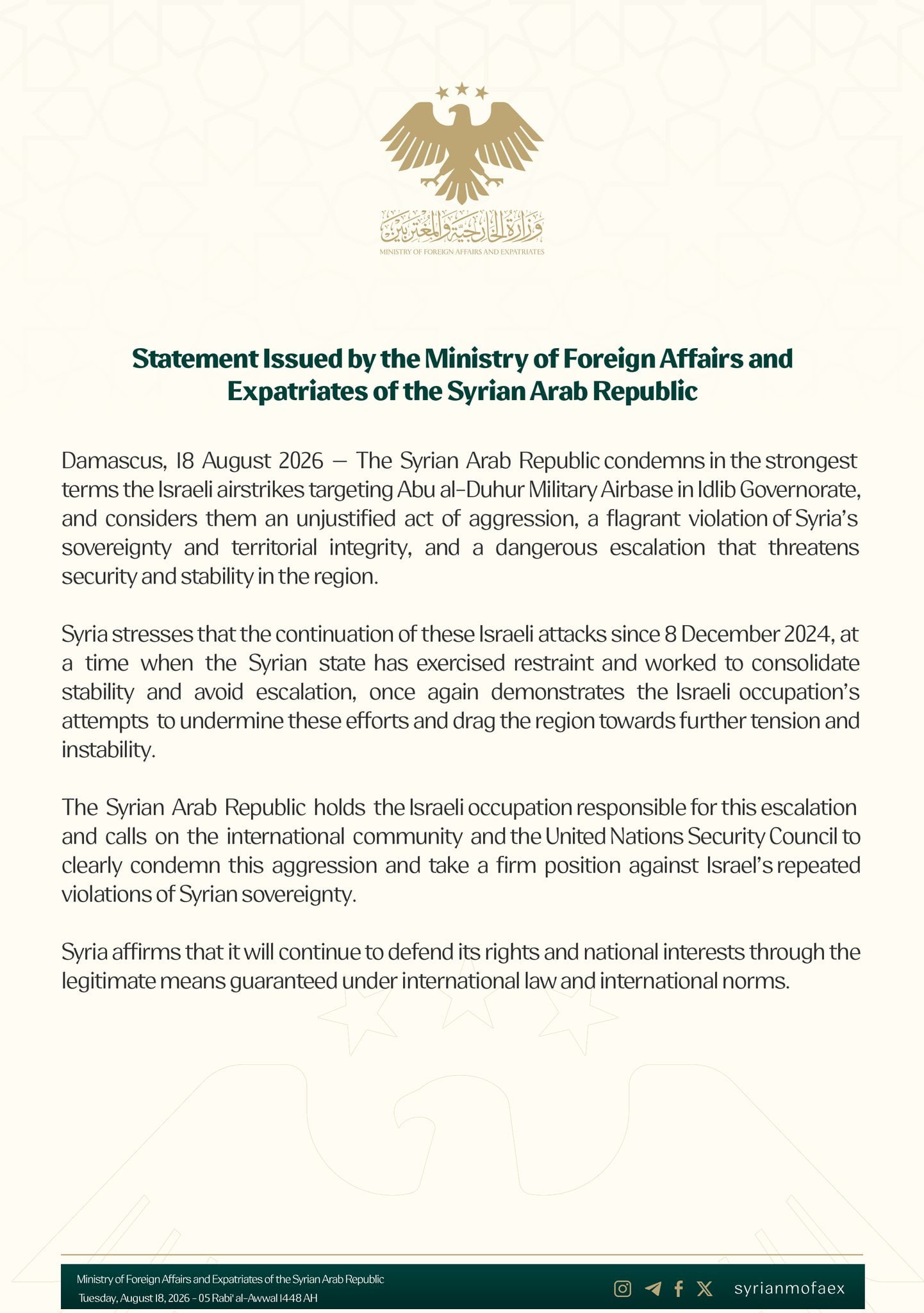
On 18 August 2026, Syria’s foreign minister announced the discovery of nuclear material in Deir ez‑Zor, confirming that the substance will remain under Syrian custody pending guarantees from the International Atomic Energy Agency (IAEA). The statement, reported by JPost, emphasized that the material will be held "subject to IAEA guarantees."
"The material will stay under Syrian control, subject to IAEA guarantees," the foreign minister said.No weapons were deployed in the discovery, and there were no reported casualties. The event marks the first public acknowledgment of nuclear‑related material on Syrian soil since the civil war began, raising concerns about proliferation risks and the need for international monitoring.
Israeli Strike Near Damascus International Airport
At 17:45 local time, Israeli forces conducted an airstrike near Damascus International Airport targeting a site identified as linked to Hezbollah. The operation, documented by the open‑source intelligence channel OSINTdefender, did not result in reported casualties or damage to civilian infrastructure. The strike aligns with a pattern of Israeli pre‑emptive actions against Hezbollah assets within Syrian territory. No conventional weapons were listed in the source, and the engagement was described solely as an airstrike.
Israeli Airstrike on Turkish Military Equipment in Idlib
Earlier, at 13:08, Israeli aircraft struck an airfield in Idlib, destroying Turkish military equipment. The incident was reported by GeoPWatch and prompted formal condemnations from Turkey, Syria, and the United States. U.S. Special Envoy for Syria Tom Barrack labeled the attack an "unnecessary escalation" in a statement quoted by the channel.
"It is an unnecessary escalation," Tom Barrack said.No casualties were reported, and the strike involved no ground forces. The event underscores the complex overlay of Turkish, Syrian, and Israeli interests in northern Syria.
Bombing of Abu al‑Duhur Airbase
At 12:30, the Israeli Air Force bombed Abu al‑Duhur airbase in Idlib Governorate, marking the first Israeli strike on Syrian territory since July 2025. The report from CIG_telegram noted that Turkey was reportedly preparing to relocate aircraft to the base, a factor that may have influenced the target selection. The strike caused structural damage but no reported injuries. Photographic evidence accompanying the telegram was referenced as media coverage of the event.
Eight Airstrikes on Idlib Airbase
At 10:11, eight coordinated airstrikes hit an Idlib airbase, according to a report by AlJazeera. Syrian state television quoted a military source confirming the attacks, which resulted in damage to infrastructure but no casualties. The strikes were carried out by Israeli forces using aircraft, as indicated in the source. The repeated targeting of Idlib air facilities reflects a sustained Israeli campaign to limit the operational capacity of Syrian and allied forces in the region.
The series of kinetic events on 18 August demonstrates a multi‑layered escalation pattern: Israel continues to conduct precision strikes against perceived Hezbollah and Turkish assets, while the Syrian government grapples with the domestic implications of a newly disclosed nuclear material cache. The involvement of the IAEA introduces an additional diplomatic dimension, as international safeguards will likely be invoked to verify the material’s nature and origin. Monitoring agencies will need to track both the kinetic and nuclear dimensions of the conflict to assess potential spill‑over effects on neighboring states and non‑state actors.