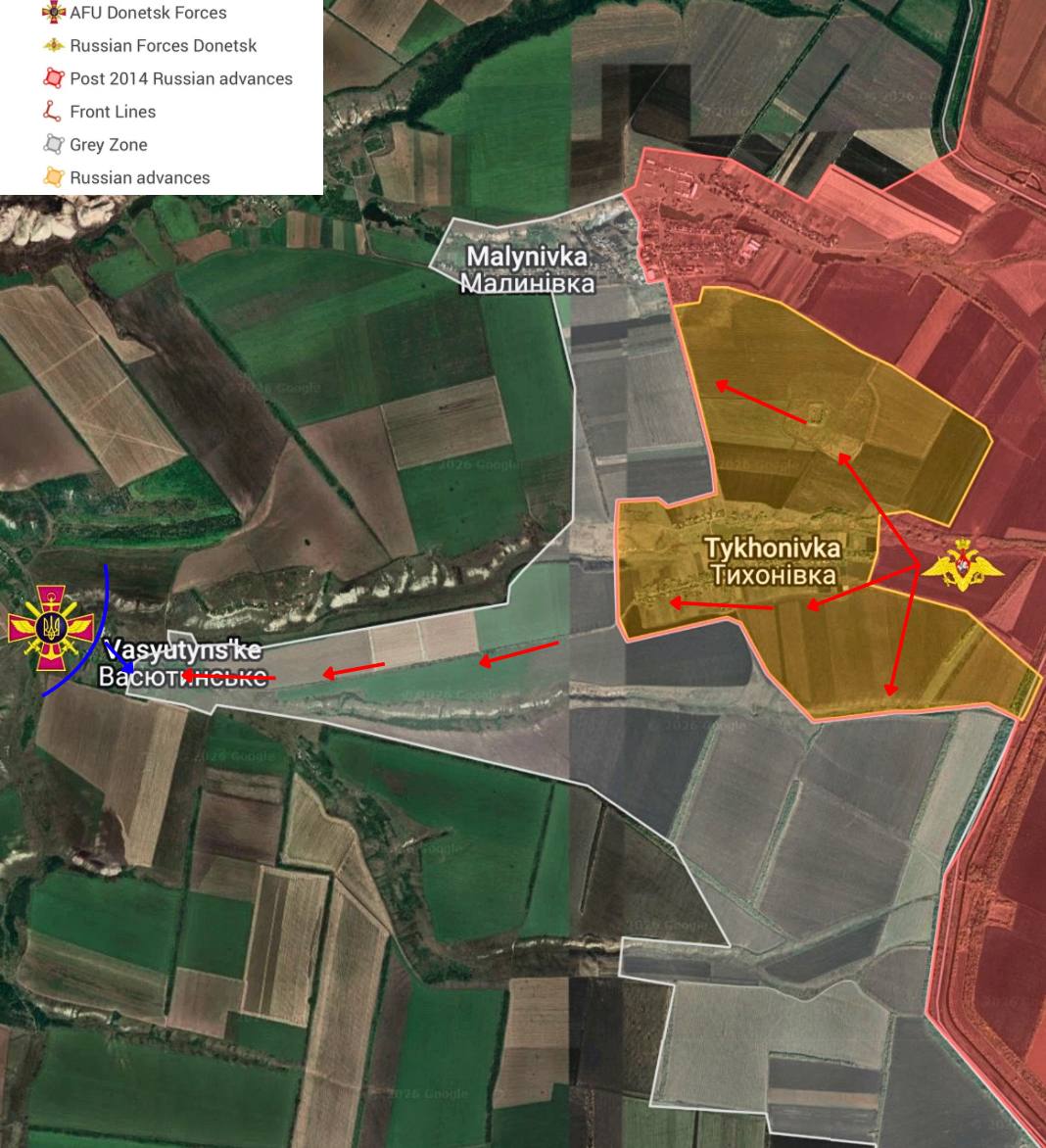
On August 4, 2026, Russian forces captured the village of Tykhonivka in Donetsk Oblast, Ukraine, and advanced to within 10.88 km of residential areas in Kramatorsk, signaling a significant ground offensive that coincides with a broader surge in drone activity across the region.
Russian Ground Advance in Donetsk Oblast
According to GeoPWatch, Russian troops seized Tykhonivka at 04:05:52 UTC and subsequently entered the neighboring settlement of Vasyutynske. The advance places Russian units less than 11 kilometers from the nearest residential buildings in the strategic city of Kramatorsk, a key logistics hub for Ukrainian forces. No casualties were reported in the initial reports, and the operation appears to have been conducted without the use of heavy artillery, relying instead on infantry and mechanized units.
"The Russian military has captured the village of Tykhonivka along with Russian personnel entering the eastern/central part of Vasyutynske. Russian forces are now only 10.88 km from the nearest residential buildings in Kramatorsk," GeoPWatch reported.
The proximity to Kramatorsk raises concerns about potential urban combat and civilian displacement. Ukrainian authorities have not yet disclosed a formal response, but the capture underscores a renewed emphasis on territorial gains in the Donetsk region.
Ukrainian Air Defense Intercepts Russian Geran Drones
In a separate development, Ukrainian F-16 fighters engaged and destroyed multiple Russian Geran drones using the 20 mm M61A1 Vulcan cannon. The interception, recorded at 04:44:24 UTC, was posted by the intelligence channel intelslava and includes video evidence of the engagement.
"🇺🇦🇷🇺⚡️ — Intercepting 'Geran' drones with the 20mm M61A1 Vulcan cannon of a Ukrainian Air Force F-16 fighter," intelslava noted.
The Geran drone, a loitering munition employed by Russian forces, has been a persistent threat to Ukrainian infrastructure. The successful use of the M61A1 Vulcan cannon demonstrates the adaptability of Ukrainian air defenses and the increasing role of Western-supplied aircraft in counter‑UAV operations.
Drone Attack on Al Doha Base, Kuwait
GeoPWatch also reported a drone attack on the Al Doha military base in Kuwait at 03:23:56 UTC. While the origin of the drone remains unconfirmed, the incident is attributed to Iranian involvement, with the United States also cited as a stakeholder in the base’s operations. Video footage accompanying the report shows a small unmanned aerial vehicle approaching the perimeter before detonating.
"Reports of a drone attack earlier this morning at Al Doha base in Kuwait," GeoPWatch stated.
No casualties were confirmed, and the base’s defensive response has not been detailed. The attack highlights the expanding geographic scope of drone warfare, extending beyond traditional conflict zones into the Gulf region.
Explosion in Sana'a, Yemen
At 03:33:51 UTC, an explosion was reported in Sana'a, Yemen, by GeoPWatch. The brief notice provides no further details regarding the cause, casualties, or responsible parties.
"An explosion was reported in Sana'a, Yemen," GeoPWatch reported.
Given the ongoing instability in Yemen, the incident may be linked to the broader pattern of urban violence, but verification remains pending.
Analysis of the Coordinated Surge
The events of August 4 illustrate a coordinated escalation across multiple theaters. In Ukraine, Russian ground forces are exploiting a window of opportunity to press forward near Kramatorsk, while Ukrainian air defenses are simultaneously adapting to counter Russian UAV threats. In the Middle East, the use of drones against a U.S.-aligned base in Kuwait underscores the growing reliance on unmanned systems for strategic signaling and limited kinetic effects.
Key observations include:
- Russian ground operations are advancing with limited reported casualties, suggesting a focus on rapid territorial gains rather than protracted engagements.
- Ukrainian forces are effectively integrating Western aircraft and armaments to neutralize Russian drone threats, potentially altering the aerial balance.
- The spread of drone attacks to Gulf installations indicates a diffusion of UAV capabilities among state and non‑state actors, raising security concerns for allied forces in the region.