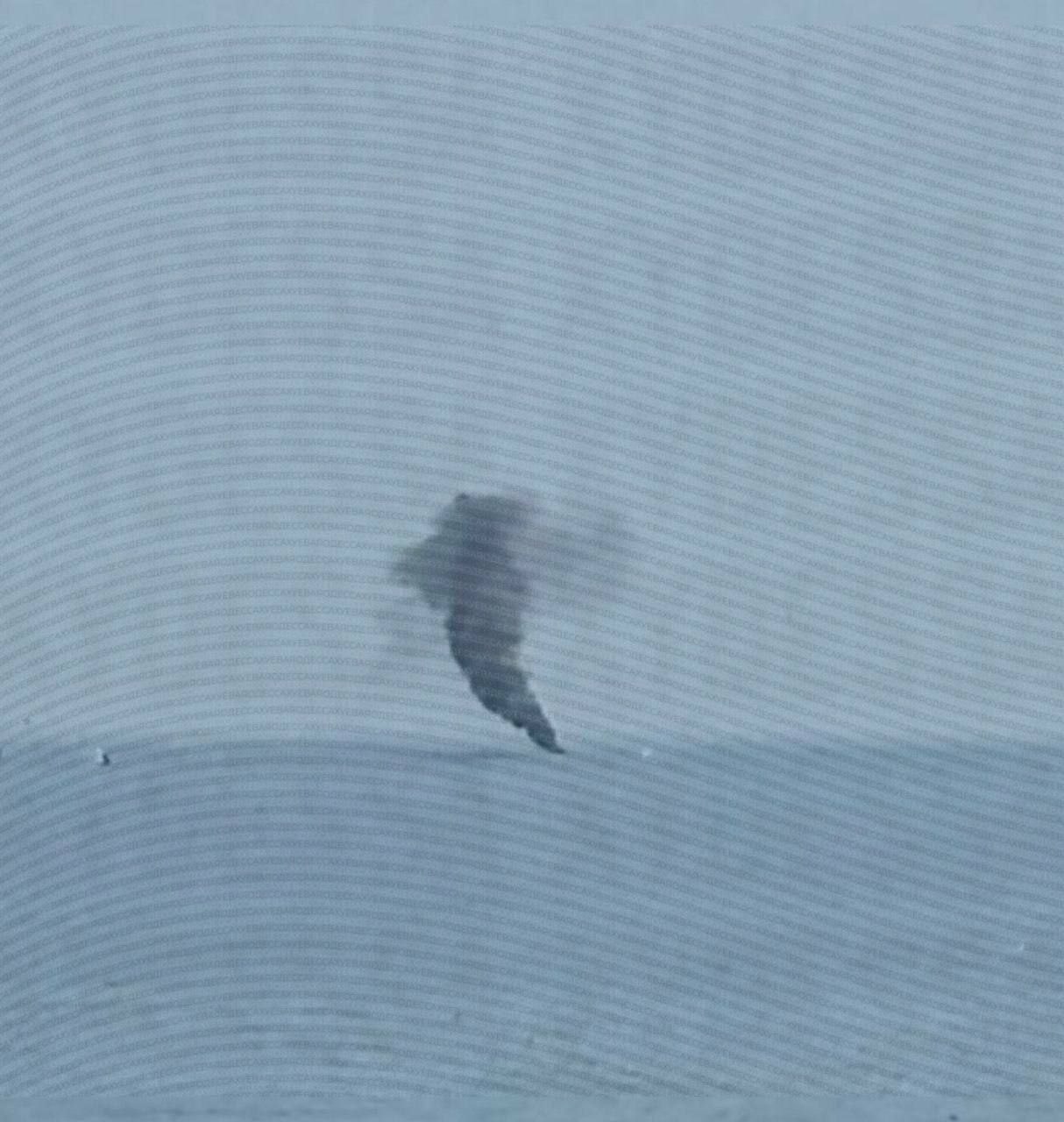
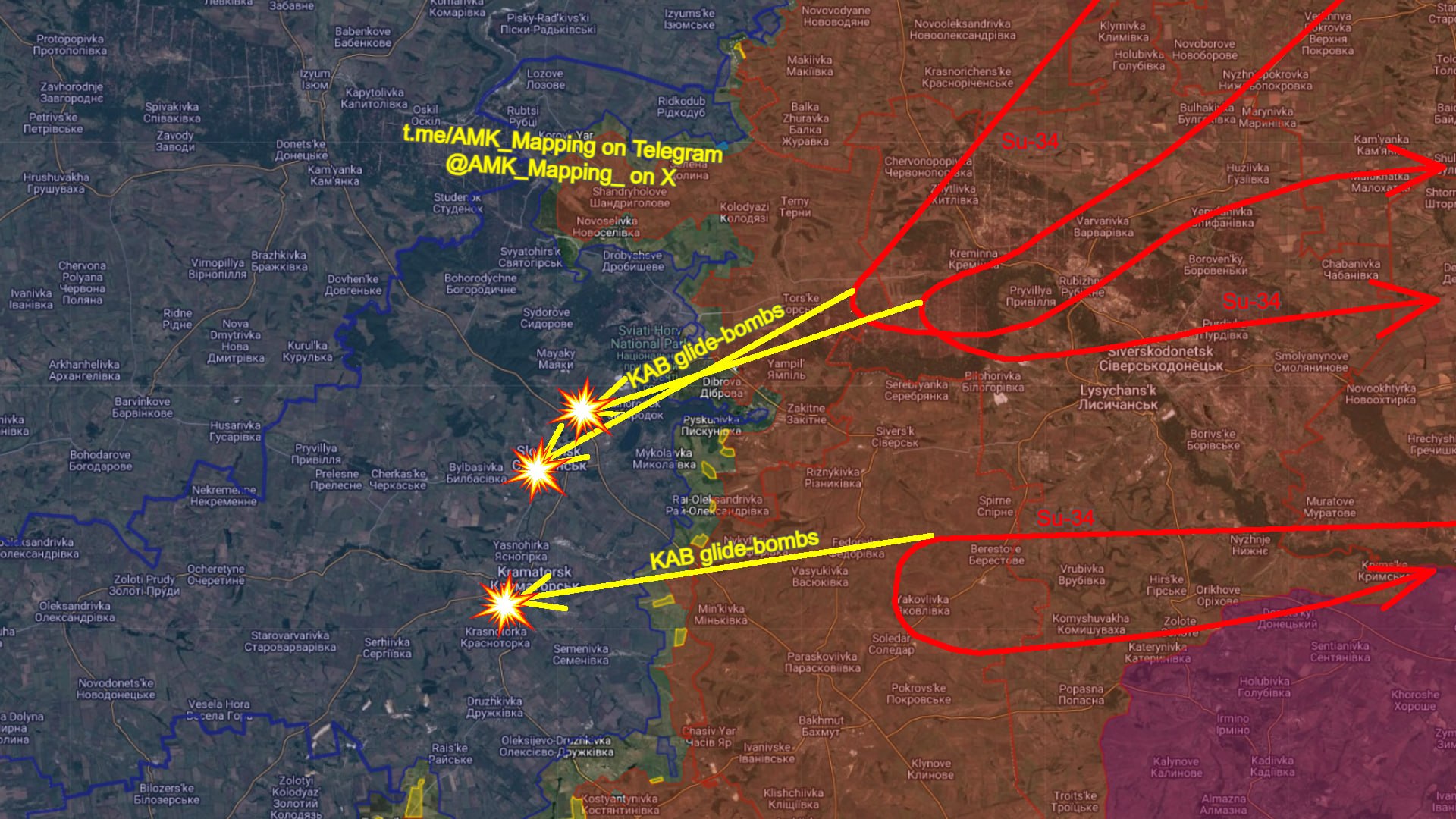
On 4 August 2026, the Ukrainian theatre witnessed a series of high‑intensity kinetic events that together illustrate a marked escalation in both the scale and proximity of combat operations. The most consequential of these was a coordinated Russian airstrike involving three Su‑34 fighter‑bombers that targeted the cities of Slovyansk and Kramatorsk in Donetsk Oblast, employing long‑range glide bombs from unusually short launch distances.
Russian Su‑34 Airstrike on Slovyansk and Kramatorsk
According to a report posted by CIG_telegram at 07:13:56, three Russian Su‑34 aircraft launched a bombing raid from launch points 14 km, 19 km and 20 km from the front line, near the villages of Torske, Rozdolivka and Kreminna. The aircraft delivered KAB‑1500 and KAB‑3000 glide bombs on targets within Slovyansk and Kramatorsk. The proximity of the launch points—significantly closer than typical deep‑strike missions—suggests Russian confidence that Ukrainian Patriot air‑defence systems are either degraded or unable to engage effectively at such ranges.
"Around 25 minutes ago, three Russian Su‑34s carried out another unusual bombing raid, this time on Slovyansk and Kramatorsk, Donetsk Oblast. The aircraft launched from 14 km, 19 km and 20 km respectively, near Torske, Rozdolivka and Kreminna." – CIG_telegram
The strike caused structural damage to civilian infrastructure; however, no casualty figures were released in the immediate aftermath. The use of high‑explosive glide bombs underscores a tactical shift toward precision‑guided munitions capable of inflicting significant damage while minimizing exposure to air‑defence systems.
Missile Strike on Odesa
At 12:06:59, the open‑source intelligence channel intelslava documented a missile impact in the port city of Odesa. The weapon type was identified as a missile, though the specific model was not disclosed. No injuries or fatalities were reported, and damage assessments remain pending. The strike adds to a pattern of long‑range attacks on Ukraine’s southern maritime hubs, which are critical for grain exports and naval logistics.
Naval Engagements in the Black Sea
Multiple naval incidents were reported on 4 August. The Russian Ministry of Defence, cited by intelslava at 15:13:37, claimed to have struck four Ukrainian dry‑cargo vessels and two unmanned boats at the port of Chornomorsk, targeting a container terminal and a drone warehouse. No casualty data were provided, but the operation indicates a focus on disrupting Ukraine’s maritime supply chain.
Earlier, at 07:34:01, CIG_telegram reported a Russian Geran‑4 jet‑drone attack on six cargo ships in the western Black Sea and at Mykolaiv Port. The Geran‑4 system combines a loitering munition with a jet‑drone platform, enabling rapid engagement of surface targets. Again, no casualties were reported, but the attacks demonstrate Russia’s expanding use of hybrid UAV‑missile systems in maritime environments.
Ukrainian Counter‑Strikes Across the Front
Ukraine conducted several offensive operations on the same day. At 17:59:53, the channel monitor_the_situation posted video evidence of a Ukrainian MiG‑29 delivering a precision bomb on a dam west of Shebekino in Russia’s Belgorod Oblast. The strike, part of a broader cross‑border campaign, reportedly caused structural damage to the dam but did not result in reported casualties.
In Bryansk Oblast, at 17:03:32, Ukrainian forces struck a Russian UAV storage and launch base near Navlya, damaging at least three protected shelters for drone warheads and fuel, as reported by monitor_the_situation. The operation highlights Ukraine’s focus on degrading Russian UAV capabilities.
Additionally, at 12:40:43, GeoPWatch documented an explosion at the Shamsabad Industrial Zone in Iran, unrelated to the Ukrainian front, and therefore omitted from the kinetic analysis of Ukraine.
Drone Activity Over Occupied Territories
Drone operations continued over contested areas. At 17:39:33, a Ukrainian fixed‑wing strike drone hit a Russian S‑400 air‑defence launcher in Kerch, Crimea, as reported by monitor_the_situation. The S‑400 system protects the strategic Kerch Bridge, and its damage could affect Russian anti‑air capabilities in the region.
In Kherson, a civilian market was targeted by a drone that followed a man before detonating, according to AlJazeera at 15:11:51. The incident resulted in no reported injuries but underscores the persistent threat of low‑cost UAV attacks on civilian populations.
Russian FPV drones also continued to target Ukrainian personnel. At 08:37:57, GeoPWatch released footage of a Russian FPV drone chasing and striking a Ukrainian civilian in Kherson, reinforcing the pattern of drone‑borne kinetic attacks on non‑combatants.
Strategic Implications
The concentration of high‑precision airstrikes, missile impacts, and naval engagements on 4 August reflects a multi‑domain escalation. Russian forces are employing glide‑bomb technology from reduced launch distances, suggesting confidence in air‑defence suppression. Simultaneously, Ukraine is extending its strike envelope across the Russian border, targeting critical infrastructure such as dams and UAV bases, indicating a willingness to conduct retaliatory deep‑strike operations.
Maritime attacks on cargo vessels and drone‑laden boats aim to disrupt Ukraine’s export capacity and logistical support, while Ukrainian drone strikes on Russian air‑defence assets in Crimea seek to erode the protective umbrella over key supply routes. The cumulative effect is a heightened risk of collateral damage and civilian exposure, as evidenced by drone incidents in Kherson.
Overall, the events of 4 August demonstrate a pronounced intensification of kinetic activity across the Ukrainian front, with both sides leveraging advanced munitions and expanding the geographic scope of their operations.