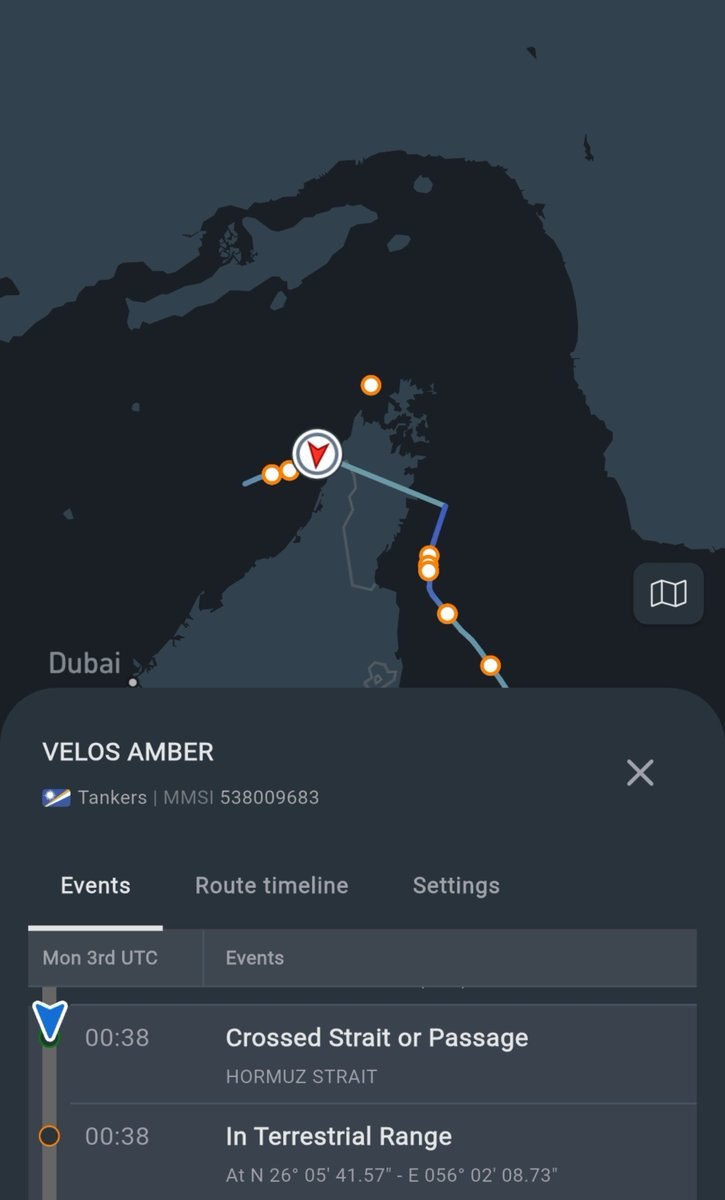
On August 3, 2026, three separate incidents underscored a rapid escalation of hostilities across the Middle East, involving state and non‑state actors and raising the risk of broader confrontation. The most consequential event occurred in the strategic Strait of Hormuz, where an Iranian Revolutionary Guard Corps (IRGC) Navy projectile struck the oil tanker VELOS AMBER while it was under United States naval escort. Within hours, a mortar was launched at a residential tower in Tel Aviv’s affluent Tzameret Park, and later that night a United States Central Command (CENTCOM) airstrike dropped a 900 kg bomb on a civilian house in Iran’s Iranshahr County. Each incident reflects distinct operational patterns, yet together they illustrate a widening security dilemma in the region.
Iranian Naval Aggression in the Strait of Hormuz
The Strait of Hormuz, a narrow waterway linking the Persian Gulf with the Gulf of Oman, remains a chokepoint for global oil shipments. At 02:08 UTC, the oil tanker VELOS AMBER was targeted by at least one projectile, which monitoring channel monitor_the_situation attributes to the IRGC Navy. The vessel was transiting under the protection of a United States Navy escort, a routine practice intended to deter Iranian interference. Despite the projectile impact, the tanker completed its passage without reported damage to cargo or crew, and no casualties were confirmed.
The oil tanker VELOS AMBER successfully transited the Strait of Hormuz under US escort despite being targeted by at least one projectile, likely from IRGC Navy.
Source: monitor_the_situation (https://t.me/monitor_the_situation/26823). The incident marks a notable escalation because it directly challenges the de‑facto security arrangement that has kept commercial traffic flowing despite longstanding tensions. The use of a projectile—presumably a small‑caliber naval gun or anti‑ship missile—demonstrates the IRGC’s willingness to test the limits of U.S. naval deterrence. Analysts note that the IRGC’s naval doctrine emphasizes asymmetric tactics, including swarm boats and low‑cost missiles, to impose costs on adversary vessels. While the immediate physical impact was limited, the symbolic breach of the escort protocol could prompt a recalibration of U.S. rules of engagement and increase the probability of a kinetic response in future transits.
Israeli Mortar Attack in Tel Aviv
At 05:34 UTC, a mortar shell landed near a high‑rise tower in Tzameret Park, an upscale residential complex in Tel Aviv. The attack was reported by Israeli channel i24 and relayed through the Telegram channel idkunim_il. No fatalities or injuries were reported, and the shell caused only minor structural damage. The incident is part of a broader pattern of night‑time mortar attacks that have been sporadically reported in Israeli urban centers over the past weeks.
The mortar war continued also tonight: a mortar was thrown towards one of the towers in Tzameret Park in Tel Aviv.
Source: idkunim_il (https://t.me/idkunim_il/62169). While the responsible organization was not identified in the source, the use of mortars—a low‑tech, indirect‑fire weapon—suggests involvement of non‑state actors or proxy militias operating from Gaza or the West Bank. Mortar attacks in densely populated civilian areas raise concerns about escalation dynamics, as Israeli security forces typically respond with targeted raids, arrests, or airstrikes against perceived launch sites. The lack of claimed responsibility complicates attribution, but the incident underscores the persistent vulnerability of Israeli urban centers to low‑intensity fire.
U.S. Airstrike on Civilian Structure in Southern Iran
At 00:41 UTC, United States Central Command (CENTCOM) conducted an airstrike in Iranshahr County, Sistan and Baluchestan Province, deploying a 900 kg bomb on a civilian house. The strike was reported by the Jerusalem Post, citing a U.S. official who described the operation as “about twice the size of the previous night,” and “wide, extensive, and impactful.” No immediate casualty figures were released, but the targeting of a residential structure raises serious humanitarian concerns under international law.
US CENTCOM appears to have dropped 900kg bomb on civilian house in southern Iran - report
Source: JPost (https://www.jpost.com/middle-east/iran-news/article-904383). The stated rationale for the strike was not disclosed, but CENTCOM’s public statements have linked recent Iranian proxy activities in Iraq and Syria to a broader campaign of retaliation. The use of a 900 kg bomb—a large, high‑explosive ordnance typically delivered by strategic bombers or heavy fighter aircraft—indicates a significant escalation in the scale of U.S. kinetic operations against Iranian targets. The incident may contravene the principle of proportionality if civilian harm outweighs the anticipated military advantage, and it could provoke diplomatic protests from Tehran and its allies.
Analytical Assessment
The three events, while distinct in geography and actors, share common threads that illuminate the evolving risk environment. First, the IRGC’s willingness to engage a U.S.‑escorted tanker signals a shift from indirect pressure (e.g., mining, harassment) to direct kinetic action against high‑value maritime assets. Second, the mortar attack in Tel Aviv reflects the persistence of low‑tech, asymmetrical tactics that can inflict psychological trauma and compel disproportionate security responses. Third, the U.S. airstrike demonstrates an escalation in the magnitude of American force projection, moving from precision strikes on specific facilities to larger‑scale bombings that risk civilian casualties.
Collectively, these incidents suggest a feedback loop: Iranian aggression may invite U.S. retaliation, which in turn could embolden non‑state actors to exploit perceived vulnerabilities. The absence of immediate casualty reports does not diminish the strategic significance; each event carries the potential to trigger escalation ladders, especially if either side interprets the actions as crossing red lines. Diplomatic channels remain essential to prevent miscalculation, but the current trajectory points toward a heightened state of alert across naval, aerial, and urban domains.