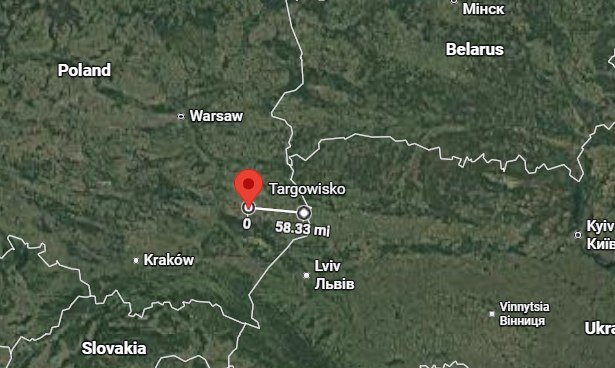
At 05:51 UTC on 30 July 2026, a Russian‑launched cruise missile entered Polish airspace and struck the Lublin region, marking the most severe kinetic event recorded in Poland today. Local surveillance footage captured the missile’s overflight and impact, confirming a direct violation of NATO airspace and the first confirmed Russian missile strike on Polish territory since the conflict began in 2022. No injuries or fatalities were reported, but the impact created a sizable crater and damaged nearby infrastructure.
Impact in Lublin Voivodeship
The missile, identified as a cruise‑type weapon, impacted a rural area of Lublin Voivodeship, approximately 90 kilometres east of the Ukrainian border. Polish emergency services arrived within minutes, securing the site and conducting a preliminary assessment of structural damage. While the exact explosive yield remains classified, the crater measured roughly 4 metres in diameter and 2 metres deep, indicating a high‑energy warhead.
"Local surveillance footage confirms a cruise missile overflight and impact in the Lublin region, adding to a series of Russian missile incidents in Poland," – monitor_the_situation, https://t.me/monitor_the_situation/26475
Key details: Weapon – cruise missile; Origin – Russia; Casualties – none reported; Damage – crater, minor property damage; Source – monitor_the_situation (video evidence).
Crater Discovered in Targowisko
At 04:21 UTC, authorities in the village of Targowisko, located in the same voivodeship, reported the discovery of a large crater in a cultivated field. The crater, described as “significant” by local officials, was linked to a Russian cruise missile that entered Polish airspace earlier in the morning. Polish police and the Ministry of Defence secured the perimeter, and a forensic team was dispatched to collect missile fragments for analysis.
"A large crater was found in a field in Targowisko, Poland, following reports of a Russian cruise missile entering Polish airspace. Polish authorities have secured the area," – monitor_the_situation, https://t.me/monitor_the_situation/26462
The site showed no signs of civilian casualties, and nearby residents were evacuated as a precaution. The incident underscores the expanding reach of Russian long‑range missiles, which can now strike targets well beyond the immediate front lines.
Strike on Otrocz Village
At 03:32 UTC, a separate incident unfolded in the village of Otrocz, also within Lublin Voivodeship. Video circulating on the CIG_telegram channel captured smoke rising from the village shortly after a Russian Kh‑101 cruise missile reportedly entered Polish airspace and impacted the area. The Kh‑101 is a stealth, long‑range cruise missile capable of delivering a conventional or nuclear payload, though the payload used in this case appears to have been conventional.
"Footage circulating shows smoke rising over the village of Otrocz in eastern Poland, about 90 kilometres from the Ukrainian border, after a Russian Kh‑101 cruise missile reportedly entered Polish airspace and impacted," – CIG_telegram, https://t.me/CIG_telegram/81325
Local emergency responders confirmed that the explosion caused damage to a residential structure and a nearby barn, but no injuries were reported. The incident prompted immediate activation of Poland’s Integrated Air Defence System (IADS) and a rapid response from NATO’s Baltic Air Policing contingent.
Air‑Raid Sirens Sound in Lublin City
At 03:28 UTC, air‑raid sirens began sounding across the city of Lublin, alerting residents to the approaching threat of Russian cruise missiles near the Polish‑Ukrainian border. The siren activation was part of Poland’s standard civil defence protocol for aerial threats and was broadcast on national radio and television channels.
"Air raid sirens are sounding in the Polish city of Lublin as Russian cruise missiles near the Polish‑Ukrainian border," – BellumActaNews, https://t.me/BellumActaNews/175967
Authorities urged citizens to seek shelter in reinforced rooms or designated public shelters. No missile impact was recorded within the city limits, and the sirens ceased after approximately ten minutes once the missiles passed the border region.
Operational and Strategic Implications
The coordinated timing of the four incidents suggests a deliberate escalation by Russian forces, aimed at testing NATO’s rapid response capabilities and demonstrating the reach of its long‑range missile arsenal. All four events occurred within a two‑hour window, indicating a possible salvo or a series of independent launches timed to overwhelm detection and interception assets.
Polish defence officials have confirmed that the national air‑defence network, including Patriot and SAMP/T batteries, was fully operational during the attacks. However, the lack of an intercepted missile in the Lublin region points to potential gaps in early‑warning radar coverage or the high speed and low radar cross‑section of the Kh‑101 platform.
NATO’s Supreme Allied Commander Europe (SACEUR) issued a statement reaffirming the alliance’s commitment to collective defence under Article 5, while urging member states to enhance intelligence sharing and surface‑to‑air missile coverage along the eastern flank.
In the immediate aftermath, Poland’s Ministry of Interior activated the State Crisis Management Centre, coordinating with the European Union’s Rapid Reaction Mechanism to assess humanitarian needs, although no displacement or medical emergencies have been reported to date.
These incidents mark the first confirmed Russian missile strikes on sovereign NATO territory since the alliance’s 2022 strategic realignment, raising concerns about the potential for further incursions and the necessity of bolstering forward‑deployed air‑defence assets.