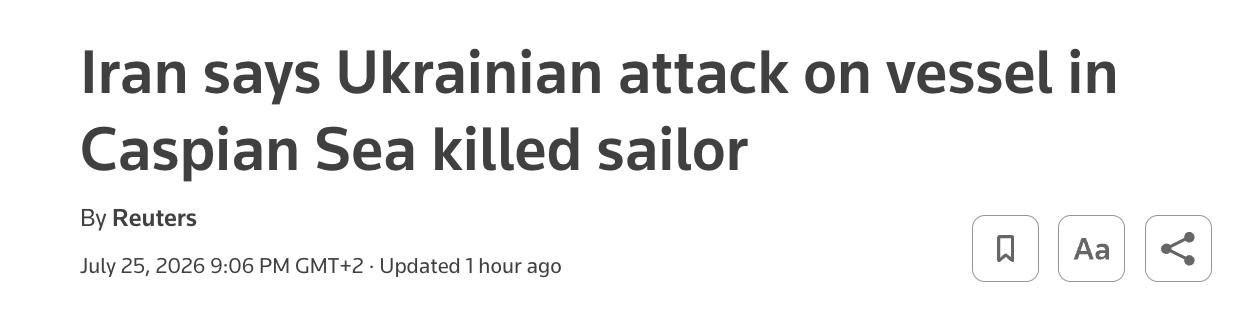
On 26 July 2026, a Ukrainian strike on an Iranian commercial vessel in the Caspian Sea resulted in the death of one sailor and injuries to another, marking the most severe maritime incident recorded today and raising the specter of a broader confrontation involving Iran, Ukraine, and Russia. The incident, reported by the intelligence channel intelslava, was immediately framed by Tehran as an "act of aggression" and a direct challenge to Iran's national security. Simultaneously, Ukrainian President Volodymyr Zelenskyy announced that Ukrainian forces had also hit a Russian military ship and associated cargo vessels in the same body of water, suggesting a coordinated effort to disrupt Russian logistical routes.
Caspian Sea Confrontation: Iran, Ukraine, and Russia
The Caspian Sea, bordered by Iran, Azerbaijan, Turkmenistan, Kazakhstan, and Russia, has traditionally been a zone of commercial shipping and limited naval activity. On the morning of 26 July, an Iranian-registered cargo vessel was struck by a projectile identified by Iranian authorities as originating from Ukrainian forces. The attack killed a crew member and wounded a second, prompting the Iranian Foreign Ministry to issue a formal protest.
"This is an act of aggression that threatens the safety of all vessels operating in the Caspian Sea," the ministry said in a statement released to intelslava.
Iran's response emphasized its commitment to protect its maritime interests, warning that any further aggression would be met with decisive action. The Iranian statement did not specify the weapon system used, noting only that the vessel sustained a direct hit. Ukrainian officials, speaking to the same channel, claimed that the strike was part of a broader operation targeting Russian naval assets, including a military support ship and two cargo carriers linked to Moscow's supply chain.
While no independent verification of the Ukrainian claim has been made, the dual narratives illustrate the complex overlay of regional rivalries. The incident also raises questions about the legal status of the Caspian Sea, which lacks a unified maritime regime and is subject to overlapping claims by the littoral states. The potential for escalation is heightened by the involvement of three major powers, each with distinct strategic objectives: Iran seeks to assert sovereignty, Ukraine aims to pressure Russia by extending its conflict into adjacent waters, and Russia is likely to view any attack on its vessels as a provocation warranting retaliation.
U.S. Military Boarding of a Blockade‑Violating Tanker
In a separate maritime episode earlier that day, the United States Navy reported the boarding and disabling of a tanker that it alleged had breached Iran's self‑imposed blockade of the Persian Gulf. The incident, covered by Al Jazeera, occurred at an undisclosed location but was described as part of a broader effort to enforce the blockade that Iran has maintained since the escalation of tensions with the United States in 2025.
According to footage released by the U.S. military, a boarding team approached the vessel, secured the deck, and disabled its propulsion system without the use of lethal force. No casualties were reported on either side, and the tanker’s cargo—identified as crude oil—was later transferred to a U.S.‑controlled storage facility. The U.S. Department of Defense framed the operation as a lawful response to a vessel that had ignored multiple warnings and attempted to navigate the restricted zone.
Iranian officials, while not providing a direct comment on the boarding, reiterated their stance that any vessel violating the blockade would be subject to interception. The incident underscores the fragile security environment in the Gulf, where competing claims over navigation rights intersect with broader geopolitical rivalries between Tehran and Washington.
Settler Violence in Qusra, West Bank
On the same day, a violent episode unfolded in the West Bank village of Qusra, where Israeli settlers set fire to a local mosque. The attack, documented by intelslava, involved a group of settlers who entered the village, ignited the mosque’s interior, and caused extensive damage to the structure. No fatalities were reported, but the incident heightened tensions between Israeli settlers and Palestinian residents.
The video evidence released by intelslava shows the mosque ablaze for several minutes before fire‑fighters arrived. While the perpetrators were not formally identified, the incident aligns with a pattern of settler‑related violence that has intensified over the past year. Palestinian authorities condemned the act as a violation of religious freedom and called for an international investigation. Israeli officials have not yet issued an official statement, and the incident remains under investigation by the Israeli military police.
These three events, occurring within a span of hours, illustrate a broader trend of escalating confrontations across maritime and land domains in the Middle East and its periphery. The Caspian Sea clash demonstrates how the Russia‑Ukraine war is spilling into adjacent regions, drawing Iran into a potential new front. The U.S. boarding of a tanker reflects ongoing friction over navigation rights in the Persian Gulf, a waterway critical to global energy markets. Meanwhile, the settler attack in Qusra highlights persistent volatility on the ground in the Israeli‑Palestinian context, where flashpoints can quickly ignite broader unrest.
Analysts note that the convergence of these incidents may strain diplomatic channels already under pressure. Iran’s accusation against Ukraine could prompt Tehran to seek support from Moscow, while the United States may increase its naval presence to deter further violations of the Gulf blockade. In the West Bank, the lack of a swift response from Israeli authorities could fuel further cycles of retaliation and undermine prospects for a negotiated settlement.
Monitoring agencies are advised to track the following developments closely: the diplomatic exchanges between Tehran, Kyiv, and Moscow regarding the Caspian incident; any escalation in naval deployments by the United States or Iran in the Gulf; and the response of Palestinian leadership and Israeli security forces to the Qusra mosque arson. These dynamics will shape the security calculus of the region in the weeks ahead.