On 24 July 2026, Bahrain and Kuwait carried out coordinated airstrikes against Iranian drone and missile depots, marking the first direct retaliation by Gulf states against Tehran. The operation, conducted under the cover of secrecy, was supported by United Arab Emirates intelligence and defensive air cover. According to the Telegram channel monitor_the_situation, the strikes targeted multiple storage facilities deep inside Iran, aiming to degrade the Islamic Revolutionary Guard Corps (IRGC)’s unmanned‑air‑system and missile capabilities.
"Bahrain and Kuwait secretly launched airstrikes against Iranian drone and missile storage depots, the first direct retaliation by the two Gulf states. The UAE provided intelligence and defensive air cover." – monitor_the_situation, 16:40 UTC, https://t.me/monitor_the_situation/25974
Strategic Context of the Gulf Airstrike
The Gulf operation follows a series of provocations attributed to the IRGC, including a reported drone and missile barrage against Kuwaiti assets earlier in the day (intelslava). By striking Iranian depots, Bahrain and Kuwait sought to demonstrate a willingness to project force beyond their borders, a shift from the traditional reliance on diplomatic pressure and economic sanctions. The involvement of the UAE, a regional intelligence hub, underscores a coordinated Gulf response to perceived Iranian aggression.
Parallel Kinetic Events in Europe and Eurasia
While the Gulf theatre intensified, a separate wave of kinetic actions unfolded across the broader Eurasian space. At 13:59 UTC, Ukrainian forces employed a Dutch‑supplied Ruta Block 1 low‑cost cruise missile against a target in Moscow, Russia. Visual evidence of missile remnants was released by Russian media, confirming the strike (monitor_the_situation). The attack illustrates Ukraine’s expanding missile inventory, now incorporating Western‑provided precision weapons.
Later, at 11:45 UTC, coordinated attacks in Ukraine and a Ukrainian strike on Kirov, Russia, resulted in at least 17 fatalities, according to Al Jazeera. Six of the deaths occurred in Kirov, where a Ukrainian missile hit a Wildberries logistics hub, while additional casualties were reported in Ukrainian territory during reciprocal Russian bombardments (Al Jazeera).
At 10:42 UTC, Russian forces struck a training ground in Ukraine that was hosting a defense‑industry exhibition. The attack, documented by combat veteran Serhii Borovyk, caused multiple fatalities and damaged equipment, highlighting Russia’s willingness to target civilian‑military hybrid venues (monitor_the_situation).
NATO Airspace Defense
In Europe, NATO responded to an incursion of a hostile drone into Romanian airspace. At 16:16 UTC, NATO fighters under the command of NATO Air Command intercepted and shot down the unmanned aircraft, marking the first confirmed NATO‑controlled drone shoot‑down in the alliance’s eastern flank (JPost).
U.S. Strategic Bombardments of Iran
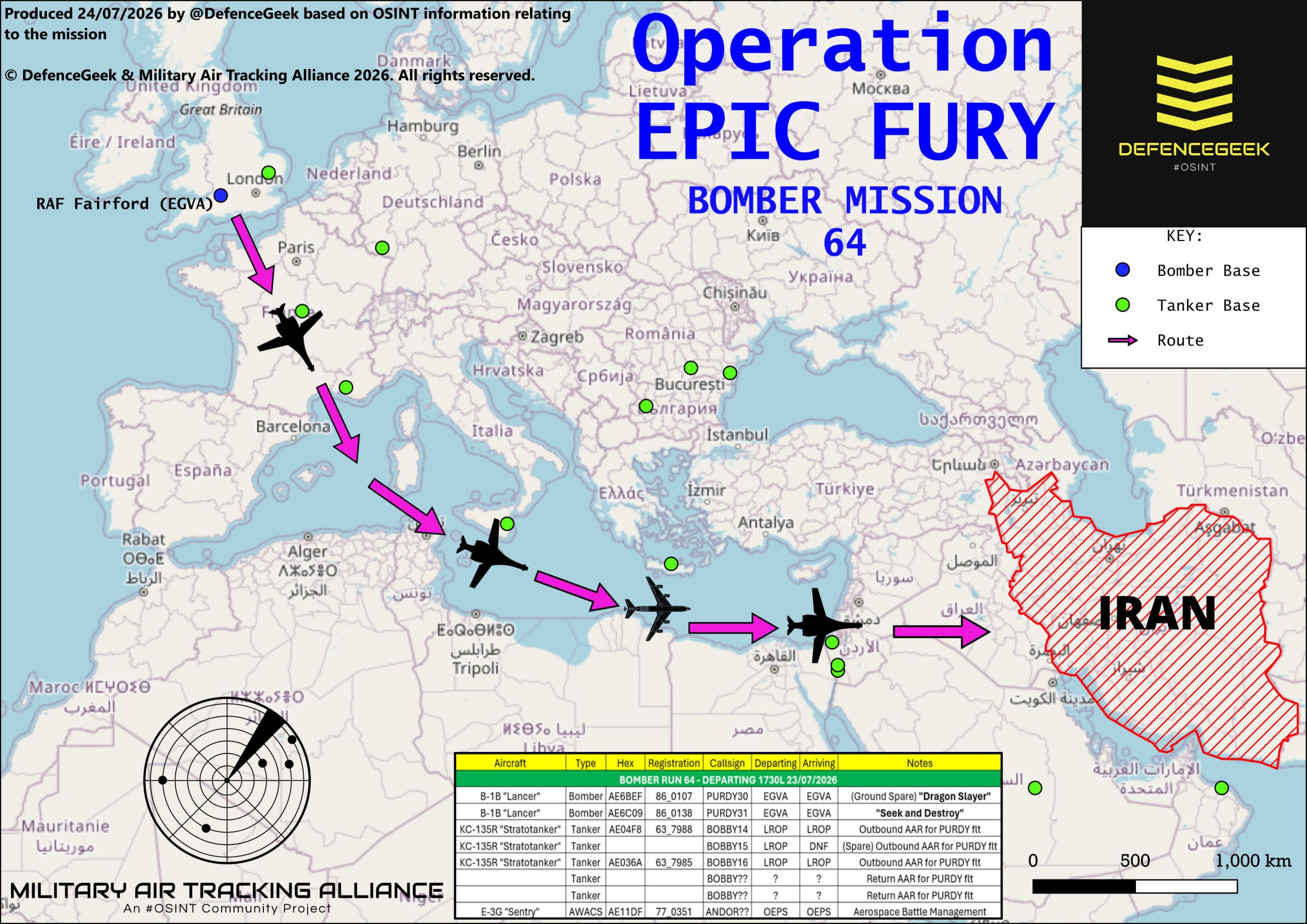
The United States continued its sustained campaign against Iranian targets. Two separate B‑1B Lancer missions launched from RAF Fairford were reported on 24 July. The first, at 13:49 UTC, involved a bomber striking deep‑inside Iranian territory, while a second sortie at 12:52 UTC deployed JDAM precision‑guided munitions against undisclosed sites (monitor_the_situation; CIG_telegram). The U.S. military also announced the completion of its 13th consecutive night of airstrikes against Iran, underscoring a prolonged kinetic pressure campaign (Al Jazeera).
IRGC Counter‑Operations Against Kuwait
In retaliation, the IRGC launched a series of drone and missile attacks on Kuwaiti territory, as reported by intelslava at 14:24 UTC. While casualty figures were not disclosed, the strikes represent a direct escalation of the Gulf‑Iranian confrontation and raise the risk of broader regional spillover.
Commercial Infrastructure Targeted in Russia
Wildberries, Russia’s largest e‑commerce platform, became a recurrent target of Ukrainian drone operations. On 24 July, multiple incidents were recorded:
- At 08:42 UTC, a Ukrainian drone ignited a major fire at a Wildberries warehouse in St Petersburg, prompting emergency response and temporary shutdown (Al Jazeera).
- At 13:12 UTC, Wildberries announced a suspension of early withdrawals for sellers and barred removal of goods from warehouses damaged by earlier drone strikes in Moscow, citing operational disruptions (monitor_the_situation).
- At 07:26 UTC, Russian media claimed Ukrainian drones had destroyed roughly 10 % of Wildberries’ warehouse capacity across Russia within a week (monitor_the_situation).
These attacks illustrate a strategic shift by Ukrainian forces to target economic assets deep within Russian territory, aiming to erode logistical capabilities and public morale.
Additional Ukrainian Missile Deployments
Ukraine’s missile repertoire expanded further with two distinct cruise‑missile strikes on Russian industrial sites. At 10:12 UTC, an FP‑5 Flamingo missile hit the Avitek defense and aerospace enterprise in Kirov, a subsidiary of Almaz‑Antey that produces air‑defence components and ejection seats (intelslava). Earlier, at 09:25 UTC, Ukrainian forces targeted Wildberries logistics centers in St Petersburg and Leningrad Oblast, though specific weaponry was not disclosed (intelslava).
Assessment of the Day’s Kinetic Landscape
The events of 24 July demonstrate a multi‑theater escalation in which state and non‑state actors employ a blend of conventional airpower, precision cruise missiles, and unmanned systems. The Gulf states’ direct strike on Iranian depots signals a new willingness to cross traditional geopolitical boundaries, while the United States maintains a relentless aerial campaign against Iran’s strategic assets. Simultaneously, Ukraine’s expanding missile inventory—augmented by Dutch, Dutch‑supplied Ruta Block 1, and domestically produced FP‑5—enables strikes deep within Russian territory, targeting both military and commercial infrastructure.
In Europe, NATO’s rapid response to a hostile drone over Romania underscores the alliance’s heightened vigilance against low‑altitude threats, a trend mirrored by the increasing use of drones in the Russia‑Ukraine conflict. The cumulative effect is a heightened risk of inadvertent escalation, as kinetic actions intersect across disparate fronts.