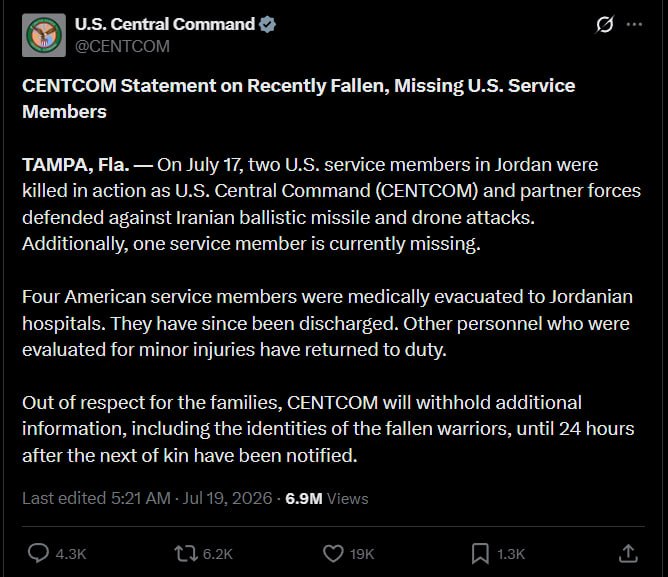
On July 19, 2026, an Iranian ballistic missile strike on a U.S. base at Muwaffaq Salti Air Base in Al Karak, Jordan, resulted in the deaths of two American service members, wounded four, and left one soldier missing. The attack, confirmed by U.S. Central Command (CENTCOM), marked the most lethal single incident reported on the day and escalated tensions between Tehran and Washington.
Iranian missile strike on Jordan
The missile impact was captured on video and later disseminated by Al Jazeera, which described the moment as “Iranian missiles hit airbase in Jordan killing US soldiers.”
"Moment Iranian missiles hit airbase in Jordan killing US soldiers" – AlJazeera video feed, 2026‑07‑19
According to the source, the missiles were ballistic and targeted a barracks housing U.S. personnel. The casualty count stands at two killed, four injured, and one missing. No Iranian forces were present on the ground; the strike was delivered from across the border, underscoring the reach of Iran’s missile arsenal.
Weapons used: ballistic missiles. Organizations involved: Islamic Revolutionary Guard Corps (IRGC) – alleged launch authority; United States Central Command – responding authority. Countries affected: Iran, United States, Jordan.
U.S. CENTCOM retaliation in Iran
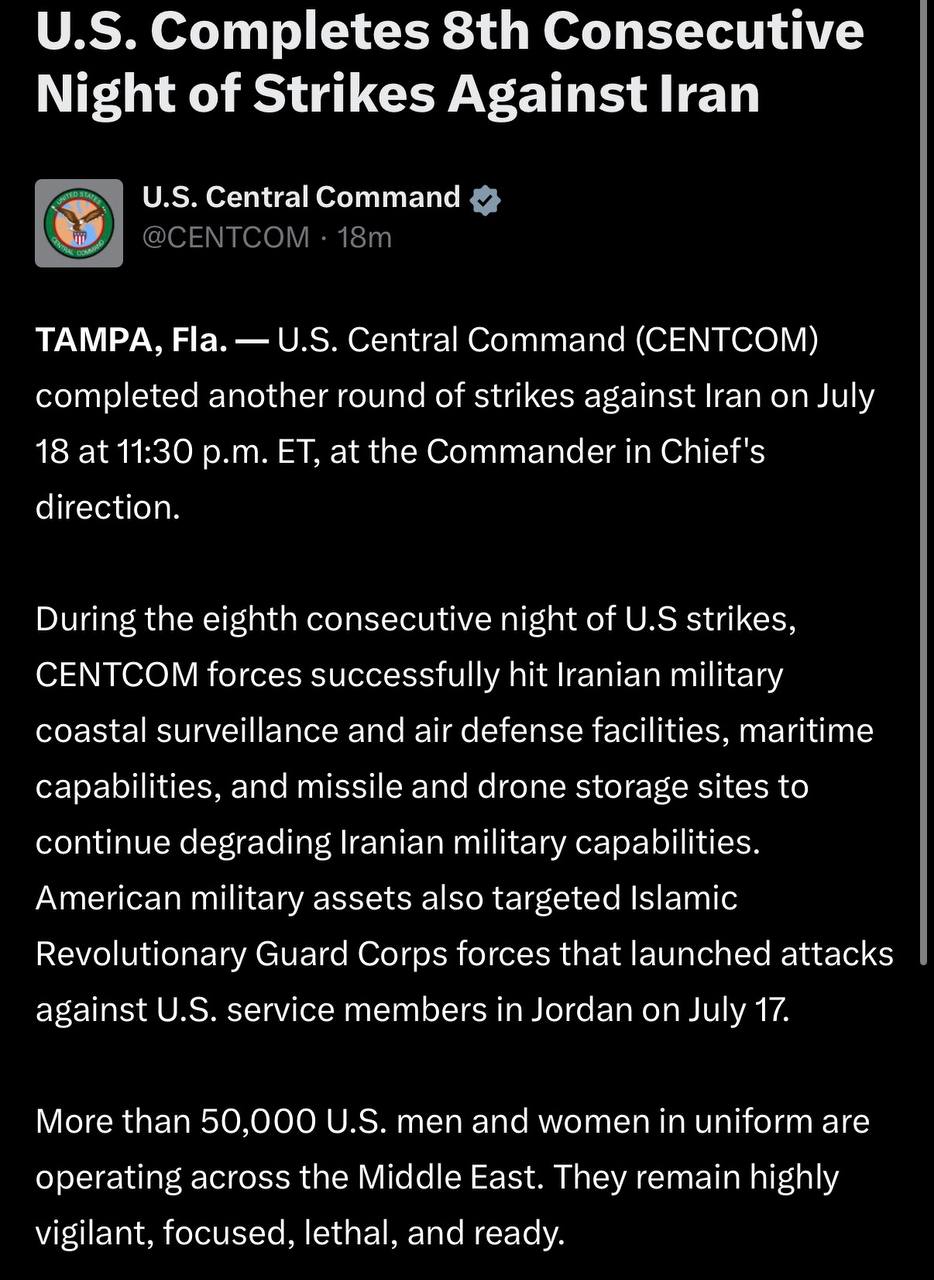
In direct response, CENTCOM launched a series of airstrikes against Iranian military infrastructure later that morning. The first strike, reported by the Telegram channel monitor_the_situation at 04:52 UTC, targeted IRGC personnel in Iran, marking the first U.S. kinetic action against the IRGC since the war resumed earlier in the year. Subsequent strikes were detailed by multiple intelligence feeds:
- At 04:28 UTC, rnintel confirmed a coordinated attack on Iranian coastal surveillance, air‑defense, maritime, and missile‑drone storage facilities, employing precision‑guided missiles.
- At 04:00 UTC, the CIG_telegram channel reported that CENTCOM also struck missile and drone storage sites linked to the July 17 attack on Muwaffaq Salti, using both missiles and unmanned aerial systems.
Collectively, the strikes aimed to degrade Iran’s ability to project missile fire and to neutralize the IRGC units identified as responsible for the Jordanian attack.
Weapons used: cruise missiles, air‑launched missiles, drones. Organizations involved: United States Central Command, Islamic Revolutionary Guard Corps. Countries affected: United States, Iran.
Collateral damage and equipment losses
Separate reporting from intelslava, citing The New York Times, indicated that the Iranian missile barrage also damaged a “significant number” of UH‑60 Black Hawk helicopters stationed at the Jordanian base. While the exact count was not disclosed, the loss of rotary‑wing assets further hampers U.S. operational flexibility in the region.
Weapons affected: UH‑60 Black Hawk helicopters. Organizations involved: The New York Times (reporting), U.S. Army Aviation. Countries affected: Iran, Jordan, United States.
Parallel kinetic events in the broader theater
While the Iran‑Jordan confrontation dominated headlines, other high‑intensity incidents unfolded:
- Ukraine‑Russia energy conflict: At 00:09 UTC, Ukrainian forces struck an oil depot in Mikhaylovsk, Stavropol Krai, Russia, for the third time in recent weeks, as reported by monitor_the_situation. The attack, captured on video, targeted fuel storage facilities, aiming to erode Russian energy logistics.
- Russian domestic target: A separate video posted by BellumActaNews showed an attack on an oil depot in Mikhailovsky, Russia, though details on the perpetrator were not provided.
Both incidents illustrate the continued use of kinetic strikes to pressure adversaries’ economic infrastructure.
Humanitarian fallout in the occupied territories
In a separate, non‑military incident, AlJazeera reported the death of Palestinian teenage footballer Fadi al‑Naasan, who succumbed to injuries sustained a week earlier when shot by Israeli settlers. The report, dated 02:57 UTC, underscores the persistent civilian toll amid the broader conflict.
Casualties: 1 civilian death. Organizations involved: None identified. Countries affected: Israel, Palestine.
Security measures on the Israeli side
At 05:51 UTC, the Jerusalem Post noted that the Israel Defense Forces (IDF) declared a closed military zone extending from Yad Mordechai Junction to Sha'ar Hanegev Junction and further to the Kerem Shalom area. The move was intended to secure key routes ahead of a planned march by the Nahala group, accompanied by Israeli politicians Bezalel Smotrich and Itamar Ben‑Gvir.
Organizations involved: Israel Defense Forces, Nahala group. Countries affected: Israel.