The most consequential kinetic event recorded on 12 July 2026 was a United States airstrike on the Bushehr Nuclear Power Plant in Bushehr Province, Iran. Satellite imagery released by the monitoring channel monitor_the_situation shows visible damage to the plant’s infrastructure, confirming that the strike achieved its intended effect of degrading Iran’s civilian nuclear capability. The operation, carried out at 16:36 UTC, involved no conventional weapons disclosed in the report, but the strategic significance of targeting a civilian nuclear facility elevates the incident to a critical escalation point. The strike occurred two days after Russian personnel were reportedly returned to the plant, underscoring the broader geopolitical context involving both the United States and Russia.
US Airstrikes Hit Bushehr Nuclear Power Plant, Iran – monitor_the_situation, https://t.me/monitor_the_situation/24582
Retaliatory Airstrikes in the Strait of Hormuz
Within the same afternoon, at 16:08 UTC, the United States launched a second wave of airstrikes in the Strait of Hormuz, responding to Iranian attacks on U.S. vessels. The source rnintel reported that the strikes were intended as retaliation, though specific weapon systems were not disclosed. No casualty figures were released for this engagement, but the action contributed to a rapid escalation of hostilities in the strategically vital waterway.
U.S. launched retaliatory strikes in response to the Iranian attacks on its vessels – rnintel, https://t.me/rnintel/63956
Explosive Activity and Rocket Launches in the Hormuz Corridor
At 15:57 UTC, multiple loud explosions were reported in the Strait of Hormuz, again documented by rnintel. While the source did not attribute the blasts to a specific weapon, the timing aligns with the broader pattern of kinetic activity in the corridor. A separate report at 15:57 UTC classified the event as a rocket incident, reinforcing the perception of a high‑intensity exchange of fire between Iranian forces and U.S. assets.
Multiple loud explosions in the Strait of Hormuz – rnintel, https://t.me/rnintel/63952
IRGC Naval Engagements and Vessel Sinkings
At 15:21 UTC, the Islamic Revolutionary Guard Corps (IRGC) engaged two commercial vessels in the Strait of Hormuz, sinking one of them. Simultaneously, two U.S.-targeted tankers were struck, though both managed to reach port. The IRGC employed missile systems in the attack, as reported by the channel CIG_telegram. The incident effectively closed the strait to commercial traffic for several hours, raising concerns about global oil supply disruptions.
IRGC fired at two ships, one sinking; U.S.‑targeted tankers hit – CIG_telegram, https://t.me/CIG_telegram/79440
Ground‑Based Airstrikes in Iran’s Interior
In the early morning, U.S. forces conducted two separate airstrikes on Iranian territory. At 08:04 UTC, a communications tower in the southern highlands of Kerman Province was hit, injuring two civilians who were later airlifted to medical facilities. The source intelslava confirmed the injuries but did not disclose the weapon type.
U.S. forces struck a communications tower in Kerman Province, injuring two – intelslava, https://t.me/intelslava/90293
Later, at 07:42 UTC, a military facility in Yasuj, the capital of Kohgiluyeh‑Boyerahmad Province, was targeted by a U.S. airstrike. Video evidence posted by monitor_the_situation shows the impact site, though casualty numbers were not released.
US Strikes Military Facility in Iran's Yasuj – monitor_the_situation, https://t.me/monitor_the_situation/24553
Political Rhetoric and Claims of Control
At 06:07 UTC, an Iranian Parliament spokesperson publicly declared that Iran had seized the Strait of Hormuz and would maintain control “by force.” While the statement did not correspond to a specific kinetic event, it reflects the heightened political posturing accompanying the military actions.
We have seized the Strait of Hormuz with force, and we will maintain it with force – rnintel, https://t.me/rnintel/63936
Secondary Explosions and Smoke Plumes in Bandar Abbas and Qeshm Island
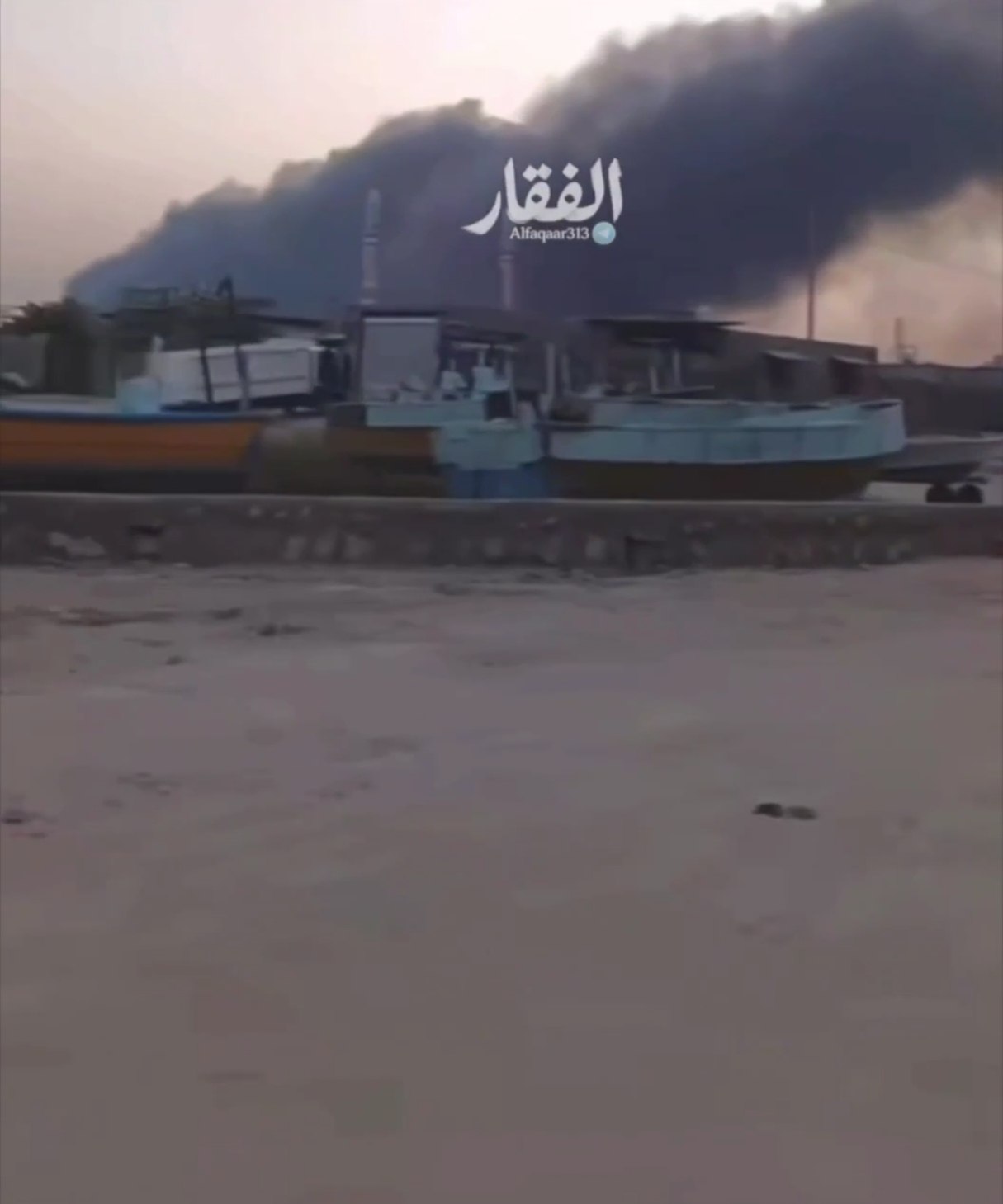
Multiple medium‑severity incidents were reported in the Hormozgan Province region. At 16:59 UTC, explosions were noted in Bandar Abbas, the provincial capital, without further detail on casualties or weaponry. Concurrently, a large smoke plume observed over Qeshm Island was traced to a petrochemical tank farm near coordinates 26.7757 N, 55.9727 E, following U.S. strikes earlier in the day. Video and photographic evidence from GeoPWatch and rnintel document the visible columns of smoke and the extent of the damage.
Explosions Bandar Abbas – GeoPWatch, https://t.me/GeoPWatch/37080
Smoke plume from petrochemical tank farm on Qeshm Island – rnintel, https://t.me/rnintel/63960
Official U.S. Statements on Strait Accessibility
At 13:25 UTC, a statement attributed to former President Donald Trump, circulated by intelslava, asserted that the Strait of Hormuz remained open and that the United States had conducted “heavy strikes” against Iran. The claim contrasts with the operational reality of multiple vessel sinkings and temporary closures earlier in the day.
Trump states the Strait of Hormuz is open and that the US has struck Iran with heavy strikes – intelslava, https://t.me/intelslava/90303
Collectively, the events of 12 July 2026 represent the most intense kinetic phase of the ongoing U.S.–Iran confrontation since the conflict’s resurgence in early 2026. The targeting of a civilian nuclear facility, combined with coordinated naval and aerial attacks in the Strait of Hormuz, signals a deliberate escalation strategy by both sides, with potential ramifications for regional security, global energy markets, and international non‑proliferation regimes.