The most consequential development on 2026-07-08 was the United States' missile campaign against Iran, which lifted Brent crude above $76 a barrel for the first time in two weeks. The strikes, reported by Al Jazeera at 04:02:32 UTC, were described as a direct response to Iranian aggression in the Strait of Hormuz and marked a sharp reversal of the oil‑price decline that had followed earlier regional tensions.
"Oil prices surge as US strikes Iran reversing fall to pre‑war levels," Al Jazeera, https://www.aljazeera.com/news/2026/7/8/oil-prices-surge-as-us-strikes-iran-reversing-fall-to-pre-war-levels?traffic_source=rss
Scale and Targets of the Iranian Counter‑Offensive
Within minutes of the U.S. attack, Iran’s Islamic Revolutionary Guard Corps (IRGC) launched a coordinated missile and unmanned aerial vehicle (UAV) operation against 85 U.S. installations across the Gulf region. The operation, documented by the Telegram channel rnintel at 03:45:00 UTC, struck the strategic Salman Port, the headquarters of the U.S. Fifth Fleet in Bahrain, and Ali Al‑Salem Air Base in Kuwait. An American MQ‑9 Reaper drone was also reported shot down during the engagement.
"Iran's Islamic Revolutionary Guard Corps launched a missile and UAV strike against 85 U.S. sites, hitting Salman Port, the U.S. Fifth Fleet headquarters in Bahrain and Ali Al‑Salem Air Base in Kuwait, and shot down an American MQ‑9 drone," rnintel, https://t.me/rnintel/63674
The IRGC employed a mix of surface‑to‑air missiles, cruise missiles, and UAVs, indicating a high level of operational coordination. No casualty figures were released, and both sides have refrained from confirming any personnel losses.
Escalation in Bahrain and Kuwait Airspace
Following the IRGC’s broad strike, a cascade of aerial interceptions and explosions was reported across Bahrain and Kuwait. The CIG_telegram channel logged repeated interceptions and explosions in Bahrain’s airspace at 03:23:36 UTC, while rnintel noted loud detonations in Bahrain at 03:04:17 UTC, attributing them to interceptor missiles launched against inbound projectiles.
"Repeated interceptions and explosions have been reported in Bahrain's airspace," CIG_telegram, https://t.me/CIG_telegram/79026
In Kuwait, Patriot interceptor missiles were launched at 03:04:45 UTC, producing visible explosions that were captured by local observers. The same channel reported that sirens sounded in Kuwait at 03:02:29 UTC, warning of Iranian drones or missiles targeting U.S. bases.
"Patriot interceptor missiles were launched in Kuwait, causing explosions," rnintel, https://t.me/rnintel/63666
These defensive actions underscore the heightened risk of inadvertent escalation, as multiple states—United States, Iran, Bahrain, and Kuwait—are now directly involved in kinetic exchanges within a narrow geographic corridor.
Naval Dimension: Anti‑Ship Missile Launches
At 00:37:06 UTC, the IRGC Navy reportedly fired anti‑ship missiles at U.S. Navy vessels, according to the Telegram channel BellumActaNews. While the exact class of missiles was not disclosed, the launch represents a direct threat to naval assets operating in the Gulf and could compel the U.S. Fifth Fleet to adjust its rules of engagement.
"IRGC Navy reportedly fired anti‑ship missiles at US Navy ships," BellumActaNews, https://t.me/BellumActaNews/175005
U.S. Airstrike Inside Iran
Concurrently, a U.S. airstrike inside Iranian territory was reported by intelslava at 00:35:06 UTC, with Iranian state‑run Press TV confirming explosions resulting from the strike. The lack of detail regarding the target or weaponry used limits assessment of the strike’s strategic impact, but it signals a willingness by Washington to conduct direct kinetic actions on Iranian soil.
"Press TV reports that a US airstrike caused explosions in Iran," intelslava, https://t.me/intelslava/89941
Broader Regional Air Activity
Intense fighter‑jet activity was observed over Saudi Arabian and Bahraini airspace at 04:08:02 UTC, as reported by GeoPWatch. While the identity of the aircraft was not confirmed, the timing aligns with the broader pattern of aerial engagements following the IRGC’s missile barrage.
Additional reports of explosions and interceptions in Bahrain throughout the early morning hours—at 03:20:51, 03:13:55, and 03:23:36 UTC—reinforce the perception of a sustained kinetic environment, though specific weapon systems were not always identified.
Outside the Gulf: Ukrainian Drone Attack on Russian Refinery
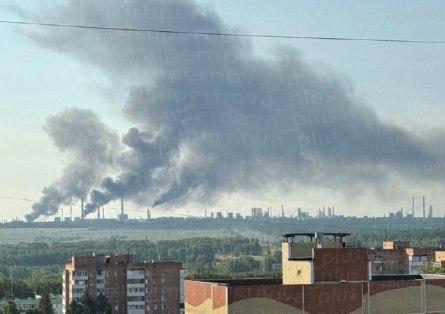
In a separate theater, Ukrainian attack drones struck Russia’s Nezhnekamsk refinery at 04:16:18 UTC, igniting a fire. This was the second Russian oil refinery hit by Ukrainian drones on the same day, as noted by the monitor_the_situation channel. While unrelated to the Gulf crisis, the incident highlights the simultaneous multi‑front nature of kinetic conflicts in 2026.
"Ukrainian drones struck the Nezhnekamsk refinery in Russia, causing a fire," monitor_the_situation, https://t.me/monitor_the_situation/24058
Implications for Energy Markets and Regional Stability
The immediate market reaction—Brent crude surpassing $76 per barrel—reflects investor sensitivity to any disruption of oil flow through the Strait of Hormuz, a chokepoint that handles roughly 20% of global petroleum shipments. The U.S. missile campaign, intended to degrade Iranian anti‑shipping capabilities, paradoxically contributed to price volatility by raising the risk premium associated with Gulf transit.
From a security perspective, the rapid succession of missile launches, UAV attacks, and interceptor detonations demonstrates a high degree of readiness on both sides. The involvement of multiple air defense systems—Patriot missiles in Kuwait, unspecified interceptors in Bahrain, and likely Saudi and Emirati assets—creates a dense, overlapping defensive envelope that could complicate de‑confliction.
While casualty figures remain unreported, the absence of confirmed fatalities does not diminish the strategic significance of the kinetic exchanges. Each side appears to be calibrating its response to avoid a full‑scale war while still signaling resolve.
Outlook
Analysts will monitor several indicators for escalation risk: (1) further U.S. strikes on Iranian military infrastructure; (2) Iranian retaliation against additional U.S. or allied assets; (3) the response of regional navies, particularly the U.S. Fifth Fleet, to anti‑ship missile threats; and (4) the impact of oil‑price movements on broader economic stability. The convergence of kinetic actions across land, sea, and air domains underscores the volatility of the Gulf theater in early July 2026.