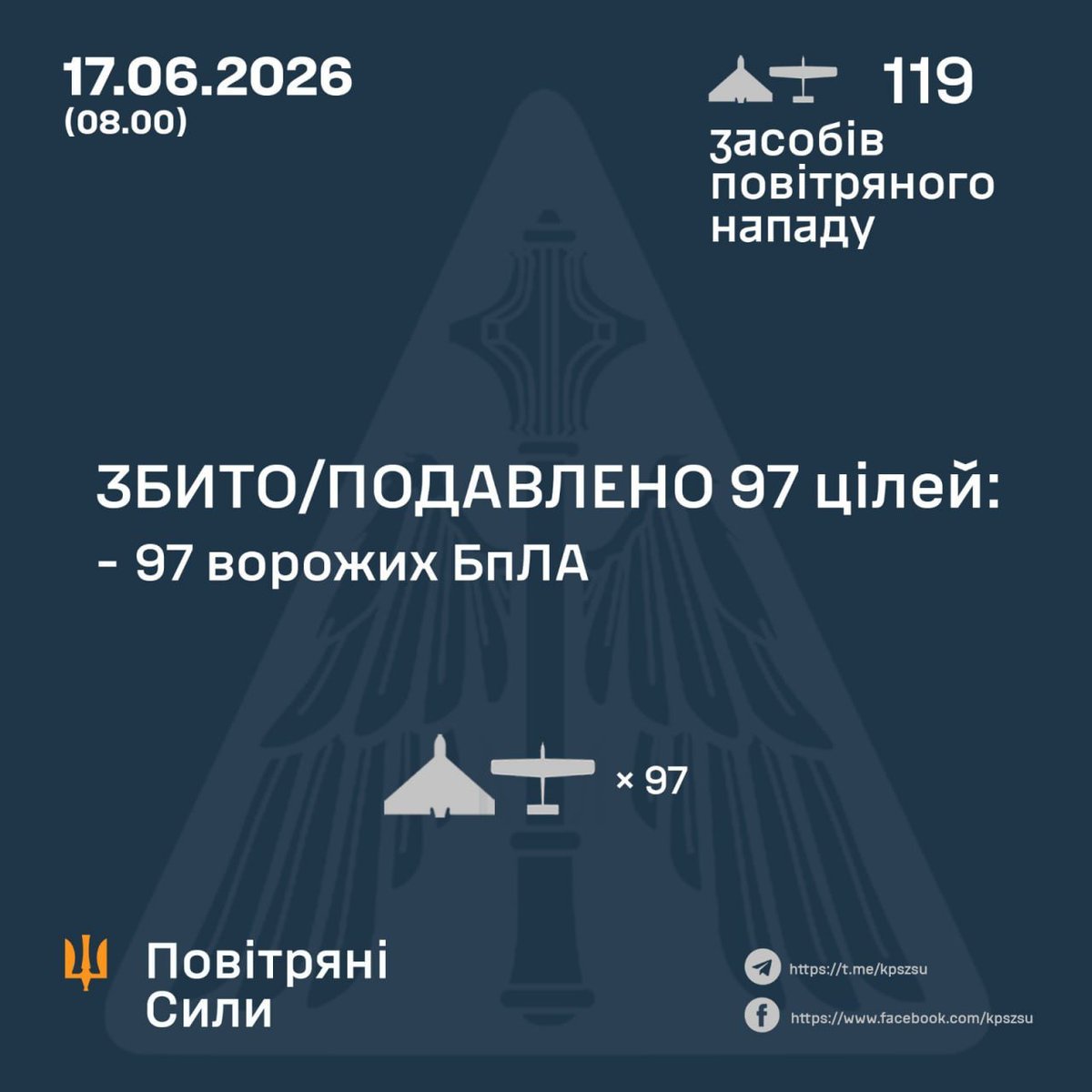
In the early hours of 17 June 2026, Ukrainian air‑defence units achieved a decisive victory against a coordinated Russian unmanned‑aerial‑vehicle (UAV) offensive, shooting down 97 of the 119 drones launched overnight. The operation, reported by the Telegram channel monitor_the_situation, marked the most extensive aerial interception of the conflict to date and underscored Kyiv’s growing capability to neutralise massed UAV attacks.
Scale and Outcome of the Drone Interception
According to the source, the Russian barrage targeted multiple regions across Ukraine, with confirmed impacts at eleven locations and debris falling at six additional sites. The Ukrainian air‑defence network, comprising Patriot, SAMP/T, and domestically produced systems, engaged the hostile UAVs continuously from 02:00 to 06:00 local time. By the end of the engagement, only 22 drones remained airborne, of which a minority reached their intended targets.
"Ukrainian air defences intercepted 97 Russian drones in an overnight attack," the monitor_the_situation channel reported, adding that the operation demonstrated "significant operational readiness" of Kyiv’s layered defence architecture.
The intercepted drones were identified as a mix of Shahed‑136 loitering munitions and newer Russian UAV models equipped with reconnaissance payloads. No civilian casualties were directly attributed to the intercepted drones, though debris caused minor property damage in three villages near the front lines.
Retaliatory Strikes on Russian Territory
Within hours of the successful defence, Ukrainian President Volodymyr Zelenskyy confirmed that Kyiv had launched its own drone strikes against Russian oil infrastructure. The statement, also relayed by monitor_the_situation, indicated that the attacks targeted facilities in the Kursk and Belgorod regions, aiming to disrupt fuel supplies used by Russian forces.
"Zelenskyy confirms strikes on Russian territory," the channel quoted the president, noting that the operations were carried out by the Ukrainian Armed Forces using tactical UAVs.
While exact damage assessments remain pending, satellite imagery and open‑source monitoring suggest that at least two oil storage tanks suffered fire damage, with temporary production halts reported by local operators. No civilian injuries were reported in the affected Russian districts.
Naval Setback for Russia: Destruction of the Corvette Boikiy
Concurrently, satellite imagery released by the same Telegram source confirmed the destruction of the Russian Black Sea Fleet’s corvette Boikiy in Sevastopol, Crimea. The imagery, captured on 16 June and analysed on 17 June, shows a large explosion crater on the vessel’s deck, followed by a visible breach in the hull. The loss represents a material and symbolic blow to Russia’s maritime capabilities in the Black Sea, where the fleet has been instrumental in supporting ground operations in southern Ukraine.
"Satellite Imagery Confirms Russian Corvette Boikiy Destroyed in Sevastopol," the monitor_the_situation post read, describing the event as a "significant loss for the Black Sea Fleet."
Russian state media have not yet issued an official comment, but the incident aligns with a pattern of Ukrainian strikes on high‑value naval assets observed since 2024.
Civilian Impact: Drone Attack on Residential Building
Amid the broader aerial campaign, Al Jazeera reported a separate incident at 03:02 UTC in which a suspected Russian drone struck a residential building in an unnamed Ukrainian city, injuring at least seven civilians. The attack, described as a "targeted strike on civilian infrastructure," resulted in minor structural damage and prompted emergency medical response.
"A suspected Russian drone attack on a residential building in Ukraine has injured at least seven people," Al Jazeera reported, linking to video footage of the aftermath (source).
While the incident was not directly linked to the larger UAV wave intercepted earlier, it illustrates the persistent risk to civilian populations from low‑altitude UAV operations.
Operational Analysis
The successful interception of 97 drones demonstrates several key developments in Ukraine’s air‑defence posture:
- Layered Integration: Coordination between NATO‑supplied long‑range systems and indigenous short‑range platforms allowed continuous coverage across the country’s airspace.
- Real‑time Intelligence: Early warning from radar and electronic‑support‑measures (ESM) networks enabled rapid vectoring of interceptors to high‑density launch corridors.
- Operator Proficiency: Repeated training cycles and combat experience have reduced decision‑making latency, increasing kill‑probability rates.
Conversely, the Russian reliance on massed UAV attacks reflects a strategic shift toward cost‑effective saturation tactics, aiming to overwhelm defensive layers and force resource diversion. The high attrition rate—approximately 82% of launched drones—suggests diminishing returns for this approach unless counter‑measures are further degraded.
Strategic Implications
Ukraine’s retaliatory strikes on Russian oil facilities and the confirmed destruction of the Boikiy corvette signal an escalation in the conflict’s cross‑border dimension. By targeting logistical nodes and naval assets, Kyiv seeks to impose operational costs on Moscow, potentially constraining Russian offensive momentum in the south and east.
From a broader perspective, the events of 17 June illustrate a maturing Ukrainian warfighting model that blends defensive resilience with offensive precision. The ability to simultaneously repel a large UAV swarm and conduct targeted strikes deep inside Russian territory underscores a shift from a purely defensive stance to a more dynamic, deterrent posture.
Conclusion
The night of 16‑17 June 2026 will likely be recorded as a benchmark in Ukraine’s air‑defence evolution. Intercepting 97 out of 119 hostile drones not only protected critical infrastructure and civilian lives but also freed Ukrainian forces to execute retaliatory operations that inflicted material damage on Russian strategic assets. Continued investment in integrated air‑defence systems, coupled with the development of indigenous strike capabilities, appears poised to shape the conflict’s trajectory in the months ahead.