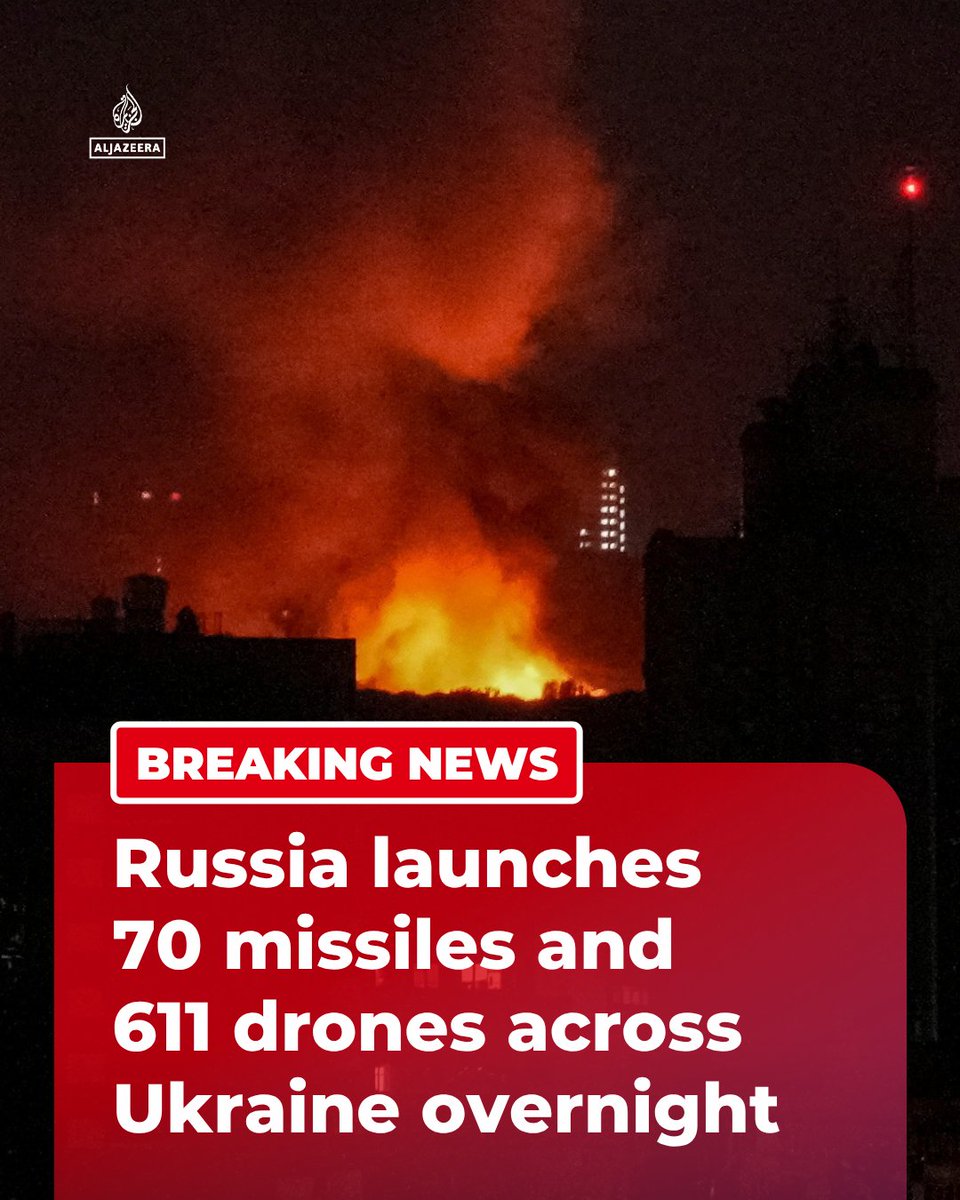
Russia launched a massive overnight attack on Ukraine, deploying 70 cruise missiles and 611 unmanned aerial systems (UAS) across the country. Ukrainian air defenses reported intercepting 50 missiles and destroying 582 drones, indicating a high interception rate but also confirming that a substantial number of weapons reached their targets. The scale of the sortie marks the most intensive single‑day aerial operation by Russian forces since the conflict began in 2022, underscoring a renewed emphasis on saturation attacks designed to overwhelm Ukraine’s integrated air defence network.
Overnight missile and drone barrage
The barrage began in the pre‑dawn hours, with launch sites identified in the Russian‑occupied territories of Donetsk and Luhansk. Missiles, primarily identified as Kalibr and Iskander variants, were programmed for both strategic and tactical strikes, targeting infrastructure, energy facilities, and command‑and‑control nodes. Simultaneously, a swarm of 611 drones—predominantly Shahed‑136 loitering munitions and Russian‑produced Geran‑2 models—penetrated Ukrainian airspace. Ukrainian sources, cited by the monitoring channel monitor_the_situation, confirmed that the majority of the drones were shot down by surface‑to‑air systems and electronic warfare assets, but several penetrated deep into the interior, causing localized fires and material damage.
Source: monitor_the_situation, https://t.me/monitor_the_situation/21484
Casualty figures for the night remain incomplete, but preliminary reports indicate at least 12 civilian injuries in the Kharkiv and Dnipro regions, where stray debris from intercepted weapons landed. No confirmed fatalities have been reported directly from the missile strikes, though damage to residential blocks and industrial sites is evident.
Zircon hypersonic strike on Kyiv
At approximately 02:00 UTC, Kyiv experienced a separate, high‑profile attack involving Russia’s Zircon hypersonic cruise missile. The weapon, capable of speeds exceeding Mach 8 and maneuvering at low altitudes, struck a central district of the capital, creating a sizable blast radius and prompting immediate emergency response. Video footage circulated by the Telegram channel intelslava captured the impact and the subsequent descent of a Patriot air‑defence interceptor that malfunctioned and fell within the city limits.
🇷🇺🇺🇦⚡️ — WATCH: Footage shows Zircon hypersonic cruise missiles striking Kyiv earlier tonight. One Patriot interceptor appears to have malfunctioned and fallen within the capital. Source: intelslava, https://t.me/intelslava/88997
The Patriot failure, while not directly attributable to the Zircon impact, highlights the strain placed on Ukraine’s layered air‑defence architecture when confronting weapons that travel faster than the response envelope of conventional systems. Ukrainian officials have not released official casualty numbers for the Zircon strike, but local authorities reported structural damage to a nearby residential building and several injuries awaiting medical assessment.
Geran‑2 attacks on Mykolaiv
In the southern port city of Mykolaiv, Russian Geran‑2 drones—an export‑oriented variant of the Shahed‑136—conducted a coordinated strike at 04:01 UTC. The drones ignited multiple fires in industrial zones and near the Mykolaiv shipyard, a strategic asset for Ukraine’s maritime logistics. Video evidence posted by monitor_the_situation shows the drones approaching at low altitude before detonating, with subsequent firefighting efforts hampered by ongoing air‑raid alerts.
Source: monitor_the_situation, https://t.me/monitor_the_situation/21476
Local emergency services reported three injuries, all non‑fatal, and significant damage to warehouse roofs and storage facilities. The attack reinforces a pattern of Russian use of loitering munitions to target economic infrastructure in the Black Sea corridor.
Assessment of the intensified air campaign
The coordinated use of conventional missiles, hypersonic weapons, and large‑scale drone swarms reflects a multi‑layered Russian strategy aimed at degrading Ukraine’s air‑defence depth while imposing psychological pressure on civilian populations. By saturating radar and missile‑defence systems with hundreds of low‑cost drones, Russian planners create gaps that allow higher‑value assets—such as the Zircon missile—to penetrate to high‑value targets. The simultaneous deployment of Geran‑2 drones in the south demonstrates a deliberate effort to stretch Ukrainian resources across multiple fronts.
Ukraine’s reported interception rates—approximately 71 % for missiles and 95 % for drones—indicate a resilient defence posture, yet the residual penetrations have resulted in material loss, civilian injuries, and disruption of critical infrastructure. The failure of a Patriot interceptor during the Kyiv strike raises concerns about the sustainability of Western‑supplied high‑end systems under continuous high‑tempo attack, especially when faced with weapons that exceed the engagement envelope of existing platforms.
Implications for the conflict trajectory
Analysts observing the June 15 events note that the scale of the operation suggests a possible escalation in Russian aerial tactics, potentially preceding a broader offensive or a shift toward attritional warfare aimed at eroding Ukraine’s defensive capacity. The inclusion of hypersonic missiles signals a willingness to employ strategic‑level weapons to achieve tactical effects, a development that may prompt NATO to reassess the allocation of missile‑defence assets in the region.
For Ukrainian authorities, the immediate priority remains the rapid repair of damaged infrastructure, reinforcement of air‑defence coverage in vulnerable corridors, and the integration of additional electronic‑warfare measures to counter drone swarms. International partners are likely to monitor the performance of supplied systems, particularly the Patriot and NASAMS networks, to determine whether further upgrades or supplemental layers—such as additional short‑range air‑defence batteries—are required.