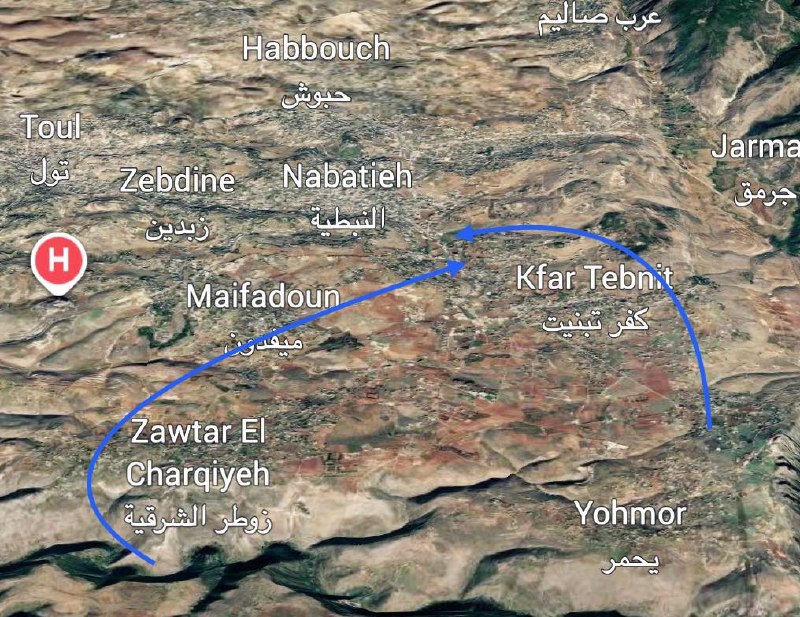
On 11 June 2026, Israeli forces of the 36th Division advanced within a few kilometres of Nabatieh, seizing the strategic Beaufort Castle ridge and reporting the death of twenty Hezbollah fighters. The movement, confirmed by BellumActaNews, represents the most significant kinetic development in Lebanon today and signals a potential shift in the operational tempo of the Israel Defense Forces (IDF) in the south.
Beaufort Ridge Capture and Immediate Aftermath
The Israeli advance began after crossing the Litani River, with Givati reconnaissance troops moving first toward Zawtar El Charqiyeh and Zawtar El Gh. According to the BellumActaNews report (source URL: https://t.me/BellumActaNews/174083), the IDF now holds the high ground of Beaufort Castle, a position that offers observation over the surrounding valleys and the town of Nabatieh. Israeli statements indicate that the troops are awaiting a political decision on whether to consolidate the newly‑gained line or push toward additional objectives further inland.
"We have taken the ridge and neutralised twenty enemy combatants. The next steps will be determined by the political leadership," an IDF spokesperson told BellumActaNews.
Casualties: 20 Hezbollah fighters killed; no Israeli casualties reported at the time of writing.
Broader Ground Operations in Southern Lebanon
Simultaneously, the IDF continued expanding its ground presence across southern Lebanon. Al Jazeera reported that Israeli forces are conducting a series of coordinated movements while cease‑fire negotiations remain stalled (source URL: https://www.aljazeera.com/video/newsfeed/2026/6/11/lebanon-latest-ceasefire-talks-continue-under-fire?traffic_source=rss). The report highlighted a pattern of incremental advances, suggesting a deliberate effort to pressure Hezbollah positions and secure forward operating bases.
Capture of Wadi al‑Sulqi
Earlier in the day, at 15:12:55, the Israeli army announced the capture of Wadi al‑Sulqi in the central sector of southern Lebanon. The operation, documented by monitor_the_situation (source URL: https://t.me/monitor_the_situation/20957), was framed as eliminating a direct threat to the Israeli towns of the Finger of Galilee and Metula. No casualties were reported on either side, and the IDF described the area as a “strategic corridor” previously used for infiltration.
Airstrike on Underground Tunnel Network
At 14:12:21, the Israeli Air Force (IAF) conducted precision strikes against a Hezbollah tunnel complex in southern Lebanon. The attack, also reported by monitor_the_situation (source URL: https://t.me/monitor_the_situation/20951), targeted fighters inside the subterranean network after detection by the elite Egoz and Yahalom units. Video footage released by the IAF showed multiple explosions within the tunnel system, though exact casualty figures were not disclosed. The strike underscores Israel’s focus on degrading Hezbollah’s underground infrastructure, which has been a persistent challenge for conventional forces.
Hezbollah Drone Strike in Khiam
At 15:20:02, Hezbollah released first‑person FPV footage of a drone strike on Israeli soldiers in the town of Khiam, southern Lebanon. The video, shared by rnintel (source URL: https://t.me/rnintel/62530), depicts a small quadcopter approaching an IDF patrol before detonating. While the footage does not confirm casualties, the incident demonstrates Hezbollah’s continued use of low‑cost unmanned systems to contest Israeli advances.
Hostile Drone Injury to IDF Soldier
Earlier, at 12:42:11, an IDF combatant sustained moderate injuries from an explosive drone strike in southern Lebanon. The incident, reported by idkunim_il (source URL: https://t.me/idkunim_il/60345), involved a single‑use drone that detonated near a forward operating position. Medical reports indicated non‑life‑threatening injuries, and the soldier was evacuated for treatment. The event highlights the growing risk of drone‑borne munitions to ground troops operating in contested zones.
Raid on Hezbollah Weapons Storage Facility
At 08:36:12, the IDF executed a raid on a known Hezbollah weapons storage site, destroying an anti‑tank launcher and seizing a cache of small arms, rockets, and RPGs. The operation, covered by the Jerusalem Post (source URL: https://www.jpost.com/israel-news/defense-news/article-899054), resulted in the death of several Hezbollah operatives, though exact numbers were not disclosed. The raid aimed to degrade Hezbollah’s conventional firepower ahead of the broader ground offensive.
"The destruction of the anti‑tank launcher removes a critical threat to our armored units," the IDF’s northern command noted in a briefing to the Jerusalem Post.
Collectively, these events illustrate a coordinated escalation by Israeli forces across multiple fronts in southern Lebanon, combining ground advances, airpower, and targeted raids to weaken Hezbollah’s operational capacity. The simultaneous use of drones by both sides adds a layer of asymmetrical threat that complicates traditional force protection measures.
While cease‑fire talks continue under fire, the intensity of kinetic actions suggests that diplomatic efforts are being tested by on‑the‑ground realities. Observers note that the capture of high‑ground positions such as Beaufort Castle and Wadi al‑Sulqi provides Israel with enhanced surveillance and artillery targeting options, potentially reshaping the tactical balance in the region.