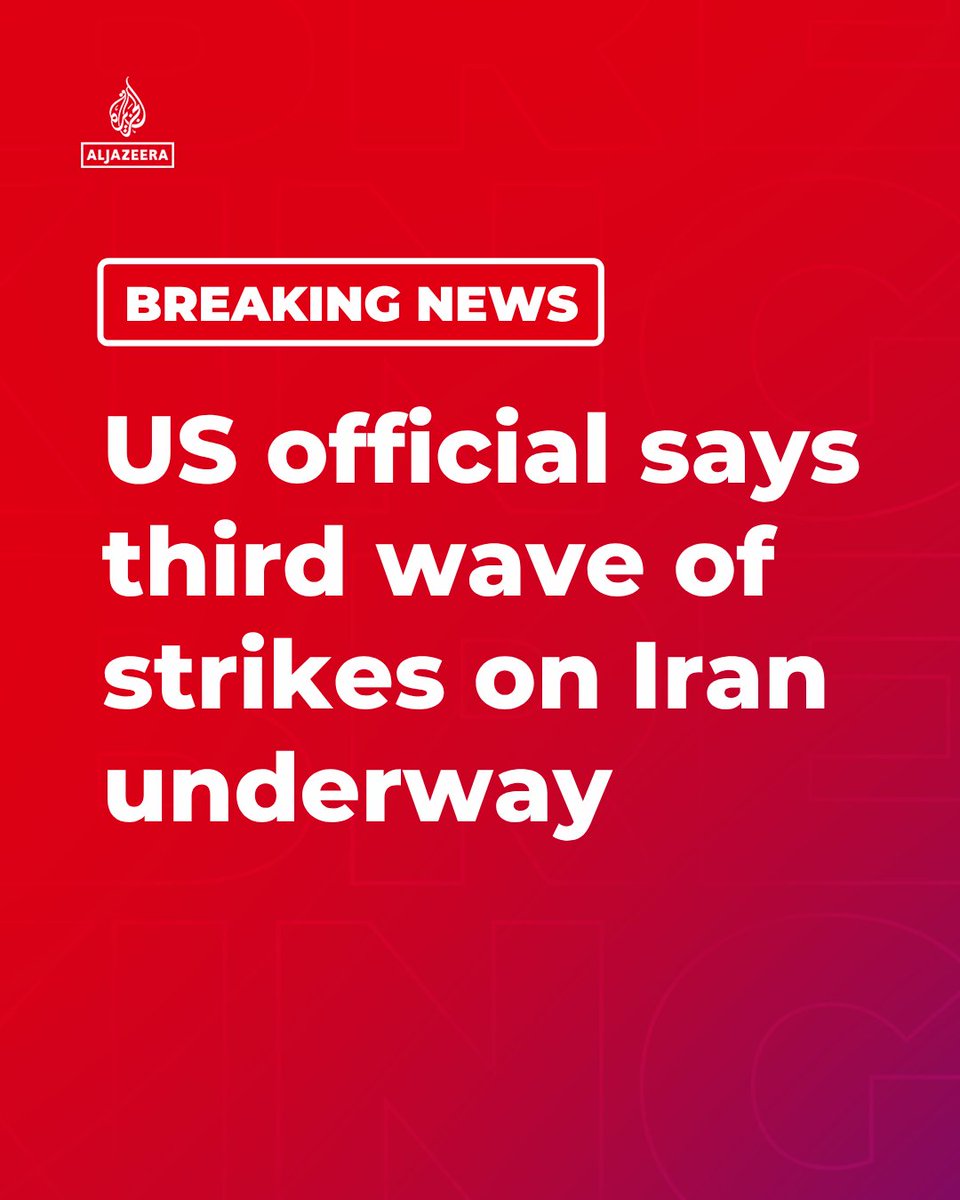
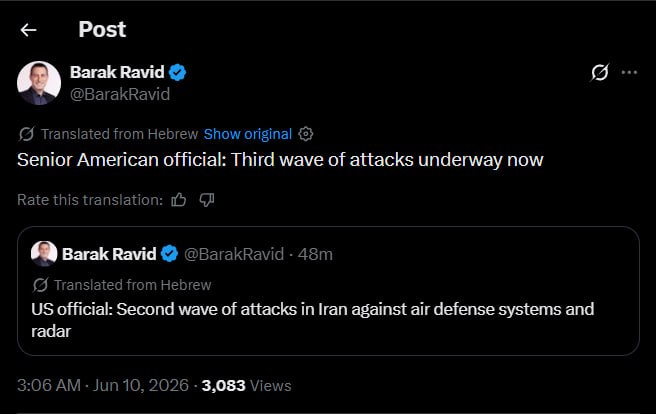
On June 10, 2026, the United States initiated a third wave of airstrikes against Iranian targets, marking the most significant kinetic event of the day. The strike, reported by the channel monitor_the_situation at 00:25:31 UTC, was confirmed by a senior U.S. official who stated that the operation is underway and represents a clear escalation in the U.S.–Iran military confrontation. The air campaign was conducted by U.S. Naval Aviation and the U.S. Air Force, as noted by BellumActaNews, and involved multiple sorties against undisclosed locations within Iran. No casualty figures were released, and the specific weapons employed were not disclosed in the source material.
"A senior US official confirms a third wave of airstrikes is underway against Iranian targets." – monitor_the_situation (https://t.me/monitor_the_situation/20612)
U.S. Airstrike Campaign Throughout the Day
Following the initial wave, additional strikes were reported by OSINTdefender at 05:20:50 UTC, describing a coordinated effort against Iranian military sites. The same day, rnintel relayed that twenty separate targets inside Iran were hit, with U.S. forces remaining on heightened alert for possible retaliation. Both reports emphasize that the United States has sustained its offensive posture, though they do not specify the nature of the targets or any material losses inflicted on Iranian forces. The repeated references to “targets” and “sites” suggest a focus on air defense, command‑and‑control, and surveillance infrastructure.
Iranian Missile Counter‑Offensive
In direct response, Iran launched a series of ballistic and cruise missiles toward U.S. installations in Jordan, Kuwait, and Bahrain. The first missile report, posted by idkunim_il at 04:14:22 UTC, detailed at least four ballistic missiles and several cruise missiles aimed at the three bases. JPost corroborated the retaliation at 03:45:58 UTC, noting that the attacks were a reaction to the U.S. strikes that had hit Iranian air‑defense and radar sites earlier in the week. The missiles were identified as ballistic missiles, with one report specifying the use of Kheibar Shekan missiles against an F‑35 hangar in Bahrain.
"Iran launched at least four ballistic missiles and several cruise missiles at U.S. bases in Jordan, Kuwait, and Bahrain as part of the response to the American strikes." – idkunim_il (https://t.me/idkunim_il/60308)
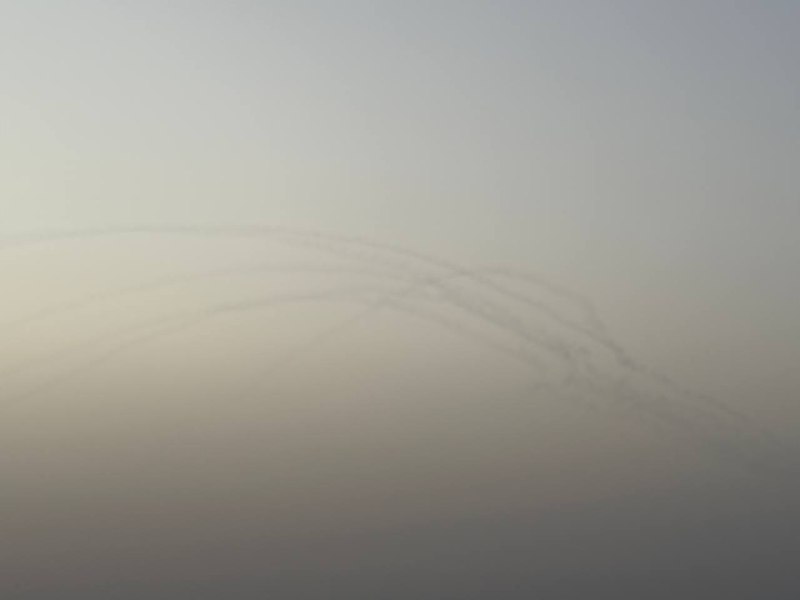
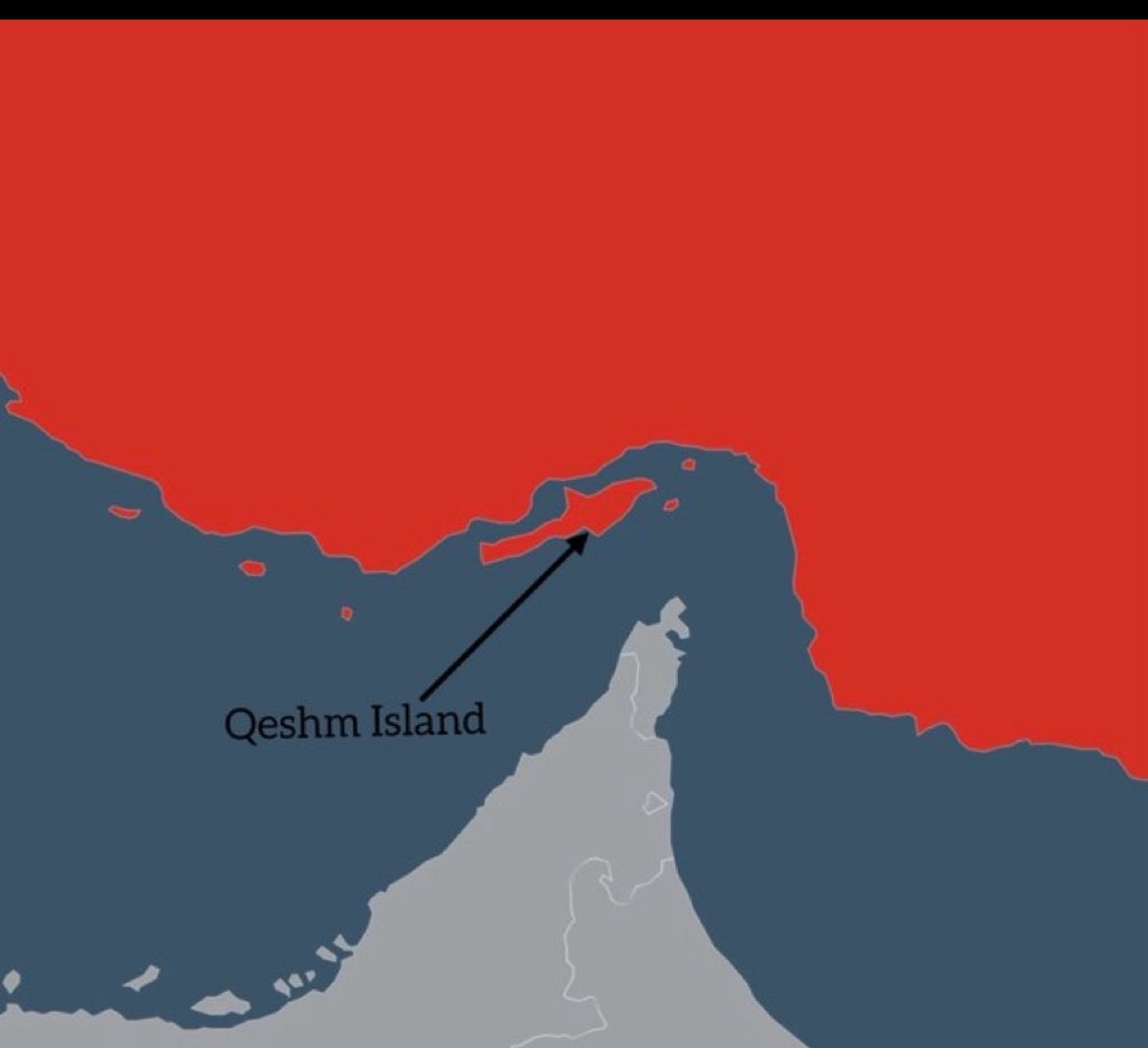
Additional missile activity was recorded throughout the early morning hours. At 02:25:44 UTC, intelslava reported that Iran’s ballistic missile launch was accompanied by sirens in Kuwait and a threat to close the Strait of Hormuz. The same channel later posted unverified footage of IRGC‑launched ballistic missiles at 01:12:10 UTC, and a separate IRGC missile attack detection at 00:14:05 UTC. GeoPWatch added that at least three interceptor missiles were launched at 02:51:11 UTC to counter the Iranian barrage, indicating an active missile defense posture by regional actors.
Intercepts, Explosions, and Regional Alerts
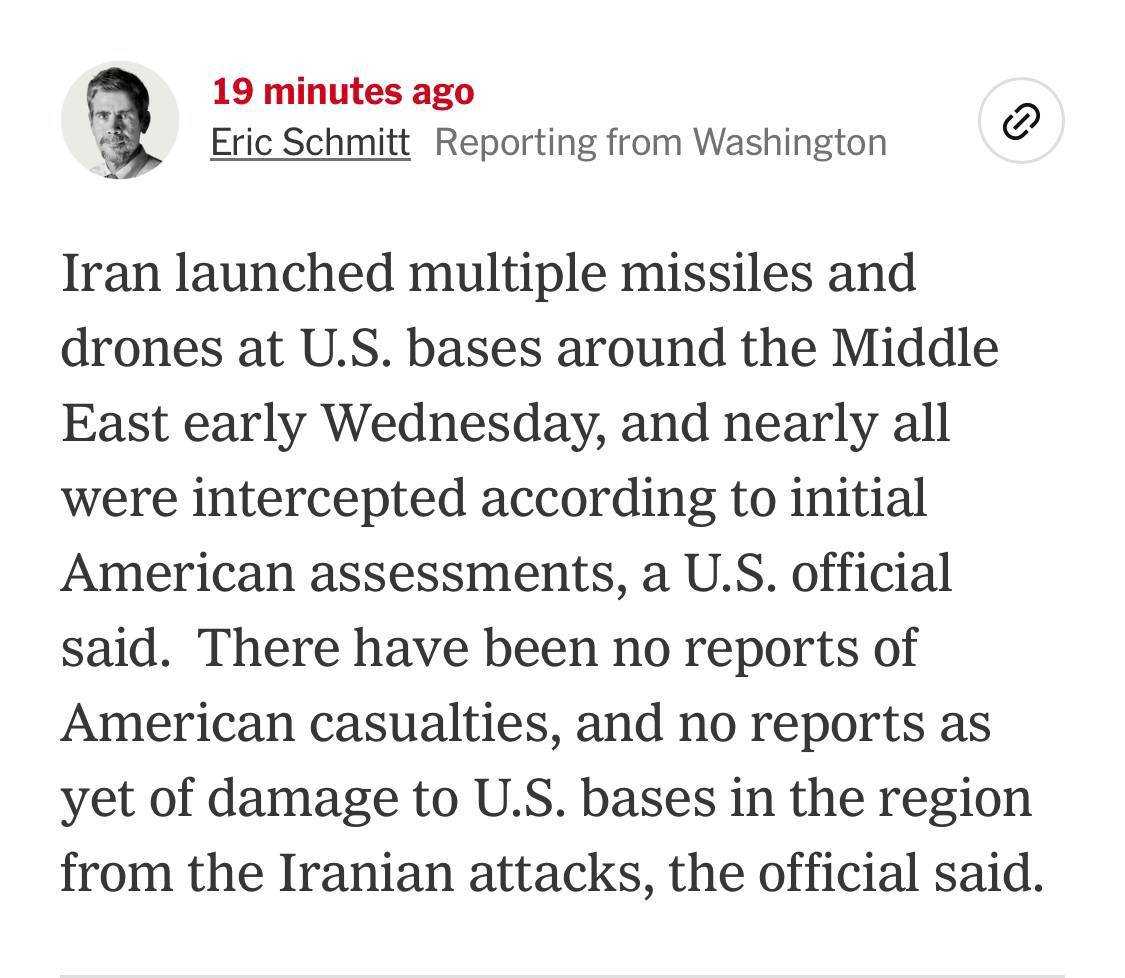
The New York Times, cited by monitor_the_situation at 03:34:15 UTC, reported that “almost all Iranian missiles and drones launched at Israel were intercepted, though some still hit.” This assessment underscores the effectiveness of Israel’s missile defense systems while acknowledging that a limited number of projectiles reached their targets. In Bahrain, multiple explosions were reported by intelslava at 03:30:27 UTC and by monitor_the_situation at 00:47:28 UTC, the latter referencing Tasnim’s claim of additional explosions across Iran. BellumActaNews documented interceptions over Bahrain at 01:46:05 UTC, and GeoPWatch recorded sixteen explosions at 01:33:23 UTC, some attributed to failed interceptor missiles.
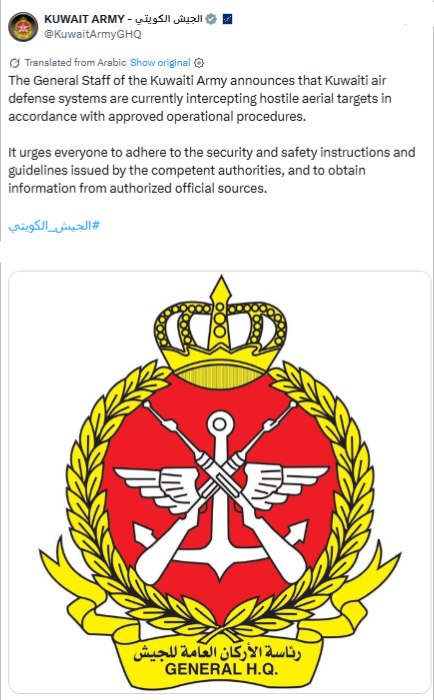
Missile alerts were repeatedly activated in Bahrain (02:44:39 UTC) and Kuwait (02:12:27 UTC), with the Kuwaiti Army General Staff Headquarters confirming renewed UAV attacks at 02:21:47 UTC. These alerts reflect heightened threat perception among Gulf states and the broader regional security environment.
Analytical Overview
The sequence of events on June 10 demonstrates a rapid escalation loop: U.S. airstrikes provoke Iranian missile launches, which in turn trigger missile defense responses and secondary explosions across multiple theaters. The lack of disclosed casualty figures suggests that the kinetic exchanges have, so far, been limited to material damage and infrastructure disruption. However, the involvement of high‑value assets—such as an F‑35 hangar and missile defense systems—indicates a potential for significant operational impact if the exchange intensifies.
From an operational perspective, the United States has leveraged both naval aviation and strategic air force assets to sustain pressure on Iranian military capabilities. Iran’s reliance on ballistic missiles, including the Kheibar Shekan, reflects its strategy of long‑range deterrence aimed at U.S. forward‑deployed forces. The reported interceptions by Israel and Bahrain demonstrate that regional missile defense networks remain functional, though the occurrence of failed interceptors and subsequent explosions highlights the strain on these systems.
Overall, the day’s kinetic events underscore a fragile cease‑fire environment, with both sides demonstrating willingness to employ high‑intensity weapons while avoiding large‑scale ground engagements. Continued monitoring of airstrike frequency, missile launch patterns, and interception success rates will be essential for assessing the trajectory of the conflict.