The Islamic Revolutionary Guard Corps (IRGC) launched a salvo of ballistic missiles against a United States air base in Bandar Abbas, Hormozgan Province, at 04:02 local time on 1 June 2026. The strike, described by the IRGC as retaliation for a prior U.S. attack on southern Iran, marks the most severe kinetic event recorded in Iran on the date and represents a direct escalation between the two militaries.
IRGC Missile Attack on Bandar Abbas
According to the Telegram channel monitor_the_situation, the IRGC employed ballistic missiles to target the U.S. installation. The channel’s post, dated 04:02:12 UTC, included a video of the launch and identified the operation as a response to a U.S. strike on Iranian territory earlier in the week. No casualty figures were released in the immediate aftermath, and the U.S. has not yet confirmed damage to the base. The weapons used were classified as ballistic missiles, though the specific type was not disclosed.
"Iran Launches Ballistic Missiles at US Air Base in Retaliation for Southern Iran Attack" – monitor_the_situation, 2026‑06‑01T04:02:12, https://t.me/monitor_the_situation/18780
The engagement raises the conflict’s intensity to the S4 – CRITICAL level, indicating a high probability of further kinetic exchanges. Both Iran and the United States have historically maintained a proxy‑based posture in the region; this direct missile exchange diverges from that pattern and may influence operational postures of allied forces in the Persian Gulf.
Missile Launch from Khuzestan Toward Kuwait
At 03:25 UTC, the Telegram channel rnintel posted visual confirmation of a missile launch from Iran’s Khuzestan Province directed toward Kuwait. The video showed the missile’s trajectory shortly after launch, but no impact data or casualty reports were available. The weapon is identified simply as a “missile,” and no organization claimed responsibility. The incident underscores the broader regional dimension of Iran’s kinetic activities, extending beyond direct U.S. targets.
"Visual confirmation of a missile launched from Khuzestan province, Iran, towards Kuwait" – rnintel, 2026‑06‑01T03:25:21, https://t.me/rnintel/61599
While the launch did not result in reported damage, the act signals Iran’s willingness to project power toward neighboring Gulf states, potentially complicating diplomatic efforts aimed at de‑escalation.
U.S. Airstrikes on Qeshm Island and Goruk
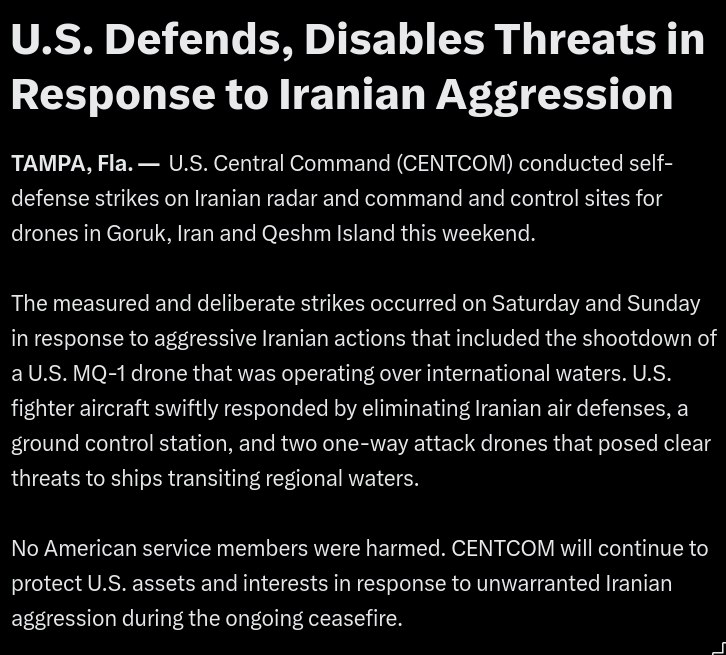
Earlier, at 03:19 UTC, monitor_the_situation reported that U.S. Central Command (CENTCOM) conducted self‑defence airstrikes on Iranian radar and command‑and‑control sites located on Qeshm Island and in the Goruk area of Hormozgan Province. The strikes were a response to the downing of a U.S. MQ‑1 drone over Iranian airspace during the preceding weekend. No weapons were listed for the U.S. operation, but the action involved precision air‑to‑ground munitions targeting electronic warfare assets.
"US Strikes Iranian Radar and Command Sites on Qeshm Island and in Goruk" – monitor_the_situation, 2026‑06‑01T03:19:59, https://t.me/monitor_the_situation/18777
Photographic evidence released by the channel showed smoke plumes over the targeted sites. The United States has not disclosed casualty numbers, and Iranian sources have not confirmed personnel losses. The engagement reflects a rapid escalation loop: Iranian missile activity prompted a U.S. drone loss, which in turn triggered retaliatory airstrikes.
Continued U.S. Naval Blockade of the Strait of Hormuz
At 01:08 UTC, the same Telegram source documented the persistence of the U.S. naval blockade in the Strait of Hormuz, despite a public statement by former President Donald Trump on TruthSocial claiming the blockade would be lifted. Commercial vessels continue to be denied access to Iranian ports, and the United States Navy maintains a presence to enforce the blockade. No kinetic weapons were employed in this operation, but the strategic restriction of maritime traffic constitutes a non‑kinetic yet coercive measure.
"US Naval Blockade of Iran Continues Despite Trump Announcement" – monitor_the_situation, 2026‑06‑01T01:08:48, https://t.me/monitor_the_situation/18773
The blockade’s continuation underscores the United States’ commitment to pressure Iran’s maritime trade, a tactic that has historically amplified regional security concerns, especially for oil‑dependent economies.
Analysis of the June 1 Kinetic Landscape
The sequence of events on 1 June 2026 illustrates a multi‑theater escalation involving air, land, and sea domains. The IRGC’s ballistic missile strike represents the highest‑intensity kinetic act, directly targeting U.S. military infrastructure. Simultaneously, Iran’s missile launch toward Kuwait expands the geographic scope of hostilities, while the U.S. airstrikes on Qeshm Island demonstrate a rapid retaliatory capability. The ongoing naval blockade adds a sustained pressure element that, while non‑kinetic, contributes to the overall escalation environment.
All incidents were reported through open‑source Telegram channels, which are frequently used by regional actors to disseminate real‑time operational information. The reliance on these channels for verification highlights the importance of digital open‑source intelligence (OSINT) in conflict monitoring. No independent third‑party verification (e.g., satellite imagery) was cited in the source material, and casualty figures remain unconfirmed across all events.
Given the absence of reported casualties, the immediate humanitarian impact appears limited. However, the potential for collateral damage in densely populated areas, particularly around the Bandar Abbas air base and Qeshm Island, warrants close observation. The escalation also raises the risk of inadvertent engagement between U.S. and Iranian forces, which could trigger broader regional involvement.