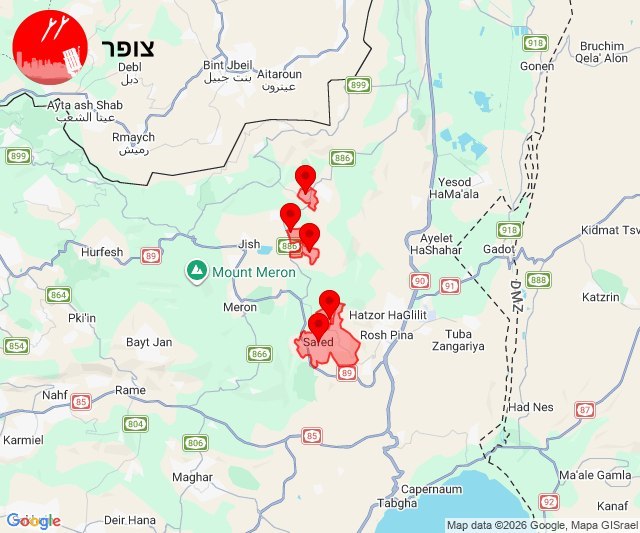
In the early hours of 1 June 2026, Israel faced a coordinated kinetic escalation on two fronts. At 04:18 UTC, Iran’s Islamic Revolutionary Guard Corps (IRGC) Aerospace Force launched a salvo of ballistic missiles targeting an Israeli air base in the central district, a direct retaliation for a recent U.S. strike on southern Iran. Within minutes, Hezbollah in Lebanon fired multiple rockets into northern Israeli towns, including Kiryat Shmona, marking the second consecutive day of cross‑border attacks. The Israeli Defense Forces (IDF) responded with an airstrike on a Hezbollah rocket launcher near Tiberias, while local alert systems recorded additional rocket and drone warnings in the Kiryat Shmona area. No casualties were reported in any of the incidents, but the rapid succession of strikes underscores a heightened risk of broader escalation.
Iranian IRGC Ballistic Missile Attack on Israeli Air Base
At 04:18:48 UTC, the IRGC Aerospace Force fired ballistic missiles toward an undisclosed Israeli air base, reportedly located in the central region of Israel. According to the Telegram channel monitor_the_situation, the missiles were intended to strike critical air‑defense infrastructure that, in Tehran’s view, facilitated the U.S. strike on Iranian soil earlier in the week. The IRGC claimed that the intended targets were destroyed, though Israeli officials have not confirmed damage or casualties. Photographic evidence posted by the source shows missile trajectories over the region, but verification of impact remains pending.
"Iran's IRGC launched ballistic missiles at an Israeli air base, claiming the intended targets were destroyed, in retaliation for a US attack on southern Iran." – monitor_the_situation, 04:18 UTC, https://t.me/monitor_the_situation/18781
The weaponry employed—short‑range ballistic missiles—represents a significant escalation beyond the conventional rocket fire typically associated with proxy groups in the region. While no injuries were reported, the attack demonstrates Iran’s willingness to project power directly against Israeli military assets, raising concerns about potential reciprocal strikes.
Hezbollah Rocket Barrage on Kiryat Shmona
Just minutes after the Iranian missile launch, at 04:25:12 UTC, Hezbollah fired a series of rockets into the northern Israeli city of Kiryat Shmona and surrounding towns. The Telegram feed monitor_the_situation documented that multiple rockets landed in civilian areas, prompting sirens and temporary evacuations. The attacks marked the second day in a row that Hezbollah employed rocket fire from Lebanese territory, signaling a sustained campaign aimed at pressuring Israel’s northern border communities.
"Hezbollah launched rocket attacks on several northern Israeli towns for a second consecutive day." – monitor_the_situation, 04:25 UTC, https://t.me/monitor_the_situation/18782
According to the same source, the rockets caused no fatalities or serious injuries, though property damage was reported in several residential blocks. The use of unguided rockets, while imprecise, continues to pose a threat to civilian populations and strains Israel’s civil‑defense infrastructure.
IDF Airstrike on Hezbollah Rocket Launcher Near Tiberias
In response to the northern rocket barrage, the IDF conducted an airstrike at 04:29:39 UTC targeting a Hezbollah rocket launcher positioned near the city of Tiberias. The operation, also reported by monitor_the_situation, involved a precision strike using unmanned aerial vehicles (UAVs) equipped with guided munitions. Video released by the IDF showed the launcher being hit and subsequently destroyed, with the footage emphasizing the IDF’s rapid targeting capability.
"Israel Strikes Hezbollah Rocket Launcher Near Tiberias" – monitor_the_situation, 04:29 UTC, https://t.me/monitor_the_situation/18784
The strike reportedly neutralized the immediate threat to Tiberias, a city that had been under fire the previous night. No Israeli casualties were reported, and Hezbollah did not issue an immediate claim of retaliation, suggesting a temporary tactical pause.
Additional Rocket and Drone Alerts in Kiryat Shmona
At 05:27:22 UTC, the monitoring platform GeoPWatch recorded two separate rocket alerts and one drone alert within a ten‑minute window over the Kiryat Shmona area. While the alerts did not culminate in confirmed impacts, they illustrate the heightened state of alertness among Israeli civil‑defense systems following the earlier attacks. The alerts were generated by automated detection networks that track incoming trajectories, underscoring the persistent threat environment in northern Israel.
"Over the past ten minutes, rocket alerts have been activated twice and a drone alert has activated once in the Kiryat Shmona area." – GeoPWatch, 05:27 UTC, https://t.me/GeoPWatch/34529
These repeated alerts, despite the absence of confirmed strikes, have contributed to civilian anxiety and have prompted local authorities to maintain heightened readiness, including the deployment of additional air‑defense batteries along the northern frontier.
Collectively, the events of 1 June 2026 illustrate a multi‑layered kinetic escalation involving state and non‑state actors. Iran’s direct missile launch against an Israeli military installation, coupled with Hezbollah’s sustained rocket campaign, represents a coordinated pressure strategy aimed at stretching Israel’s defensive capacities. The IDF’s swift retaliatory airstrike demonstrates Israel’s commitment to neutralizing immediate threats, while the continued alerts in Kiryat Shmona highlight the ongoing risk to civilian populations. Monitoring agencies will continue to verify casualty figures and assess the potential for further escalation in the coming days.