Ukrainian long‑range rocket strikes near Mariupol at 15:42 UTC marked the most significant kinetic event of the day, disrupting Russian logistical convoys up to 200 km behind the front line. According to the Telegram channel monitor_the_situation, the attacks targeted multiple transport columns emerging from occupied Mariupol, temporarily halting the flow of ammunition, fuel and provisions to Russian forward units.
"Ukrainian forces conduct long‑range strikes on Russian logistical convoys emerging from occupied Mariupol, up to 200km behind the frontline, disrupting enemy supply lines." – monitor_the_situation, 10 May 2026, https://t.me/monitor_the_situation/15633
Air‑to‑air and air‑to‑ground operations in Kherson
At 13:46 UTC, Ukrainian MiG‑29 fighter jets struck Russian drone‑operator positions in the occupied Kherson region. The operation, also reported by monitor_the_situation, demonstrated the Ukrainian Air Force’s ability to project power into contested airspace and degrade Russian ISR capabilities. No casualty figures were released, but the strike reportedly destroyed at least two ground‑based control stations and a cache of spare drone components.
"Ukraine MiG‑29 fighter jets targeted positions held by Russian drone operators in the occupied part of Kherson region, escalating ongoing conflict in southern Ukraine." – monitor_the_situation, https://t.me/monitor_the_situation/15617
Ukrainian drone successes in Donetsk Oblast
Multiple unmanned‑system engagements were recorded in Donetsk Oblast. At 13:32 UTC, a Ukrainian‑American Hornet drone eliminated two Russian soldiers, a strike attributed to the Azov Brigade’s rear‑area disruption campaign. Later, at 08:51 UTC, a Ukrainian drone equipped with a recoilless shotgun intercepted and destroyed Russian UAVs, illustrating an emerging drone‑on‑drone combat capability. Both incidents were documented by monitor_the_situation and accompanied by video evidence.
In a separate operation at 08:38 UTC, the 422nd Unmanned Systems Regiment deployed a domestically produced Bulava loitering munition to destroy a Russian fuel tanker, two transport trucks and a light armored vehicle. The strike targeted a logistical convoy moving along the Donetsk highway corridor, temporarily reducing fuel availability for Russian mechanized units.
At 08:34 UTC, the 81st Airmobile Slobozhanska Brigade’s drone unit destroyed a column of sixteen Russian motorcycles near Sloviansk, further evidencing Ukraine’s focus on degrading low‑mobility enemy assets that support reconnaissance and rapid reaction forces.
Escalation of Russian drone activity in Kherson
Russian forces intensified the use of Molniya and Lancet loitering munitions in Kherson Oblast, deploying 700‑800 drones daily, according to Southern Defense Forces spokesman Vladyslav Voloshyn. The high sortie rate reflects a shift toward saturation drone attacks aimed at softening Ukrainian defensive positions and interdicting supply routes. The same source reported that these drones constitute roughly one‑third of the total 2,500 daily UAV sorties in southern Ukraine.
"Russia has increased daily use of Molniya and Lancet drones to 700-800 out of 2,500 total in southern Ukraine, according to Southern Defense Forces spokesman Vladyslav Voloshyn." – monitor_the_situation, https://t.me/monitor_the_situation/15604
Ground movement on the Donetsk front
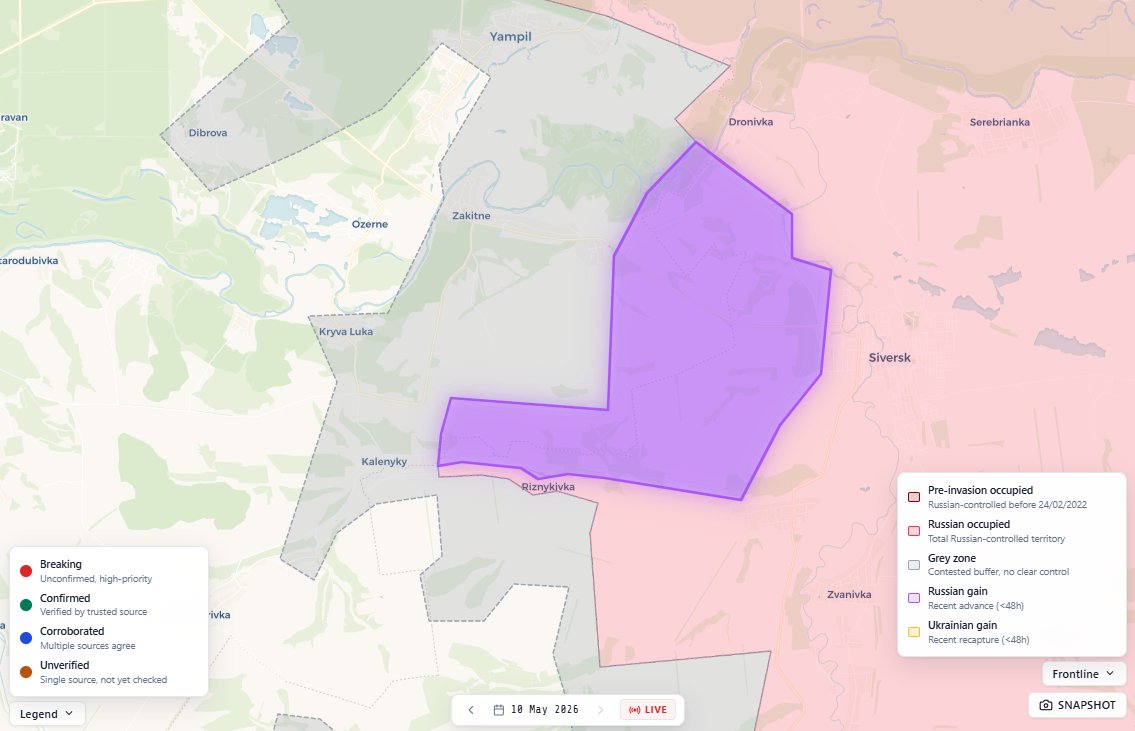
At 07:52 UTC, Russian forces advanced west of Siversk toward Kryva Luka, with the stated objective of cutting off Ukrainian positions in Zakitne and Yampil. Satellite imagery and on‑the‑ground reports confirm a modest but coordinated infantry and armored push, supported by artillery fire. While no immediate casualties were reported, the maneuver signals a continued effort by Russian command to secure a corridor that could threaten Ukrainian supply lines in the sector.
"Russia Advances West of Siversk Toward Kryva Luka, aiming to cut off Ukrainian positions in Zakitne and Yampil." – monitor_the_situation, https://t.me/monitor_the_situation/15574
Analytical overview
The pattern of kinetic events on 10 May 2026 underscores a multi‑domain contest in Ukraine’s southern and eastern theatres. Ukrainian forces leveraged long‑range precision strikes, air superiority assets and a diversified drone fleet to target Russian logistics, command‑and‑control nodes and low‑mobility assets. Conversely, Russian forces responded with high‑volume loitering‑munitions attacks and a limited ground offensive aimed at shaping the front line. The cumulative effect of these actions is a heightened attrition environment for Russian rear‑area capabilities, while Ukrainian forces demonstrate increasing proficiency in integrating manned and unmanned platforms for deep‑strike missions.