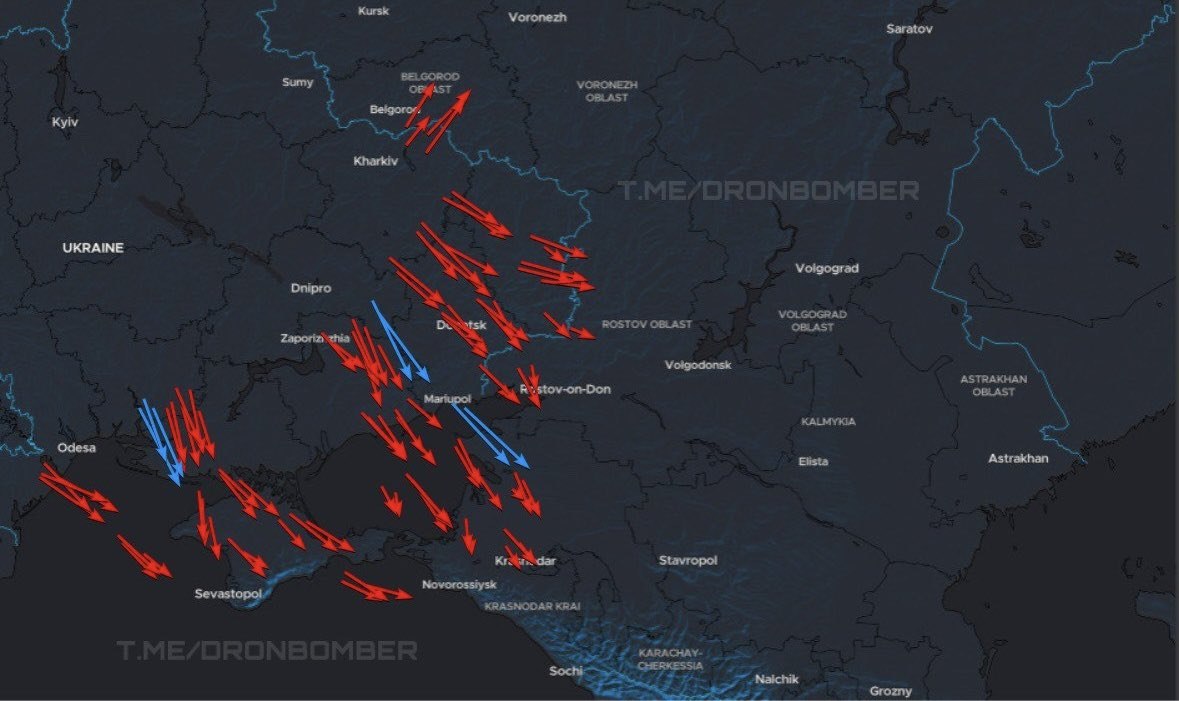
On 1 May 2026 Russian forces issued a formal warning that a combined missile and drone strike would be launched against Ukraine’s Donbas region within the next twelve hours. The announcement, posted by the monitoring channel “monitor_the_situation”, listed Iskander‑M ballistic missiles, Kinzhal hypersonic missiles, and both Geran‑2 and Gerbera drones as components of the planned operation. This threat marks the most significant escalation on the eastern front in the past month, underscoring the heightened risk of coordinated kinetic attacks across the contested frontline.
“Russia warned it will launch a combined missile and drone strike on the Donbas region of Ukraine within the next 12 hours.” – monitor_the_situation, 05:35 UTC, https://t.me/monitor_the_situation/13993
Russian Tornado‑S rocket strike on Pechenihy
At 03:39 UTC, Russian forces fired a salvo of Tornado‑S rockets at the settlement of Pechenihy in Kharkiv Oblast. The rockets struck residential areas, but no casualties were confirmed in the immediate aftermath. The attack was reported by the same monitoring channel and is catalogued under the “rocket” event type. The use of Tornado‑S, a precision‑guided artillery rocket system, reflects continued Russian reliance on long‑range firepower to pressure Ukrainian positions in the north‑eastern sector.
“Russian forces fired Tornado‑S rockets at the settlement of Pechenihy in Kharkiv Oblast, Ukraine.” – monitor_the_situation, 03:39 UTC, https://t.me/monitor_the_situation/13990
Ukrainian sea‑drone assault in the Kerch Strait
In the early morning hours, Ukrainian sea drones targeted two Russian patrol vessels transiting the Kerch Strait, a strategic waterway linking the Black Sea and the Sea of Azov. Video evidence posted by “monitor_the_situation” shows the unmanned surface craft approaching the vessels before detonating. No damage to the ships was reported, and there were no casualties among the crews. The incident demonstrates Ukraine’s expanding use of maritime unmanned systems to challenge Russian naval movements in contested waters.
“Ukrainian sea drones attacked two Russian patrol vessels in the Kerch Strait.” – monitor_the_situation, 05:59 UTC, https://t.me/monitor_the_situation/13997
Large‑scale Russian Geran‑2 drone deployment
At 05:55 UTC, Russian forces launched approximately 170 Geran‑2 drones from five oblasts—Kursk, Smolensk, Bryansk, Rostov and Oryol. Early detection systems reported around 30 of these drones in flight, indicating a coordinated mass‑release intended to overwhelm Ukrainian air‑defence networks. Geran‑2, a loitering munition derived from the Iranian Shahed‑136, is designed for saturation attacks against static and mobile targets. The operation, documented by “monitor_the_situation”, underscores a shift toward high‑volume UAV tactics by Russian forces on the eastern front.
“Russia launched about 170 Geran‑2 drones from multiple regions.” – monitor_the_situation, 05:55 UTC, https://t.me/monitor_the_situation/13995
Ukrainian drone strike on the Tuapse oil export terminal
In the Black Sea city of Tuapse, Krasnodar Krai, Ukrainian drones struck the oil export terminal at 03:25 UTC. Photographic evidence released by the monitoring channel confirms damage to storage infrastructure, though Russian authorities reported no injuries. The attack aligns with a broader Ukrainian campaign targeting Russian energy assets, aiming to disrupt export capacity and impose economic costs.
“Ukrainian drones struck the oil export terminal in Tuapse, Russia.” – monitor_the_situation, 03:25 UTC, https://t.me/monitor_the_situation/13987
Assessment of the escalating UAV and rocket activity
The series of events on 1 May illustrates a pronounced surge in both Ukrainian and Russian unmanned and rocket‑based operations along the eastern front. Russian threats and actual launches of high‑precision rockets and mass‑scale loitering munitions indicate an intent to apply pressure across multiple axes, while Ukrainian sea‑drone and aerial drone attacks reveal a diversification of tactics aimed at maritime and energy targets. No casualty figures were released for any of the incidents reported today, suggesting that while the kinetic intensity has risen, immediate human losses remain limited. Continued monitoring of launch patterns, detection rates, and target selection will be essential for assessing the trajectory of the conflict’s aerial dimension.