At 16:35 local time on 22 April 2026, an Israeli airstrike in southern Lebanon killed a journalist and left another wounded, prompting an emergency rescue by the International Committee of the Red Cross. The incident, reported by the Telegram channel monitor_the_situation, underscores the heightened risk to media personnel amid the ongoing Israel‑Hezbollah confrontation.
🟠 Israeli Airstrike Kills in Southern Lebanon, Red Cross Rescues Journalist Red Cross rescues wounded journalist following deadly Israeli airstrike in southern Lebanon amid ongoing Israel‑Hezbollah tensions. Incident highlights risks to media personnel in the conflict zone.
The strike occurred in an area of southern Lebanon that has seen repeated cross‑border hostilities. The journalist’s death marks the first confirmed media fatality in the current escalation, raising concerns about press freedom and the safety of humanitarian workers operating near the front lines.
Civilian Neighborhood Bombings
Earlier that morning, at 09:15, Israeli forces conducted airstrikes targeting residential neighborhoods in the same region. According to the same monitor_the_situation feed, the attacks damaged multiple civilian structures and resulted in an undisclosed number of casualties. The operation was described as part of “ongoing cross‑border tensions with Hezbollah.” No specific weapon systems were identified, but the use of precision‑guided munitions was implied.
Attack on a Mosque
At 09:15:13, Al Jazeera reported that Israeli forces struck a mosque in Lebanon, a violation of the ceasefire agreement that has been in place since the 2023 conflict de‑escalation. The report did not provide casualty figures, but the targeting of a religious site adds a new dimension to the pattern of kinetic engagements.
Ground Operations Near Dibbin
At 15:56, the Israeli Defense Forces (IDF) announced a ground operation near Dibbin, approximately 12 km inside Lebanese territory. The IDF claimed the killing of 20 Hezbollah fighters and the striking of over 70 targets, including command posts and weapons caches. The operation was carried out by the 91st Division in coordination with the Israeli Air Force, as detailed in a JPost article (source).
Hezbollah Drone Strikes
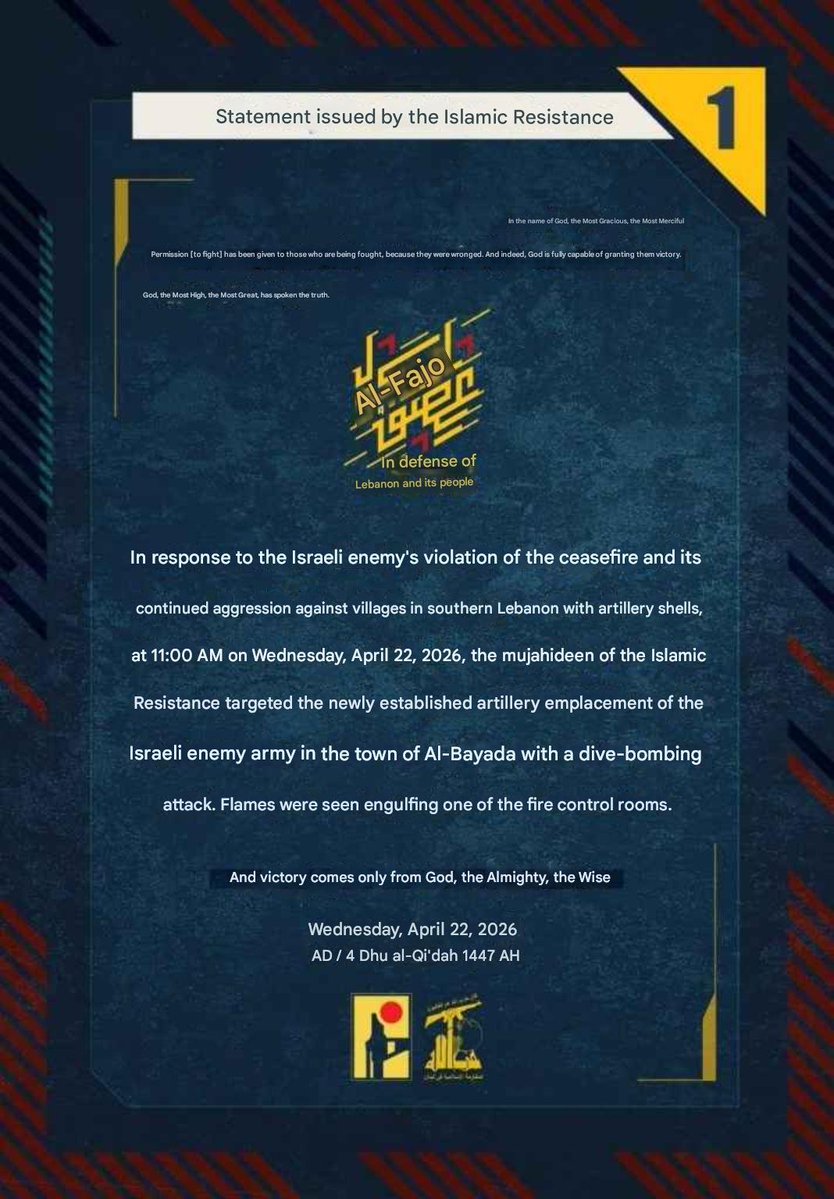
Hezbollah responded with a series of hostile UAV attacks. At 14:35:20, a Hezbollah‑operated drone struck an Israeli artillery position in Al‑Bayada, southern Lebanon. The strike was framed as retaliation for alleged Israeli ceasefire violations. Photographic evidence was shared via the monitor_the_situation channel (source).
Later, at 12:08, the Israeli Air Force intercepted a Hezbollah drone launched toward IDF forces in southern Lebanon, preventing it from crossing into Israeli territory. The IDF spokesperson labeled the launch a “blatant violation of the ceasefire agreement” (source).
Additional Israeli Airstrikes
Between 14:27 and 14:35, Israeli aircraft conducted multiple strikes on Hezbollah‑linked sites. At 14:35:29, a strike on Yahmar al‑Shaqif killed two individuals; at 14:27:33, a second strike hit at‑Tiri, targeting Hezbollah positions; and at 09:15:52, earlier in the day, airstrikes bombed civilian neighborhoods, as noted above. While casualty numbers remain limited, each strike reinforces the pattern of rapid, high‑intensity kinetic actions.
Robotic Warfare in Bint Jbail
The IDF escalated its use of autonomous and robotic weapons in Bint Jbail, a known Hezbollah stronghold. According to JPost, robots were deployed to destroy weapons infrastructure, reflecting a shift toward unmanned systems in the conflict (source).
Summary of the Day’s Kinetic Activity
April 22 2026 witnessed a convergence of air, ground, and unmanned operations across southern Lebanon. The most lethal event—a fatal airstrike on a journalist—highlights the expanding scope of risk for non‑combatants. Simultaneous strikes on civilian neighborhoods, religious sites, and military positions, coupled with reciprocal drone attacks and robotic warfare, illustrate a multi‑domain escalation that remains within the parameters of the existing ceasefire but pushes its limits.