President Donald Trump announced on April 22 that the Iran‑US ceasefire has been extended, a development reported by Al Jazeera that comes as Lebanon’s disaster management unit raised the death toll from weeks of Israeli attacks to 2,454, with 7,658 injured. The announcement, made in the early hours of the day, underscores the fragile diplomatic balance while multiple cross‑border incidents unfolded across the Levant and Iraq.
"Iran war live: Trump says ceasefire extended as talks with Tehran in limbo," Al Jazeera, 2026‑04‑22.
Escalation Along the Israel‑Hezbollah Front
At 04:20 local time, Israeli forces demolished residential structures in al‑Bayyadah, southern Lebanon, an action captured on video and disseminated by the monitoring channel monitor_the_situation. The demolition, part of a broader Israeli operation targeting Hezbollah‑linked sites, marks a sharp escalation in the long‑standing Israel‑Hezbollah conflict. No casualties were reported in the demolition itself, but the action follows a series of Israeli drone strikes in the Beqaa Valley.
At 05:43, an Israeli drone struck the outskirts of al‑Jbour in the Beqaa Valley, killing one civilian and wounding two, according to the Lebanese state news agency and reported by GeoPWatch. A second drone attack later that morning, at 05:11, hit the western Bekaa Valley, killing another individual; the strike was attributed to Hezbollah forces operating in coordination with the Israeli Air Force, as per monitor_the_situation. Both incidents illustrate a pattern of aerial retaliation that raises the risk of broader escalation.
Drone and Missile Activity in Iraq and the Levant
In northern Iraq, two separate drone attacks targeted political and militant sites. At 00:16, a drone struck the headquarters of an Iranian opposition party in Erbil Province, reportedly launched from near the Iraq‑Iran border (GeoPWatch). Later, at 00:39, a drone hit the Darshkran camp in Erbil, a facility used by the Kurdistan Freedom Party, an operation linked to Iranian and Turkish interests (GeoPWatch). No casualties were confirmed, but the attacks signal a widening of cross‑border hostilities beyond the Israel‑Lebanon axis.
In central Israel, Independence Day celebrations on April 22 were marred by multiple stabbings and a residential fire, injuring several civilians, including critical injuries, as reported by the Jerusalem Post. While not directly linked to the regional drone campaign, the incidents reflect heightened internal security tensions concurrent with external threats.
Maritime Tensions in the Gulf
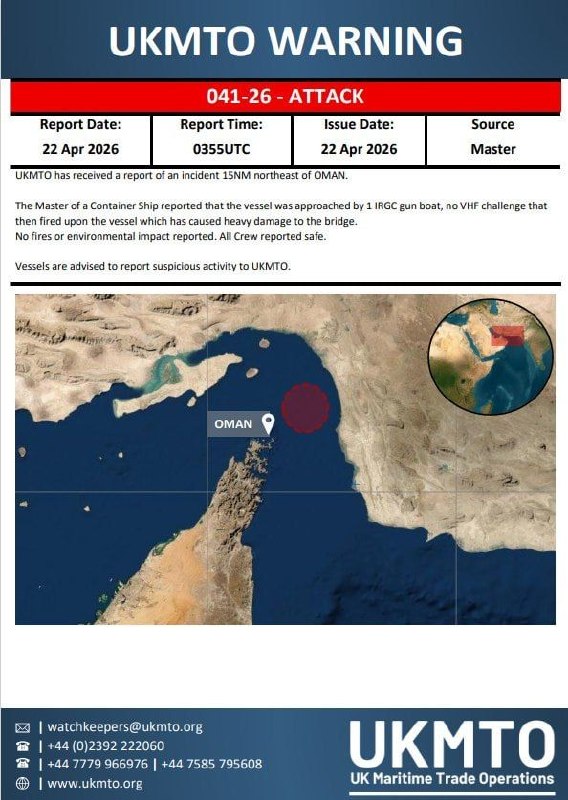
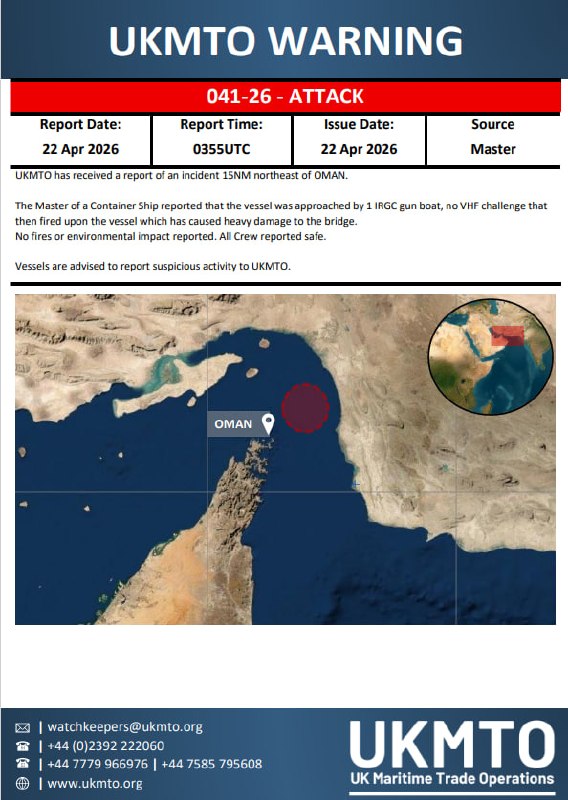
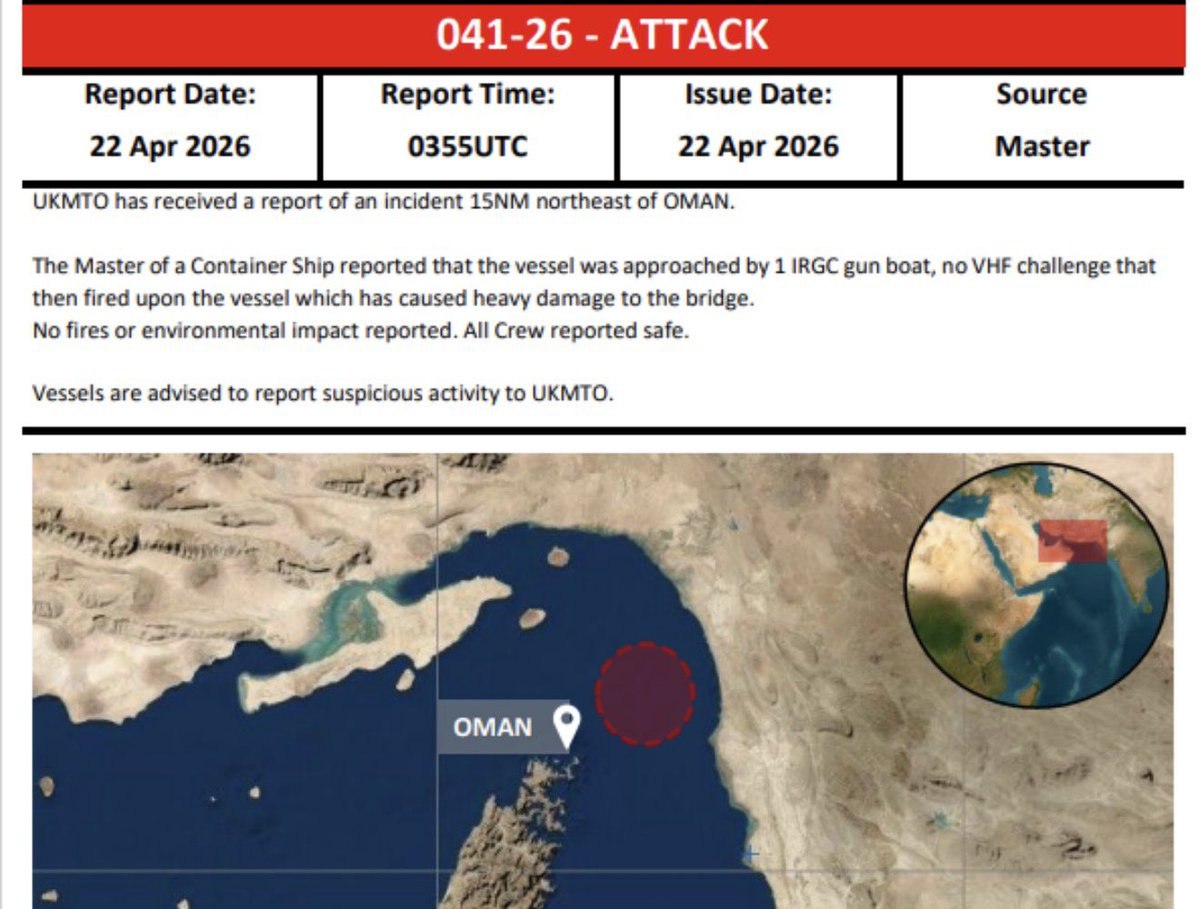
Simultaneously, Iranian Revolutionary Guard Corps (IRGC) naval units intensified activity in the Arabian Sea and the Strait of Hormuz. At 05:17, an IRGC gunboat attacked a container ship 15 nautical miles northeast of Oman, causing heavy bridge damage but no casualties (GeoPWatch). A similar incident was reported at 05:01 by rnintel, confirming the gunboat’s engagement with a commercial vessel in the same sector. Earlier, at 05:00, an Iranian gunboat damaged the bridge of a commercial vessel in the Strait of Hormuz, raising concerns about the security of a critical oil transit corridor (monitor_the_situation). These maritime incidents occurred amid ongoing US‑Iran ceasefire negotiations, adding a layer of strategic risk to the diplomatic process.
Implications and Outlook
The convergence of diplomatic activity and kinetic operations underscores a volatile environment. The extension of the Iran‑US ceasefire provides a narrow diplomatic window, yet the surge in drone and missile strikes across Lebanon, Iraq, and the Gulf suggests that non‑state actors and regional militaries are exploiting the lull to pursue localized objectives. The Israeli demolition in al‑Bayyadah and subsequent drone strikes illustrate a tit‑for‑tat dynamic that could spiral if not contained. Meanwhile, the IRGC’s maritime aggression threatens global energy markets and could provoke a naval response from the United States or its allies.
Stakeholders are advised to monitor the evolving ceasefire talks closely, as any breakdown could trigger a cascade of retaliatory actions across multiple fronts. Continued vigilance by maritime security agencies, coupled with diplomatic engagement, will be essential to prevent the current flare‑up from expanding into a broader regional conflict.