On 20 April 2026, the Iranian Revolutionary Guard Corps (IRGC) launched unmanned aerial vehicles (UAVs) against United States Navy vessels operating in the Gulf of Oman, marking the most significant kinetic incident in international waters today. The attack follows a U.S. seizure of the Iranian‑flagged cargo ship TOUSKA earlier that morning and comes amid a broader pattern of naval confrontations between Tehran and Washington in the strategically vital Strait of Hormuz and adjacent waters.
IRGC Drone Assault on US Navy Ships
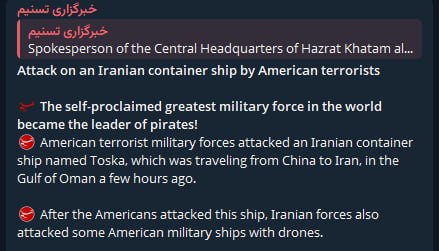
At 00:45 UTC, IRGC‑operated drones engaged “some American military ships” in the Gulf of Oman, a stretch of the Arabian Sea that lies between Oman and Iran and is classified as international waters. The incident was reported by the state‑run Tasnim News Agency and subsequently relayed by the open‑source outlet BellumActaNews (source). While no casualties were reported, the drones were described as “hostile” and capable of delivering kinetic damage to surface vessels.
"IRGC forces have attacked some American military ships with drones following the seizure of an Iranian cargo ship by the US Navy," Tasnim News Agency quoted IRGC officials.
The United States has not released an official statement confirming the extent of damage, but the presence of UAVs in a high‑traffic maritime corridor raises immediate concerns for ship safety, navigation security, and the risk of escalation. The drones were reportedly launched from Iranian‑controlled launch platforms near the coast, exploiting the narrowness of the Gulf to approach US vessels at low altitude.
Weapons used: armed UAVs (specific payload undisclosed). Organizations involved: IRGC, United States Navy. Countries: Iran, United States.
French Merchant Vessel Damaged in Strait of Hormuz
Just minutes earlier, at 00:40 UTC, a French‑registered merchant ship suffered damage while transiting the Strait of Hormuz, another critical chokepoint that links the Persian Gulf to the Arabian Sea. The incident was documented by the monitoring service monitor_the_situation and shared via a Telegram post (source). According to the report, the vessel encountered an unexplained impact that resulted in hull deformation and temporary loss of propulsion. No crew injuries were reported.
"French shipping firm reports damage to its vessel amid heightened US‑Iran naval tensions and recent US seizures of Iranian ships in the area," the post read.
The damage appears to be unrelated to the UAV attack, but the timing underscores the volatile environment in the Strait, where both state and non‑state actors have increased their operational tempo. The French shipping firm has lodged a formal complaint with its flag state and is seeking clarification from both Iranian and U.S. naval authorities.
Weapons used: none reported (collision or impact of unknown origin). Organizations involved: French shipping firm, United States, Iran. Countries: France, United States, Iran.
U.S. Seizure of Iranian Cargo Ship TOUSKA
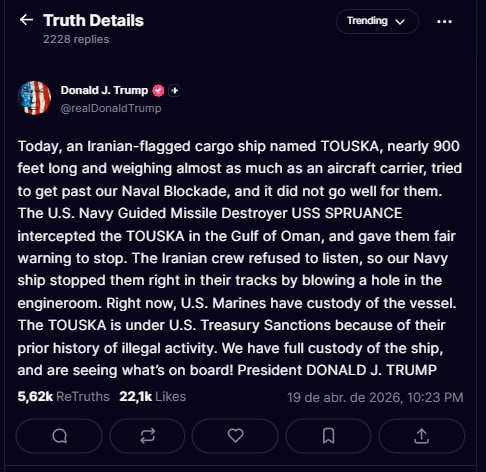
At 00:03 UTC, the United States Navy intercepted and seized the Iranian‑flagged cargo vessel TOUSKA in the Gulf of Oman after the ship attempted to breach a naval blockade imposed by the United States around Iranian ports. The seizure was announced in a statement attributed to former President Donald Trump, which was circulated by BellumActaNews (source). The vessel, nearly 900 feet long and comparable in displacement to a small aircraft carrier, was boarded by U.S. Marines from the destroyer USS SPRUEANCE and escorted to a U.S.‑controlled anchorage for inspection.
"United States President Donald Trump announced that US Navy intercepted, fired up and seized a Iranian cargo ship that tried to break the blockade on Iranian ports on the Gulf of Oman," the BellumActaNews post quoted.
No injuries were reported among the crew of TOUSKA, and the cargo—reported to include petrochemical products—has been placed under U.S. Treasury custody pending further legal review. The seizure represents a direct enforcement action that escalates the maritime standoff, as Iran has previously warned of retaliation against any perceived infringement of its shipping rights.
Weapons used: none (interdiction by naval forces). Organizations involved: U.S. Navy, USS SPRUEANCE, U.S. Marines, U.S. Treasury, Iranian vessel operators. Countries: United States, Iran.
Analysis of the Day’s Kinetic Events
The three incidents, while distinct in nature, collectively illustrate a rapid intensification of kinetic activity in international waters surrounding the Gulf of Oman and the Strait of Hormuz. The IRGC’s UAV deployment marks a notable shift toward asymmetric aerial tactics against high‑value naval assets, a capability that has been under development since the early 2020s. The French merchant vessel’s damage, though not directly linked to a weapon system, signals that commercial traffic is increasingly vulnerable to collateral effects of state‑level confrontations.
The U.S. seizure of TOUSKA demonstrates a willingness to enforce maritime blockades beyond the immediate Persian Gulf, extending the operational reach into the broader Arabian Sea. This action, combined with the UAV strike, raises the probability of inadvertent escalation, especially if future engagements involve kinetic damage to warships or loss of life.
All three events were reported by open‑source channels on Telegram, underscoring the role of social media as a primary conduit for real‑time conflict information in the region. Analysts should monitor subsequent statements from the U.S. Department of Defense, the IRGC’s public affairs office, and the French Ministry of the Sea for official casualty figures, damage assessments, and any diplomatic overtures aimed at de‑escalation.