The United States Navy dispatched its flagship carrier, USS Gerald R. Ford, and two Arleigh Burke‑class destroyers into the Red Sea early on 19 April 2026, signaling a calibrated response to rising Iranian pressure on key maritime chokepoints. The carrier group, accompanied by a P‑8A Poseidon maritime patrol aircraft, transited the Suez Canal and entered the Red Sea at 03:28 UTC, a move confirmed by the open‑source monitoring channel GeoPWatch. While no weapons were fired during the transit, the presence of a nuclear‑powered carrier and its escort vessels underscores Washington’s intent to protect commercial shipping and deter further Iranian interference.
Iranian Fire on Indian‑Flagged Tanker in the Strait of Hormuz
At 02:21 UTC, the Indian‑flagged crude tanker Sanmar Herald (IMO 9330563) reported being fired upon by boats of the Islamic Revolutionary Guard Corps Navy (IRGCN) while attempting to reverse course in the Strait of Hormuz. A VHF transmission captured by BellumActaNews shows the Indian captain repeatedly demanding clearance:
"Sepah Navy! Motor Tanker Sanmar Herald! You gave me clearance! You gave me clearance to go!"The exchange indicates a direct challenge to the vessel’s right of safe passage. No casualties were reported, and the tanker sustained no confirmed damage, but the incident illustrates Tehran’s willingness to use force to enforce a de‑facto blockade of the narrow waterway.
Cruise Ships Traverse Iranian‑Declared Minefield Under Fire
Simultaneously, four cruise ships accelerated through an area that Iran has officially declared a minefield in the Strait of Hormuz. According to monitor_the_situation, the convoy proceeded at full speed despite being subjected to live fire from IRGC coastal batteries. The ships’ crews reported hearing explosions and observing smoke plumes, though no mines detonated. The incident marks a rare instance of civilian vessels deliberately breaching a militarized zone, highlighting the escalating risk to non‑combatant traffic in one of the world’s busiest oil transit routes.
U.S. Blockade Operations Extend to the Arabian Sea
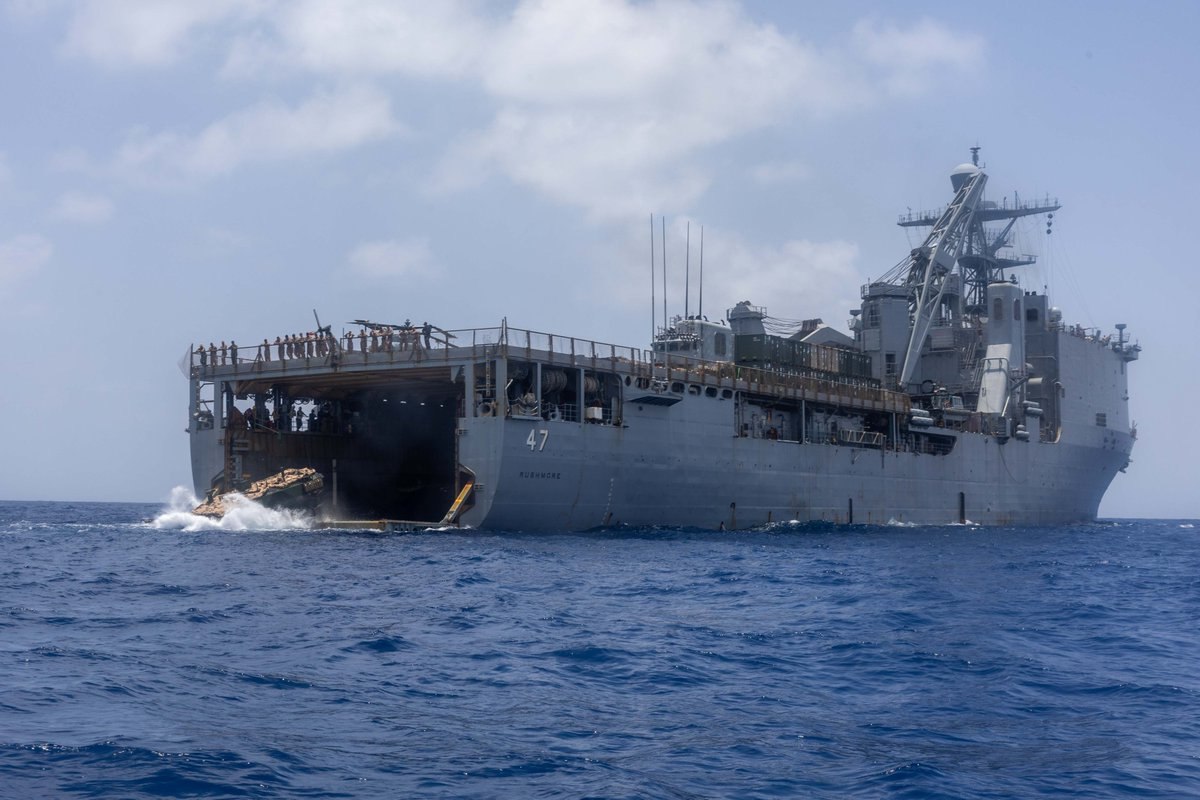
Further south, U.S. sailors and Marines from the amphibious dock landing ship USS Rushmore (LSD‑47) commenced a naval blockade in the Arabian Sea at 00:10 UTC. The operation, coordinated by CENTCOM, aims to interdict vessels suspected of supplying Iranian forces engaged in the Hormuz confrontation. While the blockade has not yet resulted in any seizures, its implementation reflects a broader U.S. strategy to apply pressure across multiple maritime corridors, from the Red Sea to the Arabian Sea, in order to constrain Iran’s ability to project power.
Collectively, these events demonstrate a rapid escalation in naval posturing by both Tehran and Washington. The United States has leveraged its carrier strike capability to project power far from its shores, while Iran has employed a combination of small‑boat harassment, mine warfare, and direct fire to challenge the freedom of navigation. The convergence of these actions in three critical chokepoints— the Suez Canal, the Strait of Hormuz, and the Arabian Sea— raises the probability of inadvertent clashes, especially given the high density of commercial traffic and the limited margin for error in narrow waterways.
All incidents were reported through open‑source channels that include GeoPWatch (https://t.me/GeoPWatch/31443), BellumActaNews (https://t.me/BellumActaNews/171242), and monitor_the_situation (https://t.me/monitor_the_situation/11425, https://t.me/monitor_the_situation/11423). No official statements from the U.S. Department of Defense or the Iranian Ministry of Defense had been released at the time of writing.