On 6 April 2026, coordinated air operations by United States and Israeli forces marked the most extensive strike campaign against Iran since the escalation began earlier this year. According to monitor_the_situation, at least twelve Iranian cities—including Tehran, Qom, and regional hubs—were targeted in a series of precision attacks that followed earlier missile exchanges between Tehran and Jerusalem.
"US and Israeli forces conducted airstrikes targeting multiple cities throughout Iran in recent hours, expanding beyond previous strikes on Tehran and Qom amid escalating regional conflict." – monitor_the_situation, 02:25 UTCThese strikes were reported alongside a fresh barrage of Iranian missiles directed at Israeli territory, underscoring a rapid escalation of long‑range kinetic engagements.
US‑Israeli Air Campaign
The air campaign, confirmed by monitor_the_situation (source URL: https://t.me/monitor_the_situation/8309), involved a combination of fighter‑borne precision munitions and stand‑off weapons. While the exact ordnance types were not disclosed, the operation reportedly neutralized command‑and‑control facilities, air‑defense sites, and logistics nodes in twelve locations across Iran. No immediate casualty figures were released by the Iranian authorities, but satellite imagery captured extensive blast craters and smoke plumes over the targeted urban areas. The strikes represent a significant expansion of the conflict beyond the previously limited engagements around Tehran and Qom.
Iranian Missile Barrage Toward Israel
Simultaneously, Iran launched a new wave of missiles aimed at Israeli territory. The missile launch, reported by monitor_the_situation (source URL: https://t.me/monitor_the_situation/8299), was described as a “fresh barrage” that intensified the ongoing exchange of long‑range strikes. Israeli defense officials confirmed the detection of multiple missile trajectories and activated the Iron Dome and Arrow systems to intercept the inbound threats. While the exact number of missiles was not disclosed, the barrage included both short‑range and medium‑range missiles, some of which were reportedly intercepted before reaching populated areas.
Ballistic Missile Launches from Iran
Earlier in the day, rnintel documented the launch of ballistic missiles from Iranian launch sites toward Israel (source URL: https://t.me/rnintel/58418). The missiles were identified as medium‑range ballistic projectiles, capable of reaching targets across the 1,500‑kilometre corridor separating Tehran and central Israel. Photographic evidence accompanying the report showed launch pads with mobile launchers, suggesting a rapid‑response capability. Israeli early‑warning radars tracked the trajectories, and the Arrow‑3 system was reportedly engaged to neutralize the threat at high altitude.
American Casualty in the United Arab Emirates
In a separate incident, an American civilian was injured when Iranian missiles inadvertently struck a corporate headquarters in the United Arab Emirates. The event, reported by intelslava (source URL: https://t.me/intelslava/85992), highlighted the broader risk of missile fallout affecting third‑party nations. The headquarters, belonging to a multinational firm, sustained structural damage, and the injured individual received medical treatment in a local hospital. No further casualties were reported, and the UAE government condemned the strike as a violation of its sovereignty.
Regional Alert Activity
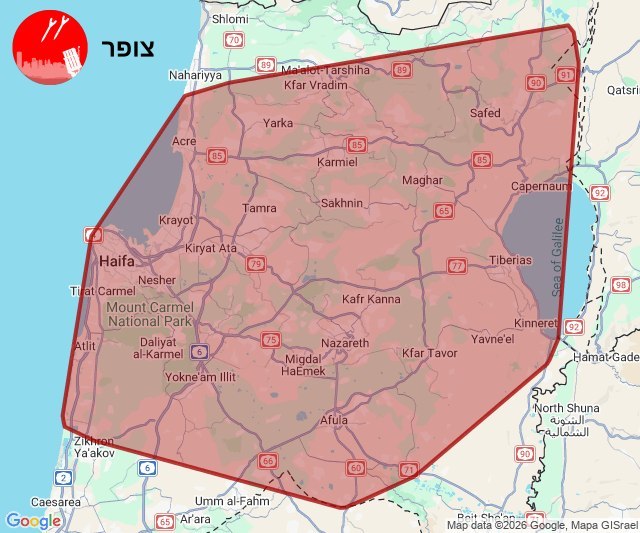
Throughout the day, multiple civilian alert platforms issued warnings of additional missile and UAV activity across the Israeli‑occupied territories. RocketAlert posted a comprehensive missile alert covering industrial zones in Samaria, the Barkan Industrial Park, and several settlements in the West Bank (source URL: https://t.me/RocketAlert/28394). The alert listed specific locations such as Barkan, Kiryat Netafim, and Ariel Industrial Park, indicating a broad targeting pattern aimed at economic infrastructure. In the northern Golan Heights, a hostile UAV alert was issued for Majdal Shams, accompanied by a photo of the unidentified aircraft (source URL: https://t.me/RocketAlert/28323). Additionally, idkunim_il reported two inbound missiles with ongoing interception attempts (source URL: https://t.me/idkunim_il/57852). While none of these alerts confirmed successful impacts, they reflect heightened vigilance among Israeli civil defense agencies.
Implications and Immediate Outlook
The synchronized kinetic actions on 6 April illustrate a marked intensification of the Iran‑Israel‑United States confrontation. The US‑Israeli airstrikes demonstrate a willingness to project power deep into Iranian territory, while Iran’s missile launches and ballistic trajectories signal a reciprocal escalation. The spillover injury of an American citizen in the UAE underscores the expanding geographic risk envelope, potentially drawing additional regional actors into the conflict calculus. Civilian alert systems across Israel and the occupied territories continue to play a critical role in mitigating casualties, but the volume and diversity of threats—missiles, ballistic projectiles, and hostile UAVs—pose significant challenges to existing air‑defense architectures.