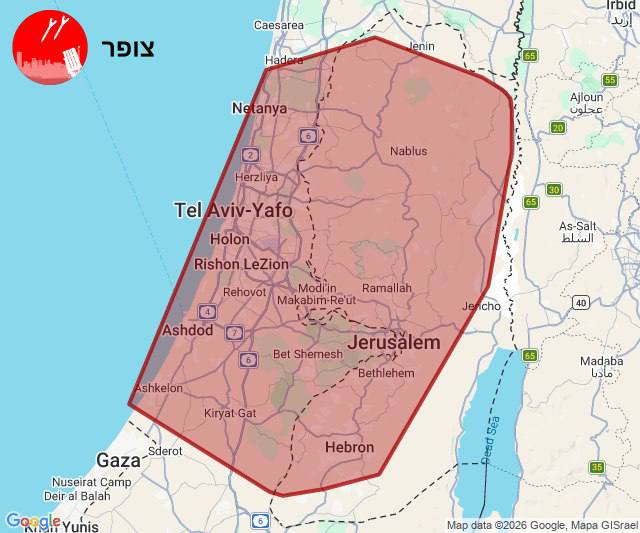
At 21:54 local time on 13 March 2026, an Iranian Revolutionary Guard Corps (IRGC) ballistic missile impacted the Negev region, striking the Nevatim Air Force Base. Ambulances were dispatched to the site, confirming the missile’s impact on a critical military installation. The strike, reported by GeoPWatch (source), marks the most significant kinetic event of the day, underscoring a rapid escalation in Iran‑Israel hostilities.
Series of IRGC Missile Impacts Across Southern Israel
Earlier, at 21:48, GeoPWatch documented a second IRGC ballistic missile landing in the Negev desert, though the exact target remained unclear (source). Shortly thereafter, rnintel confirmed visual evidence of an Iranian projectile striking southern Israel at 21:30 (source). The same outlet reported multiple injuries in Beersheba at 21:28, including one seriously wounded individual (source). These coordinated impacts suggest a focused campaign against southern strategic sites.
Cluster Munition Deployments Over Central and Tel Aviv Areas
At 20:28, intelslava captured footage of an Iranian ballistic missile releasing cluster submunitions over Tel Aviv (source). Similar cluster dispersal was observed over central Israel at 18:00 (BellumActaNews) and over Tel Aviv at 17:47 (rnintel). Al Jazeera reported a missile strike that ignited a building in central Israel at 20:04 (source). The use of cluster munitions, which disperse dozens of bomblets, raises the risk of civilian casualties and long‑term hazards.
Casualties and Injuries Across Multiple Sites
Casualty reports varied by location. In Zarzir, a predominantly Bedouin‑Arab town, more than 70 people were injured after missiles struck a building, according to CIG_telegram (source). Subsequent updates raised the wounded count to 80 (source). In Beersheba, multiple injuries were confirmed, with one victim in serious condition. A separate incident in Zerez (Northern District) resulted in 58 injuries after a missile hit four private homes (source). The cumulative injury toll from the day's kinetic events exceeds 200 individuals.
Interceptions and Defensive Responses
Israel’s air‑defence systems engaged several incoming threats. At 15:56, the Jerusalem Post reported that shrapnel from an intercepted Iranian missile caused a fire in central Israel, while a Hezbollah rocket attack wounded two people in northern Israel (source). Later, at 11:37, rnintel confirmed the interception of an Iranian ballistic missile over central Israel (source). BellumActaNews documented Iron Dome’s rare interception of a ballistic missile over northern Israel at 00:38 (source), highlighting the strain on Israel’s layered defence architecture.
Hezbollah Rocket Activity and Northern Front Tensions
Hezbollah launched a barrage of rockets at the Meron base in the Galilee at 12:15, as announced by the group (source). Concurrently, JPost noted that two individuals were wounded by a Hezbollah rocket in northern Israel earlier in the day (source). Israeli forces responded by reinforcing the Northern Command, as reported by idkunim_il (source), and by increasing troop presence along the Israel‑Lebanon border (OSINTdefender). These actions reflect heightened vigilance on the northern front.
Wider Operational Context and Strategic Implications
The missile barrage coincided with Israeli Air Force activity at Nevatim Airbase, where F‑35I jets prepared for a strike mission against Iran at 10:22 (source). Additionally, Iran’s Islamic Revolutionary Guard Corps and Iraq’s Islamic Resistance claimed responsibility for downing a KC‑135R tanker that later landed at Ben Gurion Airport (source). These developments suggest a broader escalation beyond isolated missile strikes, encompassing aerial engagements and proxy actions across the region.
JPost: "Shrapnel from an intercepted Iranian missile fell in central Israel causing fire, while a Hezbollah rocket attack wounded two people in northern Israel, adding to about 60 injuries from a prior Iranian missile barrage."
Overall, the day's kinetic events demonstrate a coordinated Iranian missile campaign targeting both military and civilian infrastructure, the deployment of cluster munitions with high civilian impact potential, and an active northern front involving Hezbollah. Israel’s defensive measures, including Iron Dome interceptions and rapid medical response, mitigated fatalities but could be strained by the volume and variety of threats.